Who Owns AEO? The Case for a Head of AEO Role (+ Job Description)
Right now, at most companies, “figure out AI search” is being handled by seven different people who don't know they're supposed to be working together.
The SEO lead is commenting in Reddit threads that are ranking for key terms.
The community manager is building relationships in Discord servers.
The content team is publishing 'AI-optimized' articles.
The PR person is pitching stories to journalists (who get cited a lot).
The social team is chasing LinkedIn engagement.
Employee advocacy is asking people to share company posts.
Influencer marketing leads are hiring B2B creators to talk about the new feature roll-out.
But there’s often not a single point person who’s making sure this work actually results in citations within ChatGPT, Perplexity, or Google's AI Overviews.
This is the current state of Answer Engine Optimization (AEO) at most organizations who’ve started this work: Head of AEO is a job that exists everywhere and nowhere simultaneously, scattered across a dozen job descriptions, measured by a dozen different metrics, optimized toward a dozen different outcomes.
So here’s what happens. A company has purchased a tool for measuring and monitoring AI search presence…and stopped there. Or maybe they’re focusing on publishing new blog content on the company website based on their findings of said tool…but they’re not really sure what’s working and why (or why not). When the team talks about AEO performance or AI search visibility, it feels like marketers are hand-waving and saying a lot without communicating much at all.
The problem is that companies are trying to solve a new discipline using existing infrastructure—when really, there needs to be a net-new role (or an overhaul of an existing one) for overseeing the work of AI search and LLM citation generation.
First, let's define our AEO terms
Since we're early enough that people are still arguing about what to even call this work, here's how I define it:
Answer Engine Optimization (AEO) is the practice of making your brand the source AI systems cite when answering the questions your customers ask. Unlike SEO, which optimizes owned content for rankings, AEO optimizes your brand's presence across the entire internet—communities, earned media, creator content, owned properties—for citation authority.
And the role we’re talking about:
A Head of AEO is the single owner of AI search visibility: the person accountable for making sure every team's work—SEO, content, community, PR, social, influencer—compounds into one outcome: being the most-cited, most-trusted source in your category across AI systems.
"Wait, isn't this called GEO?" You'll also see this discipline called GEO (Generative Engine Optimization), LLMO (Large Language Model Optimization), or just "AI SEO." They all describe roughly the same work.
I use AEO because it centers the actual behavior shift: people are asking questions and getting answers, not links. The engine that matters is the answer engine. Whatever acronym wins, the job underneath it is the same.
Here's what happens without an AEO point person
A company has purchased a tool for measuring and monitoring AI search presence…and stopped there.
Or maybe they're focusing on publishing new blog content on the company website based on their findings of said tool…but they're not really sure what's working and why (or why not.) When the team talks about AEO performance or AI search visibility, it feels like marketers are hand-waving and saying a lot without communicating much at all.
The problem is that companies are trying to solve a new discipline using existing infrastructure—when really, there needs to be a net-new role (or an overhaul of an existing one) for overseeing the work of AI search and LLM citation generation.
Budget is already flowing toward the problem faster than the org charts are adapting: Conductor found that 94% of CMOs plan to increase AEO spending this year.
SEO departments were handed the bulk of AEO work
Sometime in the last 18 months, a CEO turned to a marketing person and said: "Figure out the AI search thing." That leader did what any of us would do. They looked at it through the lens of their own department.
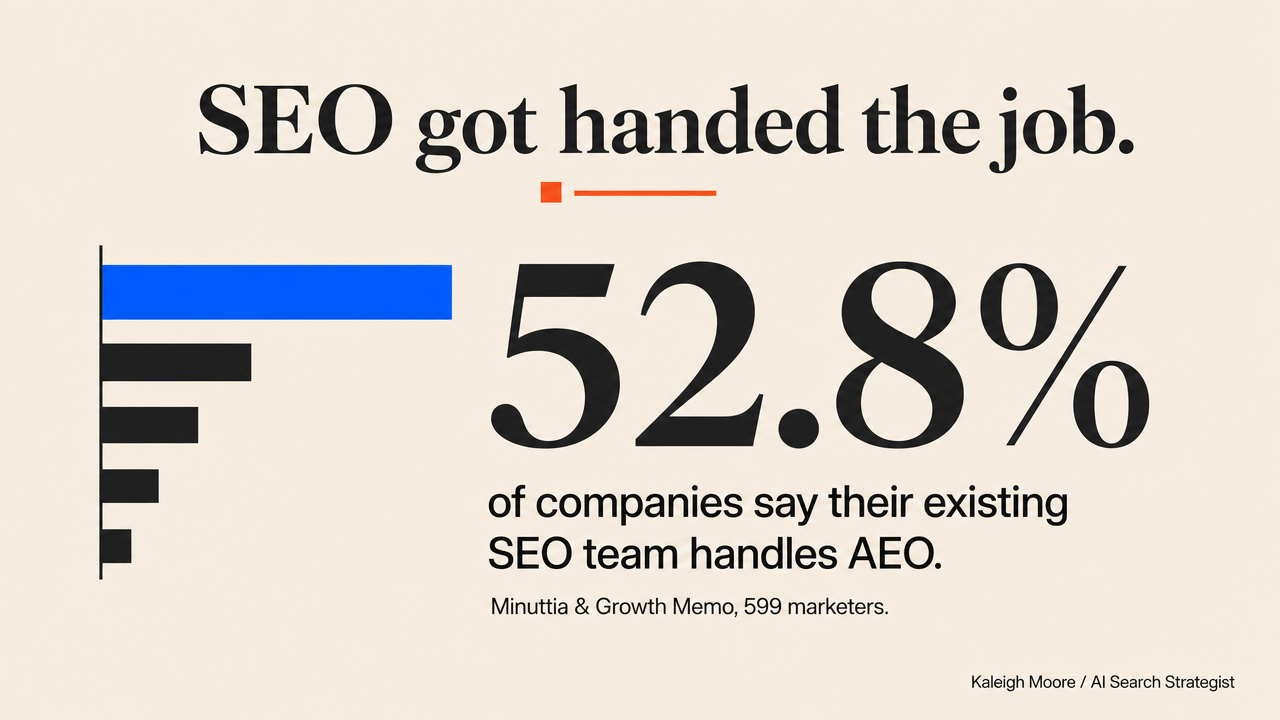
Usually that department was SEO. When Minuttia and Growth Memo surveyed 599 marketers this spring, 52.8% said their existing SEO team handles AEO.
That sounds reasonable until you look at where AI citations actually come from: Peec AI analyzed 30 million sources and found Reddit is the most-cited domain across ChatGPT, Google AI Mode, Gemini, Perplexity, and AI Overviews, with YouTube and LinkedIn right behind it. Those are communities.
(You see the problem here? SEO professionals are not on the community or social teams, and they largely focus on on-site content, not offsite/social channels.) But they've been given the task, so the SEO team does what SEO teams do.
They find old Reddit threads getting cited in ChatGPT and try to show up in as many as possible. They push "SEO content" out as LinkedIn articles. Strategically, this is sort of missing the point, because you can't keyword your way into a conversation between humans.
You have to show up and participate, add value, and make it a two-way communication channel. You have to read the room.
Meanwhile, the community and social teams know how these spaces actually work, but they haven't been asked to track AI citation rate.
PR is sitting on earned media relationships that are suddenly AEO gold, but they aren't being leveraged strategically.
Influencer marketing is booking one-off creator campaigns with a rigid brief, and crossing their fingers that creators will share their LinkedIn performance metrics after the fact.
Everyone is holding a puzzle piece, but they're not working together to solve that puzzle. They're working in separate rooms (with the doors closed).
Should AEO sit under SEO or content?
My answer: Neither—at least not permanently.
Parking AEO under SEO makes sense as a starting point (search fundamentals still 100% matter), but it structurally guarantees the wrong instincts win.
SEO optimizes for presence: maximum surface area, maximum content, show up everywhere.
AEO optimizes for trust: authentic participation, community credibility, being the source worth citing.
When those two goals conflict—and they will, weekly—the team's existing incentives decide the winner. Rankings dip in Q2? AEO gets deprioritized.
Parking AEO under content has the same problem with different metrics. Content teams are measured on output and performance of owned properties. But the data tells us the real citation opportunities live off-site, in communities the content team doesn't touch.
AEO needs its own owner precisely because it's interested in the connections between these functions, not a subfunction of any one of them.
“The tactical SEO people tie everything to SEO frameworks like topical authority, link building, and rankings,” said JH Scherck, founder of Growth Plays, a B2B content Agency. “They try to connect aspects of AEO to a concept or tactic from SEO, which was a much more gameable surface area. I prefer to move as the channel moves, stay nimble/agile, test and measure.”
The AEO job titles show this issue in action
If you want proof that AEO is being absorbed rather than owned, don't read the think pieces. Read the AEO-related job postings.
Here are the titles of AI search jobs that are currently seeking applicants:
Experian is hiring an "AEO & SEO Manager."
ADT wants a "Director of Discoverability AEO/SEO."
Odoo posted a "Growth Marketing Specialist – GEO/AEO."
Capital One went with "Senior Digital Marketing Associate – AEO, GEO and AI Search Lead."
Stripe is hiring an "AEO & GEO Marketing Manager."
Search Engine Land's weekly roundups are filling up with "SEO/GEO/AEO Manager" and "Senior Manager SEO/Gen AI."
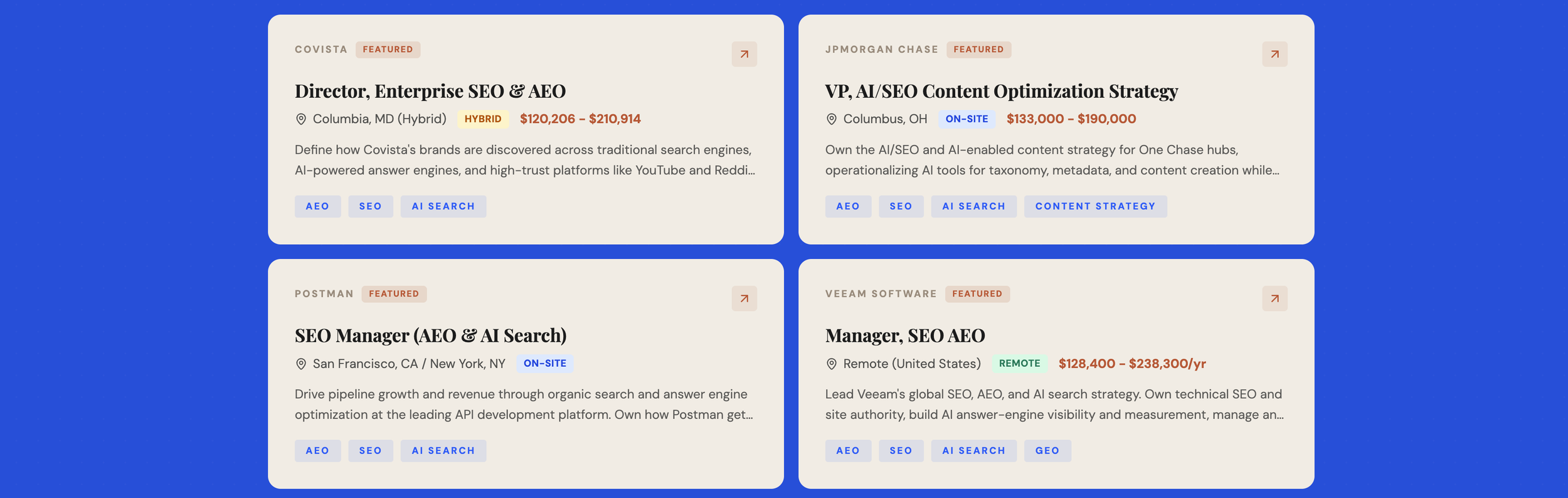
Notice the pattern? It's the slash and the ampersand. Almost every posting pairs AEO with SEO in the same title. Companies aren't creating a new role. They're renaming the old one.
And the market knows it. Every SEO on LinkedIn added "GEO" or "AEO" to their headline this year, and at least part of that is defensive; a hedge against the "SEO is dead" narrative, and an accurate reflection that the day-to-day work hasn't changed shape yet.
Which is exactly the problem. The work should be changing shape. If your AEO strategy looks like your SEO strategy with new tooling bolted on, you're optimizing for presence in a game that rewards trust.
There are exceptions to this trend, though.
AWS has a standalone "Answer Engine Optimization Manager" sitting inside its search marketing org—no slash, no ampersand, just the job.
Publicis posted a VP to lead performance content across SEO, GEO and AEO, one of the most senior agency-side titles the discipline has produced.
The title that keeps recurring at the top of the ladder is "VP/Head of Search & AI Visibility," which is the closest thing the market has to what I'm describing here. Search and visibility. Two brains, one owner.
My honest read on where we are: enterprise has figured out that AEO deserves a funded seat while everyone else is still writing it into someone's existing job description with a slash (and no raise).
What's required of the new Head of AEO role
Okay, so let’s get into what this role should look like and what skill set that person needs.The person who's slotted into this emerging Head of AEO role is a rare bird.
They're someone who likely:
Spent years in SEO or marketing operations (systems thinking + important context)
Actually participated in communities, not just studied them
Is a strong writer who can spot compelling angles, trends, and hooks
Successfully managed cross-functional projects without direct authority
Understands multiple marketing functions and how they work
Has strong opinions on strategy, but is flexible on execution
Cares about authenticity, not just optimization
They might come from SEO, community, growth, or marketing ops, but they'll be the one who got restless in one silo and started studying the others.
Whatever their background, they need the Three Brains of AEO: an SEO brain, a community brain, and a systems brain. Miss any one of the three, and the role fails.

SEO brain only? You get keyword-stuffed Reddit spam (and maybe banned from the platform)
Community brain only? You get beloved participation that never gets measured or cited and no topical focus.
Systems brain only? You get beautiful coordination decks, slam-dunk presentations, and zero execution.
Let’s look at each one more deeply.
AI search visibility manager skill #1: The SEO Brain
The SEO brain has a deep understanding of how search works: citations, rankings, share of voice, competitive positioning, E-E-A-T signals.
But crucially, this person knows when not to use SEO tactics. Publishing a polished blog post isn't the same as authentically participating in Reddit, even though both are "content." A pure SEO person optimizes both the same way.
A Head of AEO recognizes they're opposite strategies.
Can do: Audit why competitors are getting cited for specific topics, analyze what content actually becomes a reference point, identify citation gaps, and understand technical SEO as it applies to AI retrieval, not just Google crawlers.
AI search visibility manager skill #2: The Community Brain
The community brain understands why communities trust certain voices and reject others. A disclosed employee with genuine expertise gets upvoted and cited, while fake customer shilling gets flamed and banned. The difference is honesty about intent.
A Head of AEO knows:
Different communities have completely different rules (GitHub ≠ Reddit ≠ LinkedIn)
Authority is earned through contribution, not title
Consistency matters more than polish
Communities detect astroturfing immediately
The goal is being a genuine member, not extracting value
Can do: Map community cultures, identify trusted voices, create participation guidelines that feel authentic, and recognize when an opportunity is actually a trap.
AI search visibility manager skill #3: The Systems Brain
The systems brain can see across SEO, content, PR, community, social, influencer, and field marketing and recognize how decisions in one area affect outcomes in another.
They’re interested in building a cross-departmental AEO initiative where every press opportunity, YouTube shout-out, and B2B creator partnership compounds toward their goal of earning AI citations.
Can do: Map how every team's work affects AEO outcomes, spot conflicts early, design systems where different teams' work is complementary, and make defensible tradeoffs.
The Head of AEO job description (since nobody's written one yet)
If you're a leader trying to scope this role—or a marketer trying to become it—here's the canonical version.
Title: Head of AEO (also appearing in the wild as: VP/Head of Search & AI Visibility, Director of Discoverability (AEO/SEO), AEO & GEO Marketing Manager, and Director of Product (AEO & SEO).)
Reports to: CMO or VP of Marketing. This role fails if it's buried two layers deep under SEO or content—it needs the authority to redirect work across functions.
Core responsibilities:
Own the company's citation strategy across ChatGPT, Perplexity, Gemini, Claude, and Google AI Overviews
Map and prioritize the communities, publications, and platforms where citations in your category actually originate
Coordinate SEO, content, community, PR, social, and influencer work toward shared citation outcomes (without necessarily managing those teams)
Build and maintain the AEO measurement model: automated citation monitoring plus qualitative auditing
Set participation guidelines that keep the brand on the right side of community norms (disclosed, expert, genuinely useful)
Report AI search visibility to leadership in business terms: share of AI voice, citation quality, topic coverage
Resolve strategic conflicts between functions when "what's good for rankings" and "what's good for citations" diverge
KPIs this role owns:
Citation rate: How often your brand/domain appears as a cited source for your priority topics
Share of AI voice: Your citations vs. competitors' across the queries that matter to your business
Citation quality: Primary source vs. passing mention vs. unfavorable comparison context
Source diversity: Citations coming from communities, earned media, and owned properties—not just one channel
Topic coverage: The percentage of your priority question set where your brand appears in AI answers at all
Compensation (my estimate, clearly labeled as such): There's not a large enough data set out there to gauge salary range for this title yet, so we can’t anchor to comparables.
Head of SEO and Head of Community roles at B2B companies typically land in the $150K–$220K range; because this role demands both skillsets plus cross-functional authority, expect early Head of AEO hires to command a premium—roughly $160K–$240K+ base at mid-size B2B SaaS companies, higher at enterprise.
If anything, scarcity will push this up before the talent pipeline catches up.
Where I think we’ll land with “Who owns AEO?”
Vague hedging doesn't help anyone, so here are my actual predictions. Screenshot them and check my work later:
By the end of 2027, most B2B companies over $50M ARR will have a Head of AEO or equivalent title—either a net-new hire or a formally re-scoped Head of SEO/Community role with citation KPIs.
By 2028, "share of AI voice" will be a standard board-deck metric alongside pipeline and brand awareness as a temperature read on AI visibility performance and where it’s generally trending.
The acronym fight resolves within 18 months. AEO, GEO, and LLMO consolidate into one dominant term (my money's on AEO), and the hiring frenzy will follow.
Until then, I’m looking forward to watching how this evolves. Find your next job in AI search over on my job board created specifically for these types of emerging AEO roles (remote + worldwide) at www.aisearchjobs.co.
Frequently Asked Questions about Head of AEO Jobs
What is a Head of AEO?
A Head of AEO is the single owner of a company's AI search visibility — the person accountable for making sure work across SEO, content, community, PR, social, and influencer marketing compounds into one outcome: being the most-cited, most-trusted source in your category across ChatGPT, Perplexity, Gemini, Claude, and Google AI Overviews. Unlike a Head of SEO, who owns a channel, a Head of AEO owns an outcome that cuts across every channel.
What's the difference between AEO, GEO, and LLMO?
AEO (Answer Engine Optimization), GEO (Generative Engine Optimization), and LLMO (Large Language Model Optimization) describe substantially the same discipline: earning citations inside AI-generated answers. Employers currently use the terms interchangeably, and real job postings mix them freely — Experian's "AEO & SEO Manager," Odoo's "Growth Marketing Specialist – GEO/AEO," Capital One's "AEO, GEO and AI Search Lead." I use AEO because it names the actual behavior shift: people are asking questions and receiving answers, not links. If you're job hunting, search all three terms.
Is AEO just SEO with a new name?
No, and treating it that way is the most common mistake companies are making. SEO optimizes owned content for rankings. AEO optimizes your brand's presence across the entire internet — including surfaces you don't own — for citation authority. The distinction is strategic, not semantic: Peec AI's analysis of 30 million sources found Reddit is the most-cited domain across ChatGPT, Google AI Mode, Gemini, Perplexity, and AI Overviews, with YouTube and LinkedIn close behind. Those are communities, not content management systems. You can't keyword your way into a conversation between humans.
Who owns AEO at most companies right now?
Usually the SEO team, by default rather than by design. Minuttia and Growth Memo surveyed 599 marketers and found 52.8% said their existing SEO team handles AEO. In practice the work is scattered across seven functions — SEO, content, community, PR, social, employee advocacy, and influencer marketing — each measured on its own metrics, with no single owner accountable for citations. I call this the Seven-Silo Problem.
Should AEO report to SEO or content?
Neither, at least not permanently. Parking AEO under SEO is a reasonable starting point but structurally guarantees the wrong instincts win: SEO optimizes for presence, AEO requires optimizing for trust, and when those conflict, existing incentives break the tie. Parking AEO under content has the same problem with different metrics — content teams are measured on owned properties, but the citations live off-site. A Head of AEO should report to the CMO or VP of Marketing, with enough authority to redirect work across functions.
What KPIs should a Head of AEO own?
Five: citation rate (how often your brand appears as a cited source for priority topics), share of AI voice (your citations versus competitors' across the queries that matter), citation quality (primary source versus passing mention versus unfavorable comparison), source diversity (citations from communities, earned media, and owned properties — not just one channel), and topic coverage (the percentage of your priority question set where your brand appears at all). Engagement metrics are not citation metrics. A LinkedIn post with 500 likes may generate zero citations; a technical comment with 8 likes may generate thousands.
What does a Head of AEO make?
Real postings suggest $100K–$220K depending on scope and seniority. Stripe's AEO & GEO Marketing Manager posts at $143,400–$215,200. Experian's AEO & SEO Manager runs $100K–$174K. Director-level in-house roles at companies like eBay, Victoria's Secret, and Palo Alto Networks land at the top of that band; agency roles skew lower, in-house brand roles skew higher. AEO roles are being compensated like established marketing leadership, not like experimental contract hires.
What job titles are companies actually using?
Mostly compound titles that pair AEO with SEO: "AEO & SEO Manager" (Experian), "Director of Discoverability AEO/SEO" (ADT), "AEO & GEO Marketing Manager" (Stripe), "SEO/GEO/AEO Manager." The closest thing to a true head-level equivalent recurring in the market is VP / Head of Search & AI Visibility. Standalone titles exist but are rare — AWS has a dedicated Answer Engine Optimization Manager inside its search marketing org, and Publicis posted a VP leading performance content across SEO, GEO and AEO. The slash in most titles is the tell: companies are renaming the SEO role, not creating a new one.
How do you measure AEO if there's no Search Console for AI?
You triangulate. There's no clean attribution layer for AI citations — no equivalent of Google Search Console, no UTM you can drop on a Reddit thread. A workable model combines three inputs: automated citation monitoring (tools like Profound, Semrush, Conductor), quarterly qualitative auditing (manually searching your priority topics across AI systems and logging why you were cited), and community engagement tracking with context. You won't get certainty. You can get enough signal to make decisions on, and a Head of AEO has to be comfortable defending resource allocation on signal rather than proof.
Do I need to hire a Head of AEO right now?
Not necessarily — but you need someone accountable. Conductor surveyed 250+ CMOs and digital leaders and found 94% plan to increase AEO investment in 2026, with 97% saying AEO already had a positive impact in 2025. Budget without an owner is how you get seven silos. If you can't fund the headcount, the minimum viable version is naming an existing leader as the accountable owner, giving them citation KPIs, and giving them explicit authority to redirect work across functions. What doesn't work is adding "AEO" to someone's existing job description and hoping.
How do I become a Head of AEO?
Build the three brains and prove it publicly. Get deep enough in SEO to audit why competitors are getting cited. Actually participate in the communities where your category's conversations happen — not as a study, as a member. Run one documented cross-functional AEO experiment and write up what you learned. Then publish it. The companies hiring for this in 2027 won't be looking for someone with the title already on their resume; they'll be looking for someone who's visibly been doing the work. Very few people can speak both citation rates and community norms right now.