How Google and LinkedIn's 2026 Updates Changed B2B Discoverability in AI Search
Between May 6 and June 10, 2026, two of the largest platforms for B2B discovery made the same bet:
Google rebuilt its AI search experience to surface, label, and attribute independent voices.
LinkedIn built a marketplace to help brands find and partner with them.
Together, these product updates are some of the strongest confirmations I’ve seen of the premise behind the Source Signal Stack, my framework for modeling why AI search cites one source over another.
The premise of the Source Signal Stack framework is that trust comes from original, cross-verifiable signals from real people with deep expertise.
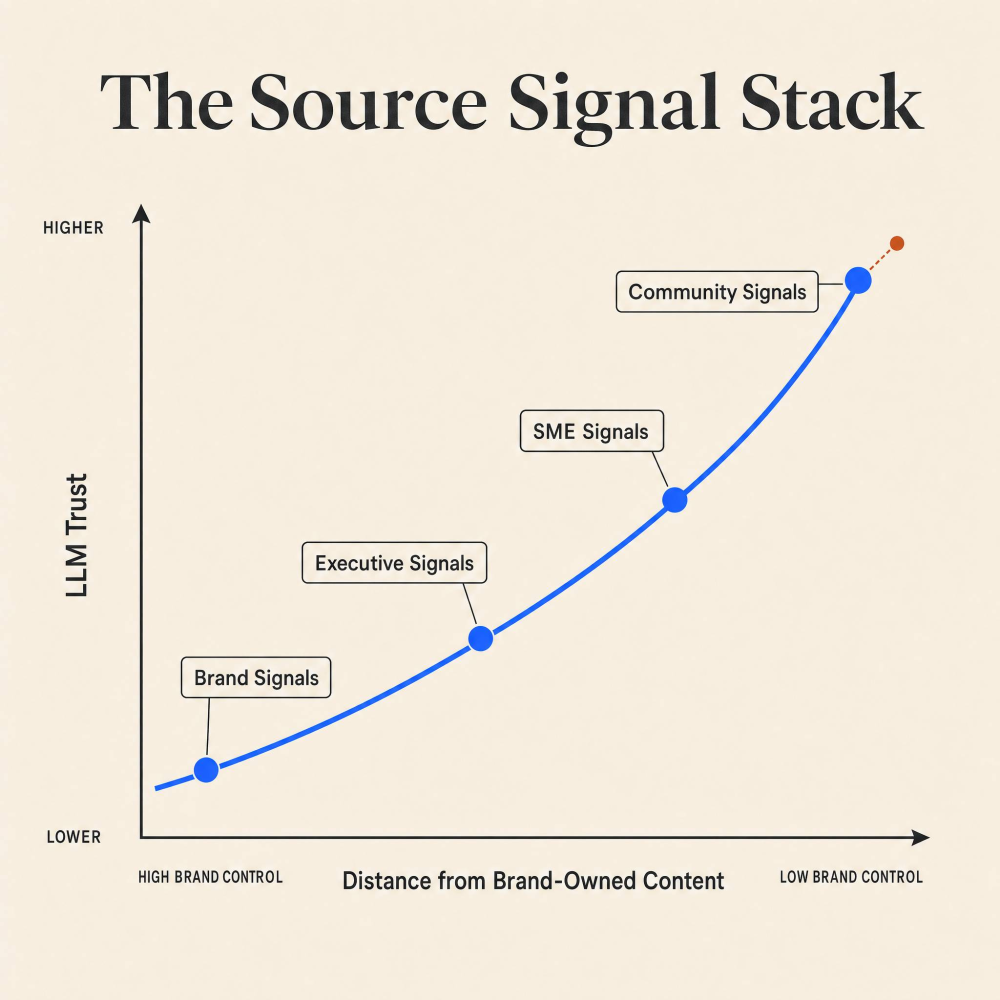
As a refresher, here's the framework. The Source Signal Stack organizes the signals AI systems weigh by their distance from the brand:
Layer 1 is brand-owned content — your website, your blog.
Layer 2 is named company leaders publishing under their own byline.
Layer 3 is subject-matter experts and employees — practitioners, not the brand page.
Layer 4 is independent third parties — press, analysts, creators, and forum voices who don't work for you.
The further a signal sits from the brand, the harder it is to manufacture…and the more weight it carries when a model or a buyer decides whom to believe.
Let’s get into these Google and LinkedIn product updates to see how the framework predicted what’s now coming true.
May: Google badges source signals + names individual voices
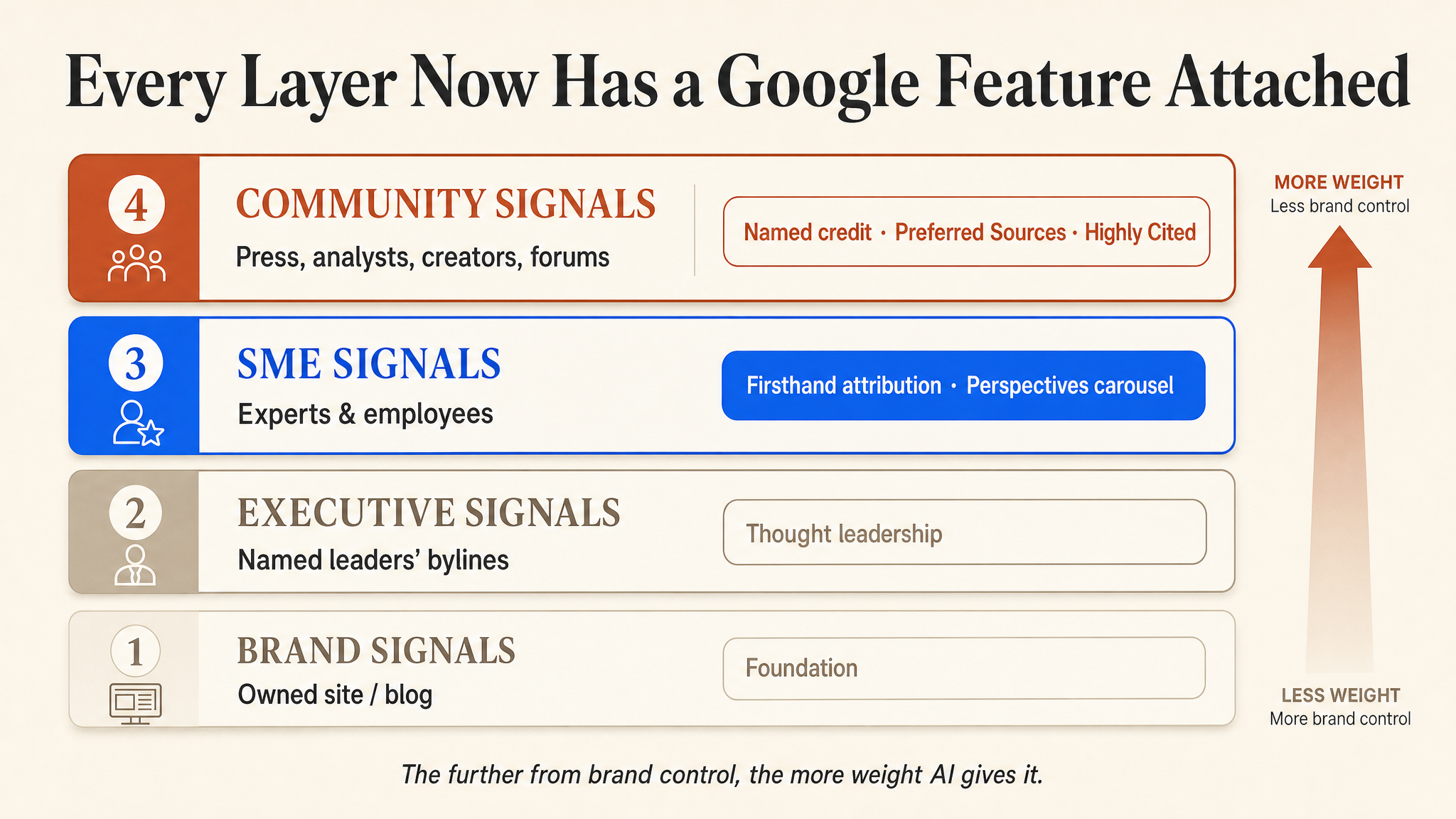
Google's May updates did one thing across four releases: they attached features to the exact signals the Stack describes.
May 6–7: AI Mode and AI Overviews started showing firsthand-source attribution: when AI cites a social post or a forum thread, it now names the actual person, their handle, and their community with an "Expert Advice" label in Google's own demo. The blog post Google shared on this new release said:
“For many searches, people are increasingly seeking out advice from others. To help you find the most helpful insights to explore further, AI responses will now include a preview of perspectives from public online discussions, social media, and other firsthand sources. We’re also adding more context to these links, like a creator’s name, handle, or community name, to help you decide which discussions you might want to read or participate in.”
That’s Layer 3 and Layer 4 voices getting named credit inside the answer. The same batch of updates added suggested topical angles—links at the end of AI answers pointing to the page that went deepest on one facet of a topic, not the page that ranked highest.
May 15: Google published its official AI search visibility guide and killed the tactical AEO playbook in one stroke: no llms.txt, no chunking, no robot-speak. There's no separate "AI search" to game; it runs on the same index as regular Search. Write the best content for humans; if it's useful and original, AI will find it. You don't trick your way in; you earn it.
May 19: Google AI Overviews at 2.5 billion monthly users, AI Mode passed 1 billion roughly a year after launch—one of the fastest runs to a billion users Google's ever had. The two are merging into one AI Search experience, which means every attribution feature above isn't an experiment on a side surface; it’s the whole thing.
May 27: Badges arrived. Preferred Sources are now highlighted inside AI answers (these are 345,000+ unique sources picked by readers, who are twice as likely to click one), as well as a perspectives carousel surfacing forum and social voices with names and communities attached, and a widened "Highly Cited" badge tagging both original reporting and everything built on top of it.
Translation: Every layer of the Source Signal Stack now has a feature attached to it somewhere in Google.
June 10: LinkedIn puts a price tag on Layers 2 through 4
LinkedIn joined the party and just announced Creator Marketplace and BrandWorks. Creator Marketplace, available inside Campaign Manager, lets brands search vetted creators by topic and expertise, assess their audience and performance, amplify their content with Thought Leader Ads, and contact them directly about partnerships.
It pulls together the creator infrastructure LinkedIn has been assembling for two years into one place. Creators, for their part, opt in and keep control: they choose which work to showcase, how brands reach them, and how their sponsored content gets used.
BrandWorks is the services half—a team of experts across brand, creative, content, and events offering hands-on strategy and production support for campaigns aimed at decision-makers. SAP and Webflow are already in.
The numbers LinkedIn published alongside the launch are the real story. From their 2026 Global B2B Marketing Outlook: 83% of B2B marketers say credibility now matters more than traditional brand messaging, 70% say buyers rely more on peer voices and experts than brand-produced content, and 56% of B2B buyers depend on creator input in the final stage of the buying process.
What LinkedIn just built is commercial infrastructure for the non-brand layers of the Stack.
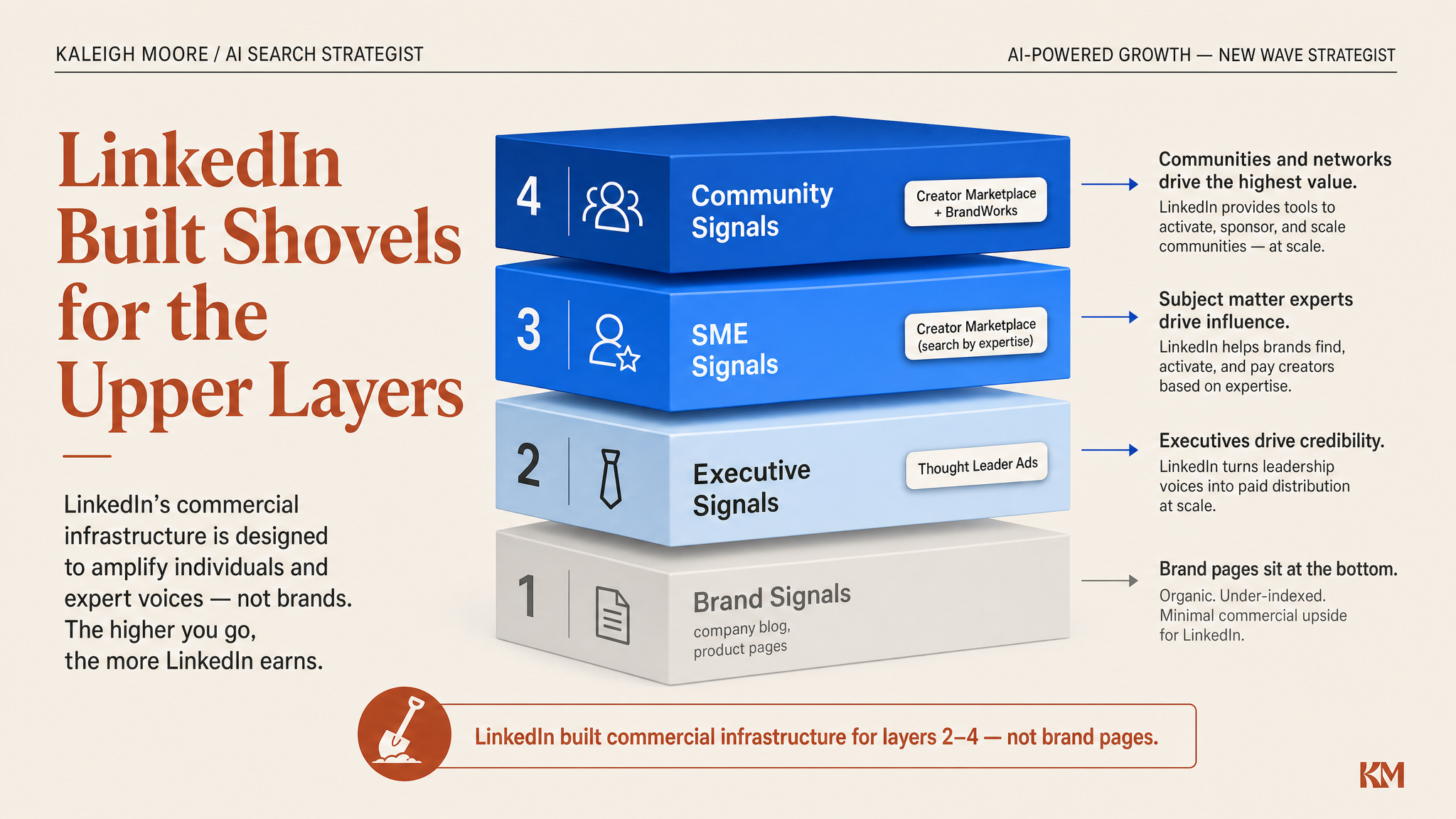
Creator Marketplace is, functionally, a directory of Layer 3 and Layer 4 signal sources with performance data attached. Thought Leader Ads are paid amplification for Layer 2 and Layer 3 voices. LinkedIn looked at where trust actually lives and built the product there.
Two platforms, one AI search visibility logic
Google's moves reward the supply of independent signals: it now names, badges, and surfaces the practitioners, experts, and third parties who publish original work. LinkedIn's moves organize the demand: it gives brands a structured way to find those voices and put budget behind them.
The same dynamic is running on both surfaces because both platforms answer to the same shift in behavior. When a buyer validates a vendor, they check independent voices. When an AI model assembles an answer, it does a machine-speed version of the same thing, pulling from sources that look credible, original, and independent of the brand being discussed.
The 56% of buyers validating with creator input at the final stage and Google's firsthand-source attribution are the human and machine versions of one behavior. Which means a creator partnership isn't just a campaign asset anymore. It's a citation source. An expert or B2B creator publishing under their own name is tackling both audiences: the buyer scrolling LinkedIn and the model deciding which sources to trust.
One caution before the to-do list, because I can already see how this gets misread: the answer is not "partner with more B2B creators and book more one-off deals."
A marketplace makes Layer 4 easier to rent, and rented signals are the easiest kind to overdo. If every credible voice in your category is suddenly sponsored, disclosure labels pile up, independence erodes, and the signal you paid for stops being the signal that worked.
The advice I’d give here: Paid partnerships can seed a thin layer, but they can't substitute for the slower, compounding work of executives and employees publishing real points of view under their own names. Brand content alone has never been weaker as a sole strategy; brand-funded content pretending to be independent is even weaker than that.
Your 30-minute AI search visibility audit for this week
1. Search your core queries in AI Mode. Run the five your buyers actually use. Who's cited? You, a competitor, or nobody? If you're missing, that's a signal gap, not a content gap, and no amount of new blog posts on the same domain will close it.
2. Check your author split. Are your execs and experts publishing under their own names (Layers 2–3), or is it all the company page (Layer 1)? Brand-page-only is fighting for the smallest slice—on both platforms now.
3. Map your Layer 4 before you shop it. Creator Marketplace's vetted-creator search is useful before you spend a dollar: it shows you which independent voices already hold authority in your category. Those are the same voices Google is now naming inside AI answers. Overlap between the two lists is your shortlist.
4. Count your layers. For your most important topic—how many independent, cross-verifiable signals actually exist? Fewer than three active layers and you're below the line.
5. Activate inside before you rent outside. LinkedIn just made external voices easier to buy. That raises, not lowers, the value of the executive and SME voices you already own (if they're actually publishing.) Don’t forget: An employee expert writing articles with a real POV on LinkedIn is the one signal source no competitor can book through a marketplace.
Want help with the above? I’m offering a two-hour workshop on June 24th to help you do just that.
FAQ: The May–June 2026 Google + LinkedIn Updates and their impact on AI search
What exactly did Google change in May 2026? Four things, across four releases. On May 6–7, AI Mode and AI Overviews started naming the actual people behind cited social posts and forum threads — name, handle, and community — with labels like "Expert Advice," and added suggested topical angles linking to the deepest page on a facet of a topic. On May 15, Google published its official guide to optimizing for generative AI features, explicitly debunking tactical AEO tricks like llms.txt and content chunking. On May 19 at I/O, Google announced AI Overviews at 2.5 billion monthly users and AI Mode past 1 billion, with the two merging into one AI Search experience. On May 27, badges arrived: Preferred Sources highlighted inside AI answers, a perspectives carousel for forum and social voices, and a widened "Highly Cited" badge for original reporting.
What did LinkedIn launch on June 10? Two things. Creator Marketplace, inside Campaign Manager, lets brands search vetted creators by topic and expertise, review audience and performance data, amplify creator content with Thought Leader Ads, and contact creators directly about partnerships. BrandWorks is the services side: a dedicated LinkedIn team offering hands-on strategy, creative, content, and events support for campaigns aimed at decision-makers. SAP and Webflow are early customers.
Why do these two launches matter together? Because they're two halves of the same shift. Google's updates reward the supply of independent signals — naming and badging the practitioners and third parties who publish original work. LinkedIn's updates organize the demand — giving brands a structured way to find those voices and put budget behind them. Both platforms are responding to the same buyer behavior: people validate vendors through independent voices, and AI models do a machine-speed version of the same thing.
Does this mean SEO is dead? No, but the scoreboard changed. Google didn't update Search at I/O 2026 — it replaced it. Search agents now answer for users before anyone reaches your page, so rankings and traffic alone no longer measure visibility. The question is shifting from "where do I rank?" to "who gets cited in the answer?" — and citations flow toward sources that look credible, original, and independent of the brand being discussed.
Is there a new technical playbook for AI search? Google says no, and said so directly in its May 15 guide. No llms.txt, no chunking, no special markup, no robot-speak. AI search runs on the same index as regular Search. The official guidance is to write the best, most original content for humans — which means the gap to close is a signal gap (who's vouching for you, and from how far outside the brand) rather than a formatting gap.
Should I just go buy a bunch of creator partnerships on the new marketplace? That's the misread to avoid. A marketplace makes Layer 4 easier to rent, and rented signals are the easiest kind to overdo. If every credible voice in your category is sponsored, disclosure labels pile up, independence erodes, and the signal you paid for stops being the signal that worked. Paid partnerships can seed a thin layer, but they can't substitute for executives and employees publishing real points of view under their own names over time.
What's the single highest-leverage thing I can do first? Activate the voices you already own. An employee expert publishing articles with a real point of view on LinkedIn is the one signal source no competitor can book through a marketplace. External voices just got easier to buy, which raises — not lowers — the value of the internal ones.
How do I know if my brand has a signal gap? Run the 30-minute audit. Search your five core buyer queries in AI Mode and see who's cited. Check whether your execs and experts publish under their own names or whether everything lives on the company page. Map which independent voices already hold authority in your category before spending on partnerships. Then count your layers: for your most important topic, if fewer than three layers of the Stack are actively producing cross-verifiable signals, you're below the line.