AEO Job Openings in 2026: Salary Data, Hiring Trends, and Market Insights
Over the past two weeks, I've been tracking every AI search job posting I can find. To be clear, these weren’t just SEO roles with "AI" sprinkled into the description; I looked for dedicated, full-time, salaried positions built specifically around AI search visibility, answer engine optimization, and generative engine optimization.
The count so far: 50+ unique roles across 50+ companies.

The companies hiring for this type of role: Stripe. Amazon. Pfizer. LinkedIn. Victoria's Secret. eBay. Palo Alto Networks. Texas Instruments. Vanguard. Citizens Bank. HubSpot. J. Jill. Anthropic. I started this tracking project because I wanted real data on where the job market is headed and insight for my fellow content marketers (or people in adjacent roles) who are looking to pivot.
I’ve heard that the job market is very tough right now, and that content marketing roles are few and far between these days. (I also know this is true because a year ago, I was in the same boat. It was grim!) But I think the reality is: It’s time for us to start looking at different types of marketing roles. Ones that, yes, will require some AI-upskilling, but that are prime for the taking right now.
That said: you can’t search for what you don’t know about. That’s why I wanted to see what kinds of roles I could surface in the Answer Engine Optimization (AEO) space.
Spoiler alert: There are quite a few, and I think there are going to be many, many more over the next 18 months.
This isn’t a vibes-based assessment, either. I dug in to get actual evidence of what companies are doing with their budgets and their org charts right now. Job descriptions are leading indicators; they tell you what companies are actually betting on, with real budget, real headcount, and real reporting structures. And the behavior driving that bet is moving fast.
Heading into 2026, TechCrunch reported AI referral traffic to websites was up roughly 357% year over year, and EMARKETER projects nearly a third of the US population (31.3%) will use generative AI search in 2026. When that many buyers start shifting their search behavior, paying attention to it stops being optional. And when this many companies create a net-new role around the same function, something larger is happening.
Here's what I found out about the rise in AEO job postings.
AEO and AI search marketing jobs aren't junior roles
When I started looking into the new roles emerging around AI search and AEO, I noticed right off the bat that this is largely a senior role with real latitude and influence. These aren't coordinator positions or "content writer with AI interest" roles.
For example, the titles include:
Director of Product, AEO & SEO (eBay)
Director of AI & Organic Search (Victoria's Secret)
VP/Head of Search & AI Visibility (Milestone)
Group Director of GEO and Search Strategy (Real Chemistry)
Senior Manager of SEO & Generative Engine Optimization (J. Jill)
Associate Director of SEO & AI Visibility (Tombras)
When a company creates a role with direct reports and budget authority, that's not an experiment; that's an investment into a permanent function. Compare this to just 12 to 18 months ago, when "AI search" was a bullet point inside an existing SEO manager's job description or a “nice to have” for a Head of Content role. You’d find AI competency as the fourth or fifth bullet, after "manage technical audits" and "coordinate with the content team."
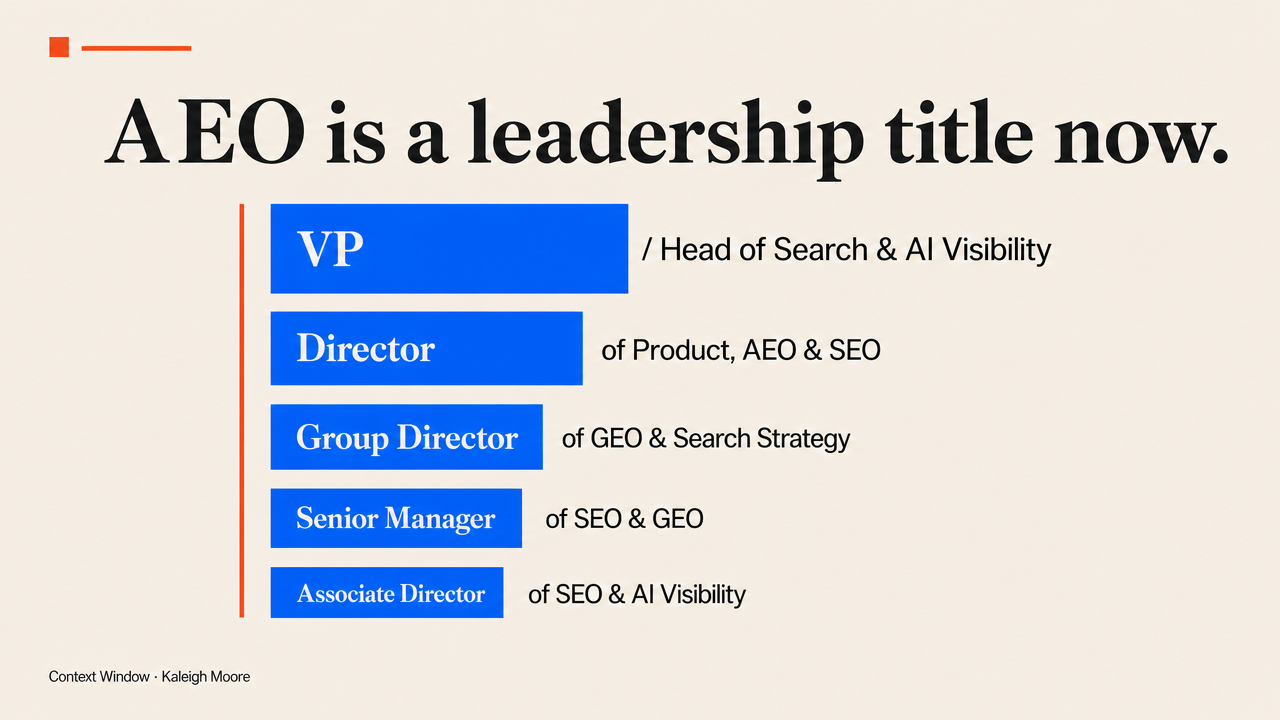
Now, AEO is the job title. The function has separated from SEO the same way content marketing separated from copywriting a decade ago. It's now its own discipline, with its own roles and dedicated budget lines.
AEO roles are popping up across every industry (not just tech)
Another interesting finding of this research was that AEO job postings aren’t limited to tech companies; hiring for AEO roles is not a Silicon Valley trend.
Take a look at what I spotted across many different verticals:
Finance: Citizens Bank, Stripe, Vanguard Group, Lendable
Healthcare and pharma: Pfizer, AMN Healthcare, Metagenics, Analyte Health
Retail and fashion: Victoria's Secret, J. Jill, Quince, Frasers Group
Enterprise tech: Amazon, eBay, LinkedIn, Palo Alto Networks, HubSpot, Texas Instruments, SailPoint, OutSystems
Insurance: Insurify, Intact Financial
Agencies: Tombras, Go Fish Digital, Lightburn, Real Chemistry, Fantasy, TriMark Digital, Elevation Marketing
When a fashion retailer, a pharmaceutical company, a semiconductor manufacturer, and a bank are all hiring for the same net-new role at the same time, I think we can safely say that brands are catching on. So much so that companies are willing to invest in having someone full-time on-staff to oversee AI search visibility work. I don’t think it’s too bold to say that if your industry isn't on this list yet, it will be (and maybe sooner than you think.)
Every company with a digital presence and a consideration-stage buyer is starting to realize they need someone who owns AI search visibility as a dedicated function.
Salary range for AEO and AI search jobs
Where ranges for AEO jobs are public, they confirm the seniority signal.
Real recent postings give us hard anchors:
Experian listed an AEO & SEO Manager role at $100K–$174K, and per SEOJobs.com data, senior content marketing roles focused on AI optimization run $150K–$210K at enterprise companies.
Further down the ladder, Odoo posted a GEO/AEO growth marketing specialist at $75K–$95K.
Director-level in-house roles at companies like eBay, Victoria’s Secret, and Palo Alto Networks land at the top of that range; agency roles skew lower, while in-house brand roles skew significantly higher. The good news here is that AEO jobs are being compensated like established marketing leadership positions, not like experimental hires on short-term contracts. To me, this is a proof point that companies are bought-in with AI search as something they are ready to invest in long-term.
The budgets back this up. Conductor surveyed 250+ CMOs and digital leaders and found 94% plan to increase their AEO investment in 2026, while 97% said AEO already had a positive impact in 2025. The new roles are just the visible edge of that spending.
One more thing the salary data reveals: the talent pool is razor-thin.
There are 50+ open roles competing for a talent pool that barely existed 18 months ago. The field is so new that practitioners can’t even agree on what to call it (GEO, AEO, LLMO, GSO), and a Search Engine Land analysis found fewer than a third use the terminology consistently. The fact that there’s not even shared language for this yet is a sign that it’s still early, but that we’re trying to find consensus!
That said: The demand curve is steep, and the supply curve is almost flat. If you’re reading this newsletter and you’ve done actual AEO work (even a few months of it), you are in a seller’s market right now.

The future of AI search jobs + my advice
If you’ve read this far, here’s what I want you to walk away from this knowing.
If you're a marketer: The job market is telling you AI search is an emerging career path, not a side project. The skills that will differentiate you are some general AEO foundations, the ability to activate executive voices, leverage employee experts, and build “brandom” strategies that generate third-party (off-site) signals.
Skills like content optimization and technical SEO will be table stakes within 18 months. Start building the skills that the job descriptions haven’t caught up to yet. My advice: Start learning the tools that brands are using to monitor AI search data, and give yourself an assignment to read one article on AI search trends each week. You’ll get up to speed quickly, without being overwhelmed.

If you're a founder or CMO: You're about to compete for talent in a market with a few open roles and an extremely small talent pool. Look for marketers who are showing initiative to get hands-on with tooling, who are running their own experiments, and who can speak confidently about their competency doing this work.
If you're an agency: The agency roles in this dataset (Tombras, Real Chemistry, Go Fish Digital, Elevation Marketing) are the leading edge. Clients will start asking for AI search services the way they asked for social media strategy in 2012. And just like in 2012, the agencies that build this capability now will own the category. The ones that wait will find themselves referring the work out to specialists who moved first.
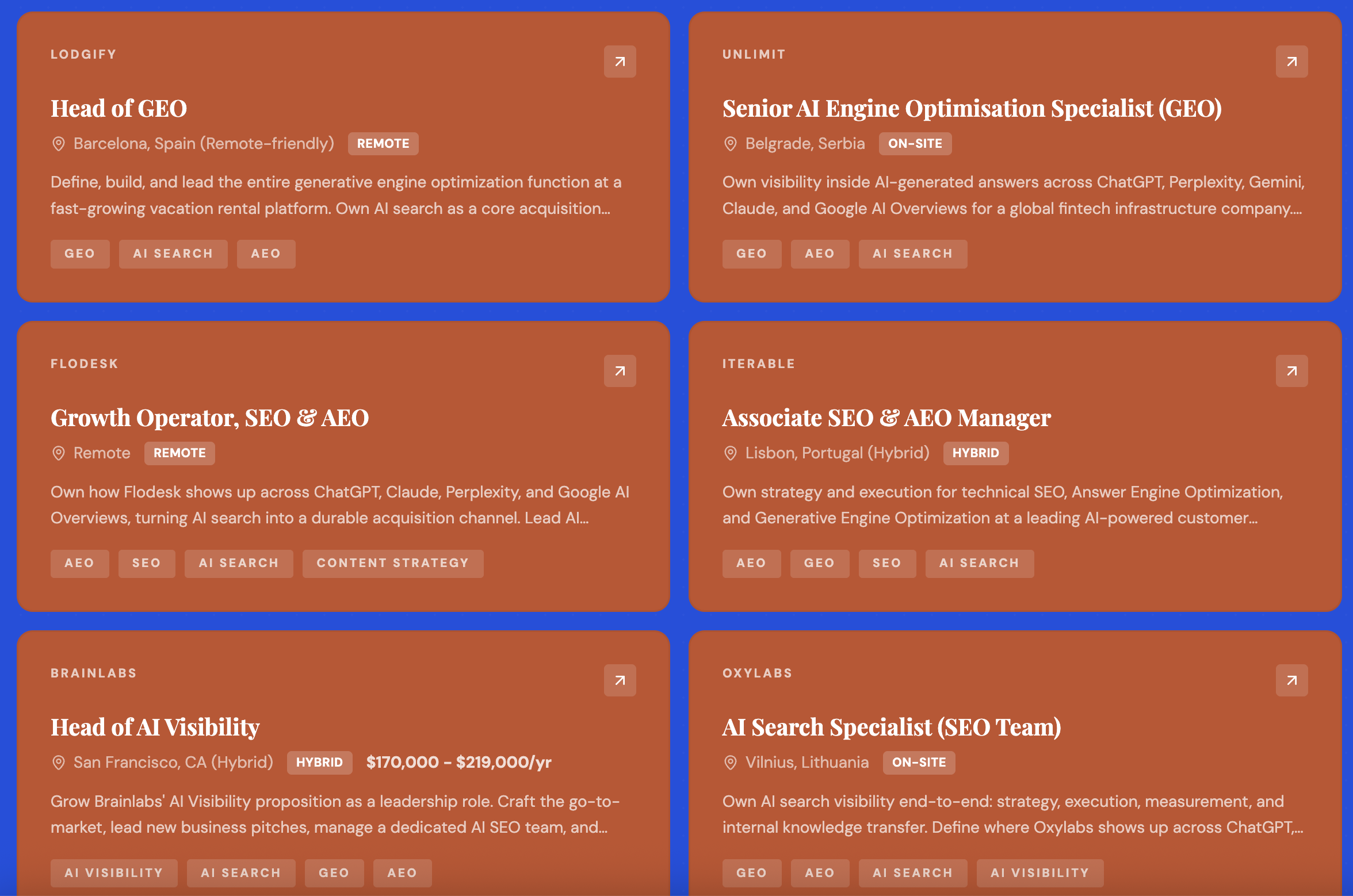
The first AI search job board
Here’s the fun part: As I'm tracking these new AI search job postings, I decided to share what I’m finding on my AI Search Jobs Board.
Every listing is verified and live, and it seems to be the only one of its kind so far (from what I’ve seen in my research!), and it’s presented by the nice folks at Profound. New roles are added each Monday.
Frequently Asked Questions about AI search jobs
What exactly is AEO (Answer Engine Optimization)?
AEO stands for Answer Engine Optimization. It's the practice of optimizing content specifically for generative AI search platforms and AI-powered answer engines. Unlike traditional SEO, which focuses on ranking in search results, AI search engines pull answers from multiple sources rather than ranking links. The goal is to make sure your content is selected as a source for AI-generated answers.
What's the difference between AEO, GEO, and other terms I keep hearing?
The field is so new that there isn't standardized terminology yet. You'll hear AEO (Answer Engine Optimization), GEO (Generative Engine Optimization), LLMO (Large Language Model Optimization), and GSO (Generative Search Optimization). They're largely used interchangeably. The fact that practitioners haven't agreed on terminology yet is actually a signal that this is an emerging field still finding its footing.
How much of the population is actually using AI search right now?
According to eMarketer, nearly a third of the US population (31.3%) will use generative AI search in 2026. TechCrunch reported that AI referral traffic to websites was up roughly 357% year over year. This kind of shift in buyer behavior is what's driving the sudden surge in job postings.
Are these entry-level positions or senior roles?
These are predominantly senior roles with real authority and budget control. Examples include Director of Product (AEO & SEO), VP/Head of Search & AI Visibility, and Senior Manager of SEO & Generative Engine Optimization. The fact that companies are creating dedicated positions with direct reports and budget authority signals these are permanent functions, not short-term experiments.
What can I expect to earn in an AEO role?
Salary ranges vary by level and company size:
Manager-level roles: $100K–$174K (e.g., Experian's AEO & SEO Manager posting)
Mid-market specialist roles: $75K–$95K (e.g., Odoo's GEO/AEO Growth Marketing Specialist)
Senior content marketing roles focused on AI at enterprise companies: $150K–$210K
Director-level in-house roles: Top of the range
The fact that these are being compensated at leadership levels confirms they're being treated as permanent, strategic functions—not experimental hires.
Why are salaries so competitive for a role that barely existed a year ago?
Because the talent pool is razor-thin. There are 50+ open roles competing for practitioners who barely existed in the field 18 months ago. This creates a seller's market for anyone with hands-on AEO experience.
I'm a marketer thinking about pivoting into AEO. Should I do it?
Yes—but strategically. The job market is signaling that AI search is an emerging career path with real opportunity. Focus on developing skills that will be in even higher demand: the ability to activate executive voices, coordinate subject matter expert programs, and build earned media strategies that generate off-site signals. Content optimization and technical SEO will become table stakes within 18 months. Start by learning the tools brands are using to monitor AI search data and commit to reading one article on AI search trends per week.
I have a few months of AEO experience. What does that mean for my career prospects?
You're in a seller's market. With only 50+ open roles and an extremely small talent pool, anyone with hands-on AEO experience has significant leverage right now.
I'm a founder or CMO looking to hire for AEO. What should I look for?
Look for marketers who are showing initiative to get hands-on with AI search tooling, running their own experiments, and speaking confidently about their AEO competency. The best candidates are those taking initiative to learn before they're asked.
I run an agency. What should we be doing about this?
The agencies represented in this job data (Tombras, Real Chemistry, Go Fish Digital, Elevation Marketing) are the leading edge. Expect clients to start asking for AI search services the way they asked for social media strategy in 2012. Agencies that build this capability now will own the category. Those that wait will find themselves referring work to specialists who moved first.
Is this a temporary trend or a permanent shift?
All signs point to permanent. Evidence includes: 94% of CMOs plan to increase AEO investment in 2026, 97% said AEO had a positive impact in 2025, companies are creating dedicated budget lines and permanent headcount for these roles, and job descriptions are a proven leading indicator of where companies are actually betting real budget.
What will the AEO job market look like in 18 months?
Expect significantly more roles. Skills that are now differentiators will become table stakes. The field will likely develop more standardized terminology and best practices. Companies across every industry will have someone dedicated to AI search visibility.
Will traditional SEO jobs disappear?
Not necessarily. AEO is separating from SEO the same way content marketing separated from copywriting a decade ago. It's becoming its own discipline with dedicated roles, budget, and talent requirements. Traditional SEO skills will likely remain valuable as part of a broader marketing function.
My industry isn't mentioned in the list. Does that mean there are no opportunities there?
If your industry isn't on the list yet, it likely will be soon. Every company with a digital presence and consideration-stage buyers is starting to realize they need someone dedicated to AI search visibility. The trend is moving fast across industries.
Is this really happening, or is this just hype?
This is concrete, measurable behavior with real budget and headcount behind it. The evidence includes real job postings from real companies with public salary ranges, 94% of CMOs planning to increase investment, and 357% year-over-year growth in AI referral traffic. These aren't projections—they're documented trends happening right now.