How to Build an AEO Strategy From Scratch
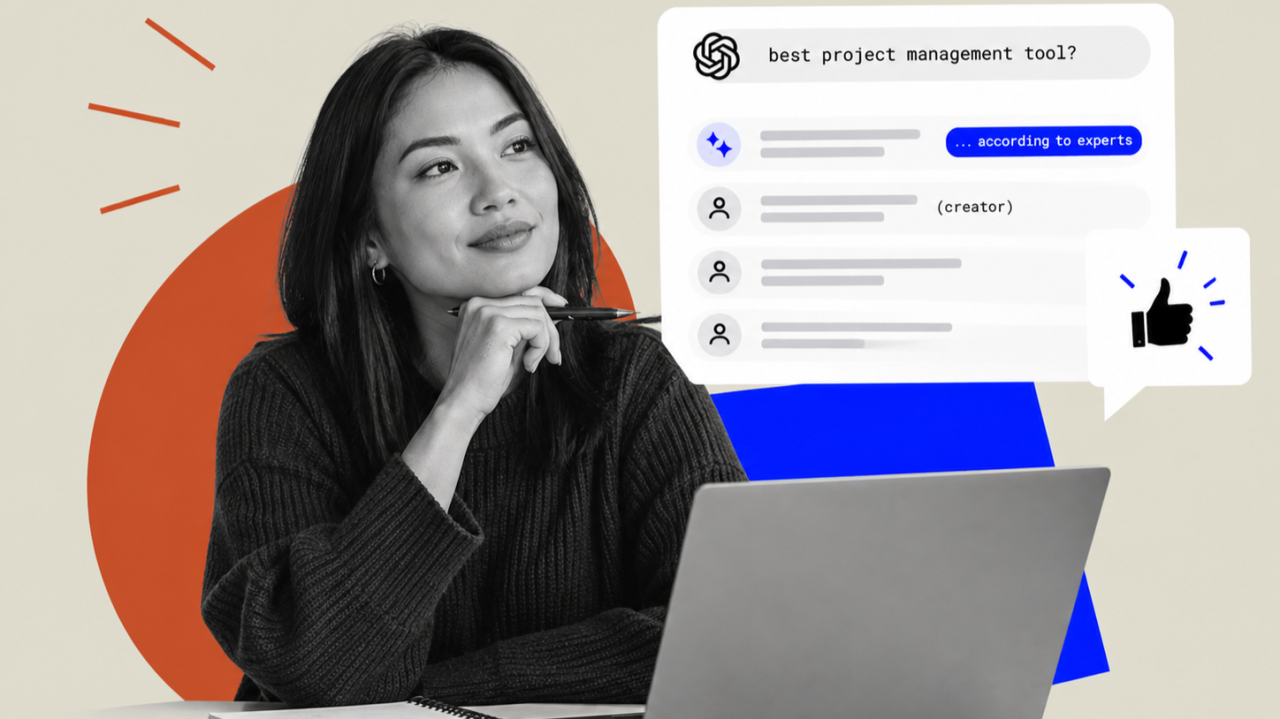
Open ChatGPT. Type the exact question your best buyer would type. Something like: "What's the best [your category] for a [customer persona]?"
Did your brand name show up? Maybe it didn't. Or worse: it mentioned you but got your info completely wrong, describing you as the thing you stopped being two pivots ago.
There's already a version of your brand living inside these AI models. It's your job, as the person tasked with "figure out AEO," to make sure that version is correct, up to date, and cross-verified by people outside your brand. You do not need the 4,000-step checklist that every "Complete Guide to AEO" is trying to sell you. You need a handful of moves in the right order.
Move 1: Audit your current AI visibility
You can't fix what you haven't seen, so go look at what the different models actually say about you/your brand.
Open ChatGPT, Perplexity, Gemini, and Google's AI Mode. Ask all four the same ten questions. Not "what is [category]." The real ones your potential buyers ask:
"Best [category] for [your buyer]?"
"[You] vs [competitor]: which is better for [use case]?"
"Top tools for [the job your product does]?"
Screenshot everything. Congratulations, you now have three lists:
Where you're flat-out invisible.
Where you show up, but the model gets you wrong.
Who keeps getting recommended instead of you.
That's your map. Every move after this is just closing those three gaps. Do it again bi-weekly or monthly, because the models update daily as new content is published. One thing to know before you panic at a bad result: AI answers are probabilistic. (I will do a deep dive on this in the future, but I’ll keep it high-level today.)
Run the same prompt twice, and you can get two different lists. So don't read one screenshot like it's gospel. Run each question two or three times, and pay attention to the pattern, not the one-off. If you're invisible in three out of three runs, that's a signal. If you're in one out of three, that's a foothold you can grow.
Move 2: Review your digital footprint across the internet
AI will not confidently recommend a brand it can't pin down.
If your homepage says "revenue intelligence platform," your G2 review page says "sales analytics software," and your LinkedIn bio is still wearing its 2021 tagline, the model has no idea who you are. Your buyers are probably confused, too.
LLMs like brands or individuals with a story that’s clean and boring and consistent.
Do this today:
Write one sentence that says exactly what you are and who it's for. Clear beats clever, always.
Paste that exact sentence everywhere: homepage, G2, Capterra, Crunchbase, LinkedIn, your About page, every founder bio. Same name, same category words, same claims…everywhere. Nobody gets to be a thesaurus today.
It's the least exciting hour in this whole plan, but it's also the hour that makes every other move actually work.
Note: I personally have had to do this gruntwork for my own "personal brand" (air quotes because that feels so stupid to write! I am just a girl, not a brand, but…alas.)
With this new pivot into AEO, I've had to go back and get alllll my important old bios updated across the places that matter, because it's crucial for LLMs that you're consistent in how you show up across the internet. Unsexy work, but very important.
Move 3: Update your top blog posts so they’re answer-first
Start with the owned content side of AEO (namely your blog), and update/refresh/optimize your top-performing pieces that are already ranking and driving website traffic. This is your low-hanging fruit.
The biggest thing to keep in mind for AEO work here: Every page that matters should answer the question in the first two sentences, then expand. Journalists call it the inverted pyramid. You should call it the thing that gets you cited.
Here's what it looks like in action: "[Category] software helps [buyer] do [job]. For [your segment], the right pick comes down to three things. Here's how to choose."
Start with your top ten pieces or the ones tied to actual buying decisions. Lead with the answer in the first/top section. No runway, no warm-up, no "in this article we'll explore." Get to the point!
It also doesn’t hurt to add a FAQ section to the end of each of these articles, either.
Move 4: Publish data that only you have
This is the highest-leverage move on the list, and almost nobody does it.
You’re sitting on a gold mine you keep ignoring: your product usage data, your customer outcomes, your benchmarks, the customer behavioral shifts and patterns you spot in your own support tickets. Pull one interesting finding from your data set and build a report or post around that insight.
One original data finding, published with a solid explanation and context attached, will earn more AI citations than "ultimate" guides. Why? Because it’s unique, data-backed, and ONLY YOU CAN HAVE IT. If you were a journalist, you’d consider this your “scoop,” AKA the insider angle only you have.
Move 5: Tie new content to a human employee expert
AI tools, when evaluating sources, increasingly favor people, not faceless company brands. A real expert with real credentials beats a faceless byline every time.
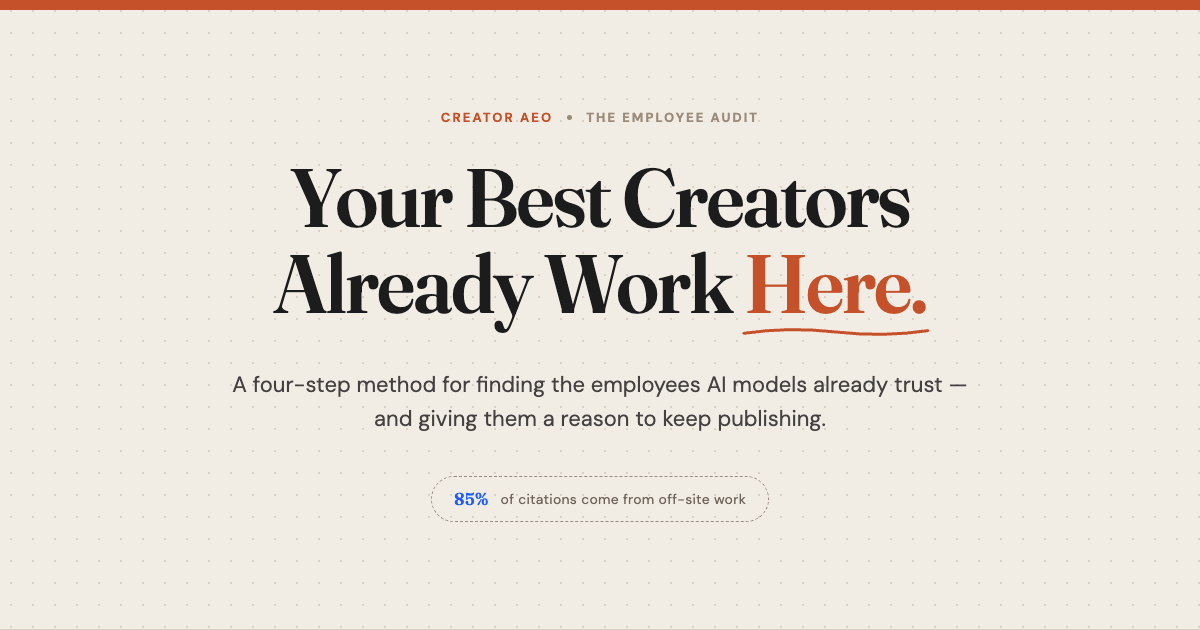
So: Put a real, human byline on every new piece of content you publish. A name, a photo, a two-line bio with credentials that aren't made up. Push your sharpest employee expert out front, publishing consistently in the thing they're actually an expert in. Or, if you’re using freelancers or B2B creators, spotlight their expertise.
Think about what subject matter expertise from internal employees you can leverage that adds something new to the conversation. Don’t be part of the B2B content monoculture.
Move 6: Focus on the off-site work, intensely
Plot twist: most of your AI citations won't come from your own site. They'll come from everyone else's.
This is the whole premise behind my framework, the Source Signal Stack: the further a source is from brand control, the more trustworthy it is to an AI model.
Plus, data shows that much of what’s actually moving the needle in the realm of AEO is happening on third-party/off-site locations, like Reddit, YouTube, and LinkedIn. Start thinking about how you’re regularly showing up in these places. You need to be there!
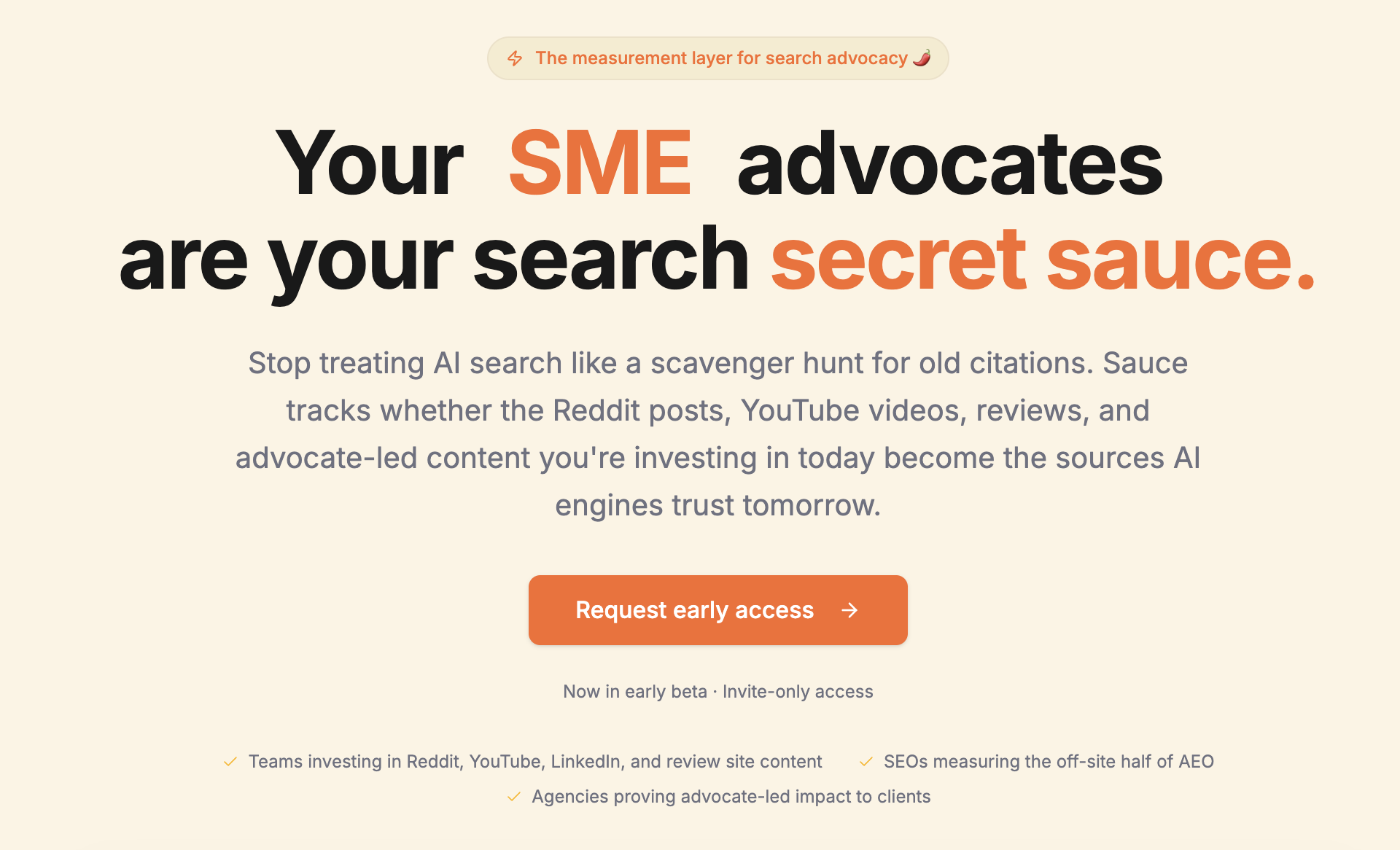
Hot tip: Off-site has been notoriously hard to track, but this new tool Sauce (still in beta, but you can request access), has been INCREDIBLY helpful at keeping tabs on what’s getting AI citations beyond the company website
The AEO metrics that matter
Now let’s talk measurement. Forget rankings and traffic for a minute, as they aren’t as relevant in the AEO conversation. In fact, Ahrefs data shows only about 12% of the URLs ChatGPT cites also rank in Google's top 10. You need a new scoreboard.
There are two halves to this:
The first half is visibility metrics: are you in the AI answer at all, and if so, how well/how often?
The second half is business metrics: does any of that turn into traffic and revenue?
Answering these will help you answer whether or not AEO work is driving leads and sales (and, therefore, making a case for why it’s worth doing.)
AEO visibility metrics
Here are the visibility metrics I like to keep an eye on:
Mention rate: how often you show up at all, across your tracked questions.
Share of voice: you vs. the competition when your category comes up. This is the one that actually maps to "are we winning."
Citation rate: how often you're the linked source, not just a name-drop. A mention is nice. A citation is a vote.
Sentiment and accuracy: Being mentioned is not the same as being mentioned correctly. A model that recommends you while describing a product you sunset two years ago is an own goal. Track whether the mention is right and whether it's positive.
Average position: when the model lists five tools, are you first or fifth? First-mention rate is its own little kingdom worth holding.
Question (or prompt) coverage: of all the questions your buyer asks on the way to a decision, what share do you show up for? If buyers ask 100 questions across their journey and you appear in 40, that's your number, and the other 60 are your roadmap.
One critical point here: track this per engine, not as one blurry average. ChatGPT, Perplexity, Gemini, and Google's AI Mode do not behave the same way, and the differences are big enough to change your strategy. If you blend all four engines into one score, you'll optimize for the average and win nowhere. Break it out.
AEO business metrics
Now, for the business side of things. Two key ones to watch:
AI referral traffic: the sessions that actually land on your site from an AI answer.
AI conversion rate: how that traffic converts versus your organic baseline. This is the number that gets AEO funded, because AI-referred visitors tend to convert at multiples of regular organic traffic across most studies. They arrive pre-qualified; the engine has already vouched for you.
Check the visibility metrics against your Move 1 screenshots monthly. Mentions flat? Your entity's still messy; go back to Move 2.
Mentioned but never cited? You need more original data and named humans; that's Moves 4 and 5.
What this looks like on a real company: a 90-day audit
Let's make this concrete. Say you've just taken over marketing at "Ledgerly," a mid-size expense-management tool for finance teams at fast-growing startups. Decent product, modest brand, a homepage that's been quietly rewritten three times by three different founders.
Here's what the first 90 days look like.
The audit (week one). I open all four engines and ask the ten questions a startup finance lead would actually ask: "best expense management software for startups," "Ledgerly vs [two named competitors]," "expense tools that integrate with [popular accounting platform]," and so on. I run each two or three times because, again, the answers fluctuate.
What I find is depressingly typical, and it sorts cleanly into the three buckets:
Invisible: On "best expense tools for startups," Ledgerly shows up in zero of three ChatGPT runs. Three competitors show up in all three.
Mentioned but wrong: On a head-to-head comparison prompt, Ledgerly appears, but the model describes it as "a corporate card provider," which is the thing they pivoted away from 18 months ago. Worse than absence.
Who's eating my lunch: Two competitors and one review listicle get cited on nearly every prompt. I go look at the listicle. Ledgerly isn't on it.
Now I have my map. Here's the 90 days.
Days 1–30: Fix the entity and the foundation. This is unglamorous Move 2 work, and it comes first because nothing else compounds until it's done. One sentence describing exactly what Ledgerly is now, pasted identically across the homepage, G2, Capterra, Crunchbase, LinkedIn, and every founder bio. Kill the "corporate card" language everywhere it still lingers. Then rewrite the top five money pages answer-first (Move 3), the comparison pages especially, since those are where buyers are closest to deciding. By day 30, the model should at least be able to pin down what Ledgerly is.
Days 31–60: Build the asset only Ledgerly has. This is the Move 4 swing for the fences. Ledgerly is sitting on anonymized spend data across thousands of startups, so we publish "The State of Startup Spend" with one genuinely original, quotable number ("startups waste X% of software budget on duplicate SaaS subscriptions"). Real methodology, real context, a named human analyst on the byline (Move 5). This is the page designed to get cited elsewhere, which is the whole point. In parallel, I pull the list of sites the engines kept citing in my audit and start pitching them, leading with that stat and an expert quote, not a press release.
Days 61–90: Earn the outside citations and re-measure. Now I chase the rooms the models already trust (Move 6). Contributed pieces and expert quotes on the two or three outlets my audit flagged, plus an outreach push to get Ledgerly onto that review listicle that keeps getting cited. I’d also start thinking about engaging creators on LinkedIn, getting a Reddit strategy in place, and building out a YouTube strategy with videos targeting key customer questions or topics Ledgerly is trying to own within the vertical.
And then I’d close the loop: I re-run the same ten prompts from week one and lay the screenshots side by side.
Start with the AEO audit
This is a LOT…I know. But start small by getting the lay of the land with your audit. From there, you can start chipping away at the next moves one at a time.
Need a jump start on your visibility audit (move #1?) I built an AEO audit tool that's free and gives you a jumping off point.
Frequently Asked Questions About AEO
What is AEO (Answer Engine Optimization)? AEO is the practice of making sure AI tools like ChatGPT, Perplexity, Gemini, and Google's AI Mode mention, cite, and accurately describe your brand when buyers ask them questions. There's already a version of your brand living inside these models. AEO is the work of making that version correct, current, and verified by sources outside your own website.
How is AEO different from SEO? SEO optimizes for where you rank in a list of blue links; AEO optimizes for whether you show up inside the AI-generated answer itself. The overlap is smaller than you'd think. Only about 12% of the URLs ChatGPT cites also rank in Google's top 10, which means your old ranking-and-traffic scoreboard won't tell you how you're doing in AI search. You need new metrics.
Where do I actually start? Start with an audit. Open ChatGPT, Perplexity, Gemini, and Google's AI Mode, then ask all four the same ten questions your real buyers ask, like "Best [category] for [your buyer]?" or "[You] vs [competitor]?" Screenshot everything. You'll end up with three lists: where you're invisible, where you show up but the model gets you wrong, and who keeps getting recommended instead of you. That's your map, and every other move just closes those three gaps.
Why do I get different answers when I ask the same question twice? Because AI answers are probabilistic. Run the same prompt twice and you can get two different lists, so no single screenshot is gospel. Run each question two or three times and watch the pattern, not the one-off. Invisible in three out of three runs is a real signal; showing up in one out of three is a foothold you can grow.
How often should I re-run the audit? Bi-weekly or monthly. The models update constantly as new content gets published across the internet, so your visibility shifts even when you're not actively working on it. Re-running the same ten prompts and laying the screenshots side by side is also how you measure whether your work is paying off.
Why does consistency across my website, G2, LinkedIn, and other profiles matter so much? Because AI won't confidently recommend a brand it can't pin down. If your homepage, your review-site profile, and your founder bios all describe you differently, the model has no clear idea who you are, and neither do your buyers. Write one sentence that says exactly what you are and who it's for, then paste that same sentence everywhere. Same name, same category words, same claims, across every profile.
What does "answer-first" content mean? It means answering the question in the first two sentences of a page, then expanding, instead of warming up with "in this article we'll explore." Journalists call it the inverted pyramid. Lead with the answer in the top section, skip the runway, and you make the page much easier to cite. Adding an FAQ section to the end of your key pages helps too.
Why is publishing original data the highest-leverage move? Because it's something only you can have. Your product usage data, customer outcomes, benchmarks, and support-ticket patterns are a scoop no competitor can replicate. One original finding, published with real methodology and context, will out-earn fifty more "ultimate guides," because it's unique and data-backed rather than another entry in the B2B content monoculture.
Why put a human byline on content? Because AI tools increasingly favor real, credentialed people over faceless company brands when they evaluate sources. Put a real name, a photo, and a genuine two-line bio on every new piece, and push your sharpest internal expert (or your best freelancer or guest contributor) out front to publish consistently in their area of expertise.
Where do most AI citations come from? Mostly from everyone else's sites, not your own. Third-party and off-site sources like Reddit, YouTube, and LinkedIn tend to move the needle more than your owned content, and the further a source sits from your direct control, the more an AI model trusts it. That's why earning outside mentions and contributed pieces matters as much as fixing your own pages.
Which metrics should I track? Two halves. Visibility metrics tell you whether you're in the answer: mention rate, share of voice, citation rate, sentiment and accuracy, average position (and first-mention rate), and question coverage. Business metrics tell you whether that turns into results: AI referral traffic and AI conversion rate. Share of voice is the one that best maps to "are we winning," and AI conversion rate is usually the number that gets AEO funded, since AI-referred visitors tend to arrive pre-qualified and convert well.
Should I track all the AI engines together or separately? Separately, per engine. ChatGPT, Perplexity, Gemini, and Google's AI Mode don't behave the same way, and the differences are big enough to change your strategy. Blend them into one average and you'll optimize for the middle and win nowhere.
My brand shows up but never gets cited. What do I fix? That usually means you need more original data and more named human experts, so focus on publishing a unique data asset and putting real bylines on your content. If you're not showing up at all, the problem is more likely a messy, inconsistent entity, so go back and fix how you describe yourself across every profile first.
How long does AEO take to show results? You can make real progress in about 90 days. A typical arc is fixing your entity and foundation in the first 30 days, building a unique data asset with a named expert in days 31 to 60, then earning outside citations and re-measuring in days 61 to 90. It's a lot of work, so the realistic move is to start small with the audit and chip away at the rest one move at a time.