Why Expert Interviews Are the Irreplaceable Step in AI-Optimized Content
There's a step in the AI-optimized content production process that doesn't get talked about enough, and it's the one where most projects quietly fall apart. It’s the subject matter expert interview.
An important piece of creating content that LLMs cite in AI summariesincludes getting fresh, original insights from experts (both internal and external to your organization). This is part of "owning your topic" efforts.
AI can’t (yet) conduct those interviews, so it’s your job to show up and maximize your time with a subject matter expert via strategic questions, a clear narrative arc, and opportunities to gather valuable social proof points.
When you show up to an expert interview without a real plan, you end up with a transcript full of meandering answers and half-finished thoughts. Building a compelling narrative out of that is very, very difficult. The research phase is where time goes to die. And it's the phase I haven't seen many systems for.
Here's what I've been using.
Before the interview: build your question set around the story, not the subject
Most people prep interview questions by thinking about the topic. I prep by thinking about the narrative I'm trying to build and working backward from there. Before I schedule an expert call, I write a one-paragraph summary of the story I'm trying to tell. Not the article. The story.
What's the tension?
What does the reader need to believe by the end?
What would a perfect quote from this expert actually look like?
Then I work with Claude to develop a set of interview questions that will help produce this narrative. That means fewer "tell me about your experience with X" questions and more "what do most people get wrong about X" questions.
The second type produces hot takes, a strong POV, and usable quotes. The first type produces irrelevant, vague responses that are essentially dead ends.
My prep prompt for Claude looks like this:
"I'm interviewing [name/title] for an article about [topic]. The central argument I'm building is [one sentence]. The audience is [specific reader]. Generate 12 interview questions designed to surface strong, quotable insights that support this argument. Include at least three questions that challenge conventional wisdom, and two that ask for a specific example or data point."
That gives me a working question set in about 90 seconds. Then I edit it down, reorder based on conversational flow, and add two or three questions specific to that person's background or recent work.
Total prep time: under 15 minutes.
An interview habit that changes everything
I record every call and use an AI transcription tool to get a rough transcript. That part most people already do. The habit that really changed my output, however, was timestamping key conversation moments in real-time.
When someone says something genuinely useful, I type a single asterisk into the chat or my notes app. That's it. One keystroke. I don't try to write down what they said. I just mark the moment.
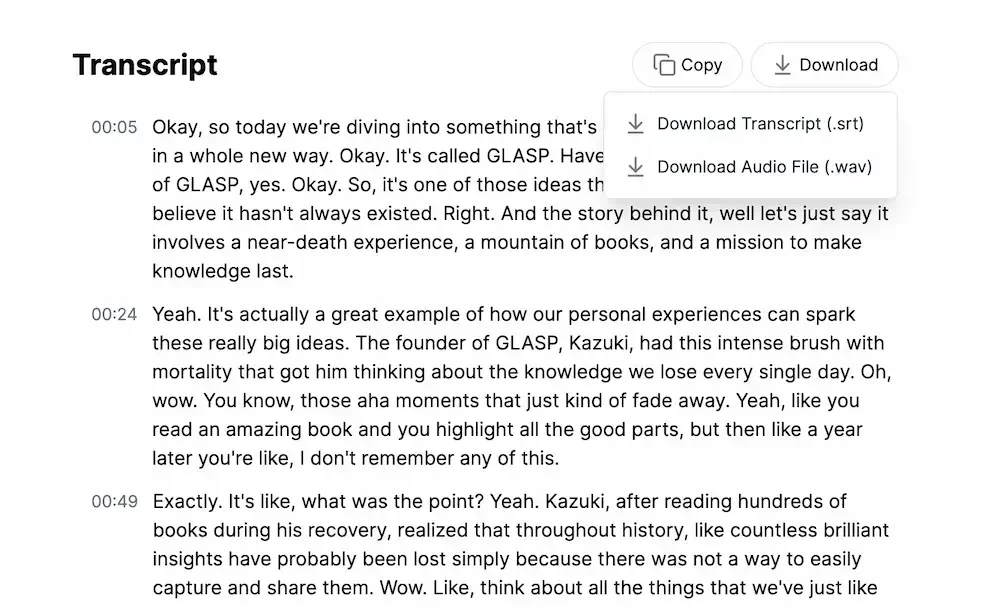
When the transcript comes through, I search for those timestamps and pull the surrounding text first. Instead of reading 6,000 words linearly, I'm skimming to the flagged moments and evaluating those first. Usually, 80% of my usable material is in those marked sections.
After the interview: the prompt that turns a messy transcript into organized raw material
This is the step that saves the most time. Once I have the cleaned transcript, I don't read the whole thing. I feed it to Claude with this prompt:
"Here is an interview transcript. I'm writing an article about [topic] for [audience]. The central argument is [one sentence]. Please do the following: (1) Pull the five to eight most quotable moments and present them with their surrounding context. (2) Identify any data points, statistics, or specific examples the expert mentioned. (3) Flag any moments where they contradict conventional wisdom or say something unexpected. (4) Note any gaps: questions I should have asked or topics they touched on that I didn't follow up on."
What comes back is essentially a pre-organized brief of the most valuable material in the transcript. I still read the full transcript eventually, but I start with the synthesis. Nine times out of ten, everything I need is already surfaced.
Put your editorial taste hat on
Here's the thing about AI-assisted content production that I don't think gets said enough: the tools are only as good as the inputs, and the inputs come from human conversations, human expertise, and human judgment about what's actually interesting.
The writers who are going to win over the next few years aren't the ones who prompt the best. They're the ones who ask the best questions, know how to listen for the unexpected angle, and can turn a messy 45-minute conversation into a clean, compelling narrative. That skill is not automatable, but the organizational layer around it absolutely is.
The interview prep system, the transcript prompt, the gap analysis at the end: none of that is magic. It's just structure applied to a process most people are still doing by feel.
Build the system once. Use it every time. Your drafts will be better before Claude writes a single word.