The Source Signal Stack: How to Win AI Search Via Employee SMEs Posting on LinkedIn
You've read the AEO playbooks, and you understand what needs to happen: Your employee subject matter experts (not just the CEO, but also the PMs, solutions engineers, and VPs of customer success) should be publishing under their own names, consistently, with a defensible point of view.
The problem is that you're running a team already stretched past its limit.
Your SMEs have jobs to do, and nobody has thirty free hours a month to figure out which experts to activate, what they should say, how to extract it from them, and how to turn twenty minutes of someone's thinking into a month's worth of interesting, citation-worthy LinkedIn content. While you're solving that puzzle, leadership is asking with increasing frequency what you're doing about the brand’s AI search presence to increase citation rates across various LLMs.
Most B2B content leaders are in this jam right now.
The AEO strategy they know they need is also the one they have no realistic path to executing, and most of the advice floating around only makes the problem more stressful because it treats AI search and employee/SME thought leadership as two separate initiatives (each of which would require its own budget, its own team, its own roadmap). I’m here to tell you: Wrong. These should be ONE program. A properly built employee/SME creator program is also a key part of an AEO program.
The content infrastructure that turns your SMEs into resolvable experts on LinkedIn is the same infrastructure that helps make your brand citable in ChatGPT, Perplexity, Claude, and Google AI Mode.
Key Points
Employee/SME thought leadership and AEO are the same program. The infrastructure that makes your experts resolvable on LinkedIn is what makes your brand citable in ChatGPT, Perplexity, Claude, and Google AI Mode.
85% of AI citations come from third-party platforms, not brand-owned sites. Most B2B programs over-invest in the signals LLMs trust least and ignore the ones they trust most.
The Source Signal Stack has four layers: Brand (owned media), Executive (C-suite under their own names), SME (non-exec internal experts under their own names), and Community (earned third-party coverage). The further a signal sits from brand control, the more weight LLMs give it.
Layer 3 is the unclaimed opportunity. 96% of B2B companies do thought leadership, but only 37% involve specialized employees, and fewer than 5% of headcount is doing the work. Activating three to five SMEs is a 4–6x increase in citable expertise.
The stack compounds multiplicatively. One SME insight can generate seven independent signals across all four layers and five-plus platforms — exactly the cross-verifiable attribution AI rewards. A full stack beats a Layer 1 program producing 5x the volume.
A 15-minute diagnostic: search your company, your CEO, and three SMEs in ChatGPT and Perplexity, then count third-party mentions of your people in the last 90 days. One strong result out of four is the typical B2B failure pattern.
The window is narrowing. Once LLM entity graphs anchor around competitors' named humans, displacing them gets expensive. Build before your category's citation patterns harden.
The Data Indicates LinkedIn is Ripe for AI Search Wins via Employee/Personal Accounts
Once you see the data on how LLMs like ChatGPT, Google Overviews,and Claude actually decide who to cite, the symbiosis around leveraging employees as thought leaders on LinkedIn and boosting LLM citation rate becomes obvious. As a quick refresher: last week, we did a deep dive into new AEO data that shows 85% of AI citations come from third-party platforms, not brand-owned sites.
The issue here is that B2B SaaS brands typically invest in only one or two types of source signals (like a company blog and a CEO with a LinkedIn presence) and build everything on top of those. Meanwhile, the AI systems they're trying to show up in are cross-verifying multiple data sources to ensure they’re giving the best possible answer. The imbalance is invisible until you map it, but once you do, you’ll see the clear gap between what most B2B content programs produce and what LLMs actually reward.
I've started calling this gap analysis the Source Signal Stack. It's the mental model and framework I now use with every B2B company (and individual SME) I work with on LinkedIn for “employees as B2B creators” initiatives. It's the clearest way I've found to diagnose why a content program ranks in Google, performs well by every owned metric, and still gets nearly zero citations in ChatGPT, Perplexity, Claude, or Google AI Mode.
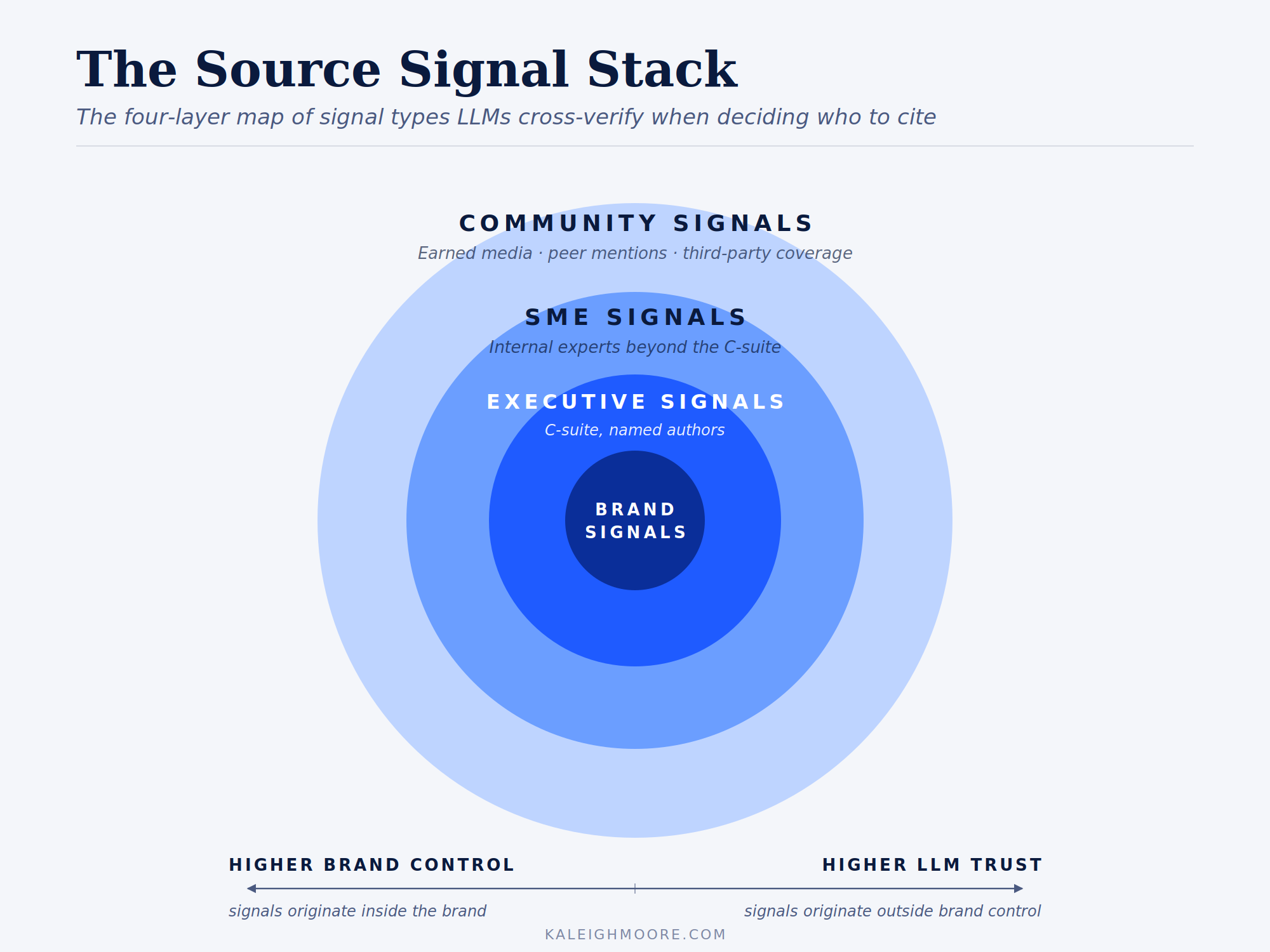
The Source Signal Stack is a four-layer map of the source signals (aka types of data LLMs cross-verify) when deciding which content to cite on a topic.
The four layers I like to focus on are:
Brand Signals: The company blog and/or LinkedIn page
Executive Signals: C-suite individuals publishing under their own names
SME Signals: internal experts beyond the C-suite, publishing under their own names
Community Signals: earned media, peer mentions, third-party coverage
Read the list top to bottom, and you’ll see there's a principle hiding in it that most B2B marketers have not yet fully articulated: the further a source signal originates from brand control, the more weight LLMs give it.
Brand-owned content is the least trusted signal in the stack. Earned community mentions are the most trusted.
Executives and SMEs sit in between, and the independence dial moves as you go from Layer 2 to Layer 3. Executives are still structurally tied to the brand, while SMEs (especially non-managerial ones) can differentiate more from the company, leveraging their expertise as independent voices.
This is the part most AEO content programs have backward, as they invest the most time, energy, and money into one of the layers LLMs trust the least.
Layer 1: Brand Signals
Brand Signals are everything you own: your website, your blog, your resource hub, your company LinkedIn page, your product documentation, your category pages.
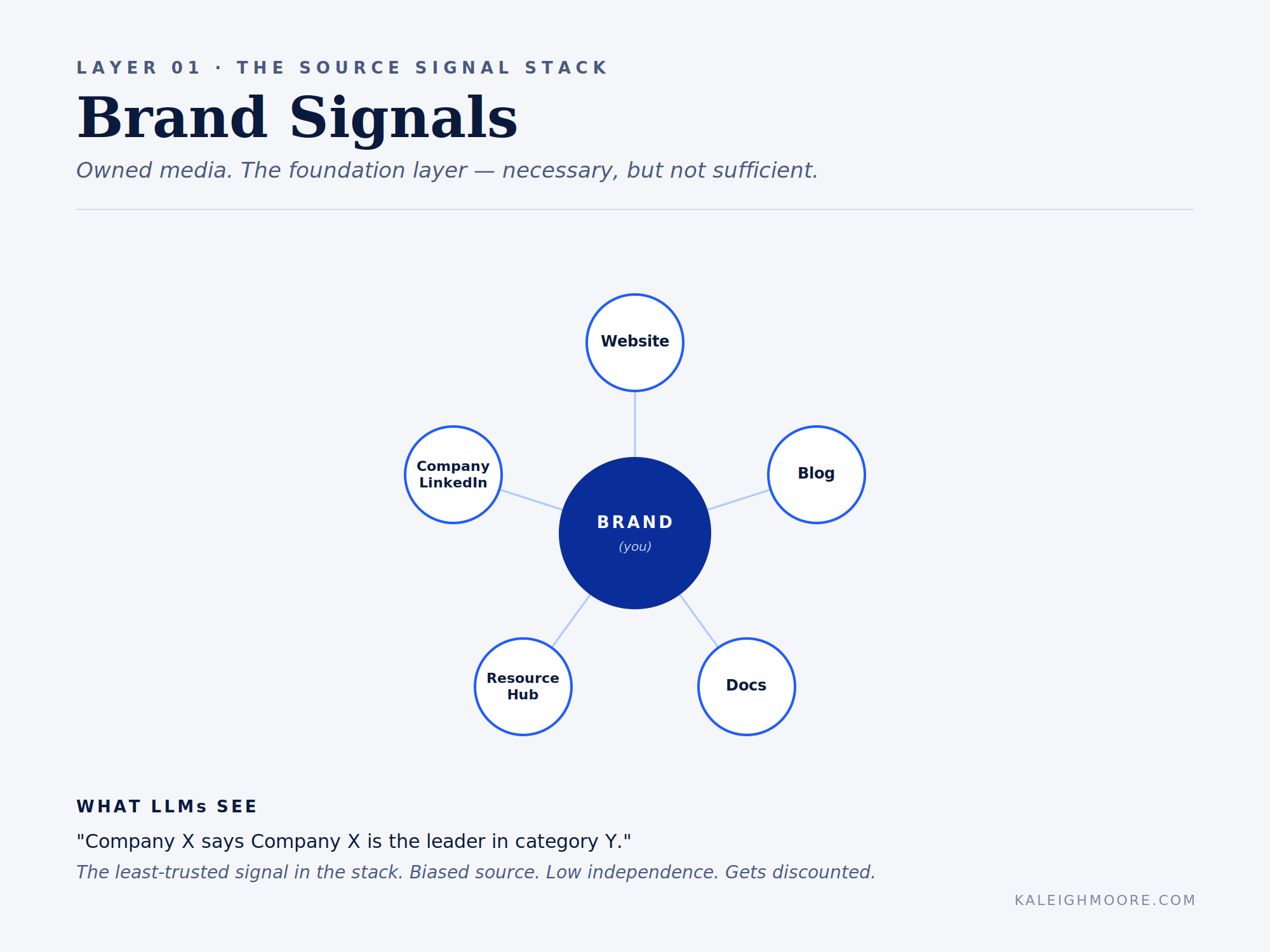
This is the foundation layer. Without Brand Signals, LLMs have no canonical definition of what your company is, what it does, or which topics it has any business being cited on. Stripe's documentation is probably the closest thing the B2B world has to a perfect Layer 1: it's so authoritative and well-structured that it shows up as a source in AI answers about payments, developer APIs, and fintech infrastructure because nothing else on the open web explains those topics with the same clarity, depth, and rigor.
That said, Layer 1 is also where most B2B content programs stop or get stuck. Two years of SEO blog posts with no author bylines, no named experts, no data that no other company has, no point of view anyone would remember…this is a content strategy that’s not going to do much for boosting your LLM citation rate.
The reason Layer 1 alone can't carry a citation program has to do with the structuring here: An LLM evaluating "Company X says Company X is the leader in category Y" bumps up against the same issue a human reader would: The source isn't neutral; it has an obvious stake in the claim.
LLMs discount self-referential brand content the same way an editor discounts a press release.
"Doing Layer 1 well" means getting the table stakes right: bylined authorship, consistent entity descriptions, clear category definitions, structured data, and cited sources/original research. Volume doesn't fix a quality problem; it amplifies it.
The test: if someone removed every instance of your company's name from your blog, would the remaining content still tell an LLM who you are and what you know? If the answer is no, you have a branding program, not an authority program.
Layer 2: Executive Signals
Executive Signals are the first human layer in the stack. Your CEO, founder, CMO, or chief product officer publishes under their own name across places like LinkedIn, op-eds, on podcasts, and at industry events.
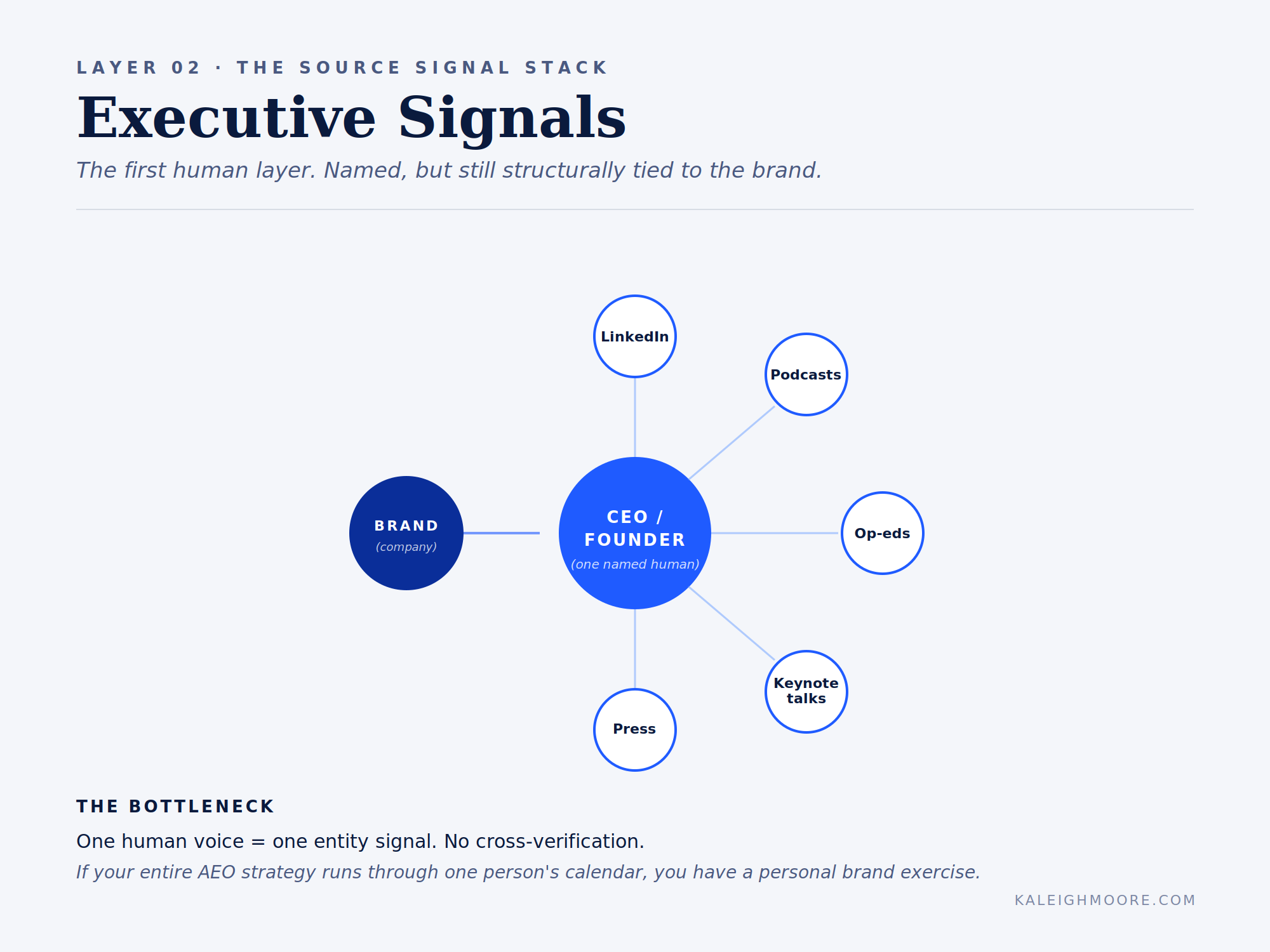
This layer matters because it gives LLMs something they can't get from Layer 1 alone: a named, identifiable human associated with your brand's topic areas. A well-run executive content program starts to build out a programmatic AEO approach around a real person who can be referenced, cited, and cross-verified independently of the company they work for. They become a source signal.
We see this in action with folks like Patrick Collison at Stripe, Des Traynor at Intercom, and Tobi Lütke at Shopify. By the time LLMs started synthesizing answers on topical expertise, those execs had already spent 10 years being recognized as named experts in their respective domains.
This is an important point about this layer: executives are still structurally aligned with the brand. An LLM's independence check treats a CEO saying the company is great roughly the same way it treats the company saying the company is great; they're related parties. Executive Signals are more trusted than Brand Signals because they're attached to a named human, but they are not fully independent.
This is consistent with the recent Profound analysis of 1.4 million AI citations, which found that on ChatGPT and Google AI Mode, 59% of cited LinkedIn content comes from individual members rather than company pages; a sharp tell that AI systems are weighting human-authored signal above brand-authored signal.
The common mistake at Layer 2 is that most B2B companies treat "our CEO has a LinkedIn presence" as evidence of a functioning thought leadership program. One person publishing once a week is a single-source signal with a single point of view (and no cross-verification.)
If an LLM has one human voice associated with your brand and that voice disappears (the exec leaves, takes a sabbatical, goes quiet), your graph for this work collapses back down to Layer 1.
Layer 3: SME Signals
Layer 3 is where the Source Signal Stack stops being a diagnosis and starts being an opportunity.
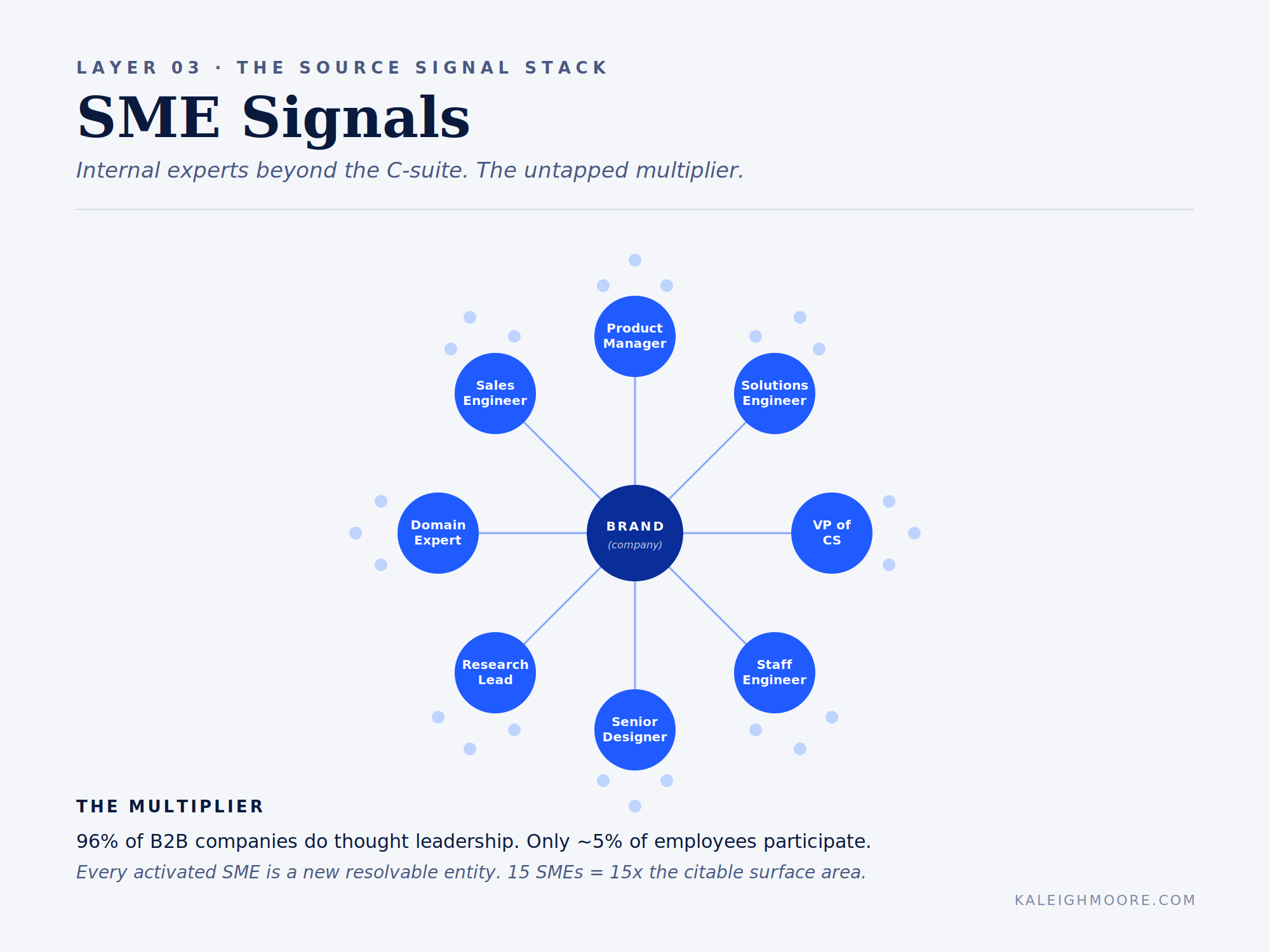
Subject Matter Expert (SME) Signals are the non-executive internal experts at your company (product managers, solutions engineers, senior customer success leaders, staff engineers, researchers, domain specialists) who are publishing original perspectives under their own names. This is the layer almost every B2B content program has left completely inactive.
Content Marketing Institute research shows that 96% of B2B companies create thought leadership content, but only 37% have employees with specialized knowledge contributing to those efforts. Of that 37%, fewer than 5% of the total employee roster is actually doing this type of work.
Most B2B companies have a content team, a CEO who occasionally publishes, and an organizational chart full of experts who are structurally invisible to AI. Those SMEs within your organization who aren't publicly sharing their expertise are untapped source signals.
Another 3-5 resolvable human experts associated with the company (each associated with the company's topic areas) are new, individual, and cross-verifiable signals for LLMs, each generating their own Layer 4 activity downstream. That’s a 4-6x increase around the company’s surface area of citable expertise.
Good SME content isn't hard to identify, either. It takes a few consistent shapes (which I will leave out, as these are core parts of my service offering…but if you’d like to hire me for this expertise-extraction work, we should chat).
What I will say: Each of these shapes produces content that LLMs can cross-verify, because each one attaches a specific, dateable, defensible claim to a named person with a verifiable track record.
This is also consistent with what SEMrush's study of 325,000 AI prompts found about which LinkedIn content gets cited: LinkedIn articles between 500 and 2,000 words account for 72–77% of AI citations, 95% of cited LinkedIn content is original (reshared posts almost never appear), and 75% of the LinkedIn authors whose content gets cited post at least five times per month.
AI rewards substantive, original, and consistent publishing from named experts, which is exactly the kind of output SMEs can generate when the editorial infrastructure is in place to support them.
The reason most companies don't execute Layer 3 is that their SMEs don’t have a ton of free time for this type of effort, and their content teams don't know how to extract this kind of material from experts who don't naturally write that way.
Pssst! I have a system for this, and it comes from a decade of writing for publications like Forbes and Vogue Business, where I had to find compelling hooks/new angles for stories. If this is something you're interested in learning, consider applying to join the cohort of marketers I'll be teaching how to do this over a 90-day sprint.
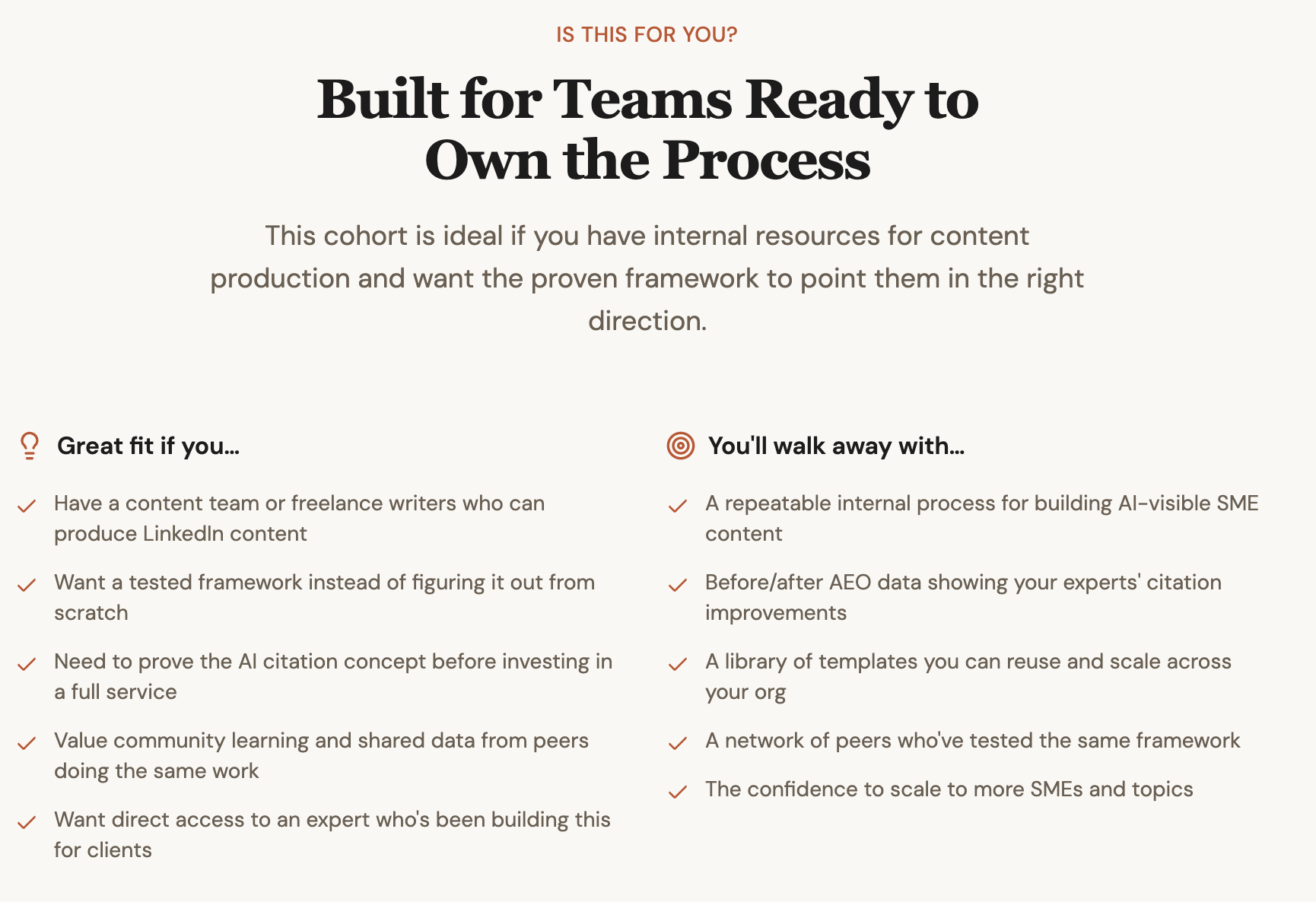
Applications close April 30, 2026.
The gap between "ghostwrite a blog post for the CEO" and "conduct an interview that surfaces a unique SME insight" is significant, and it's where most teams typically fall off. But every SME you activate at Layer 3 is a seed for Layer 4 (where the stack actually starts to compound).
Layer 4: Community Signals
Community Signals are the outermost ring of the stack: third-party podcast appearances, trade press quotes, Reddit threads referencing your people by name, Substack mentions, peer shoutouts on LinkedIn, panel citations, community Q&As, and independent research that quotes your SMEs.
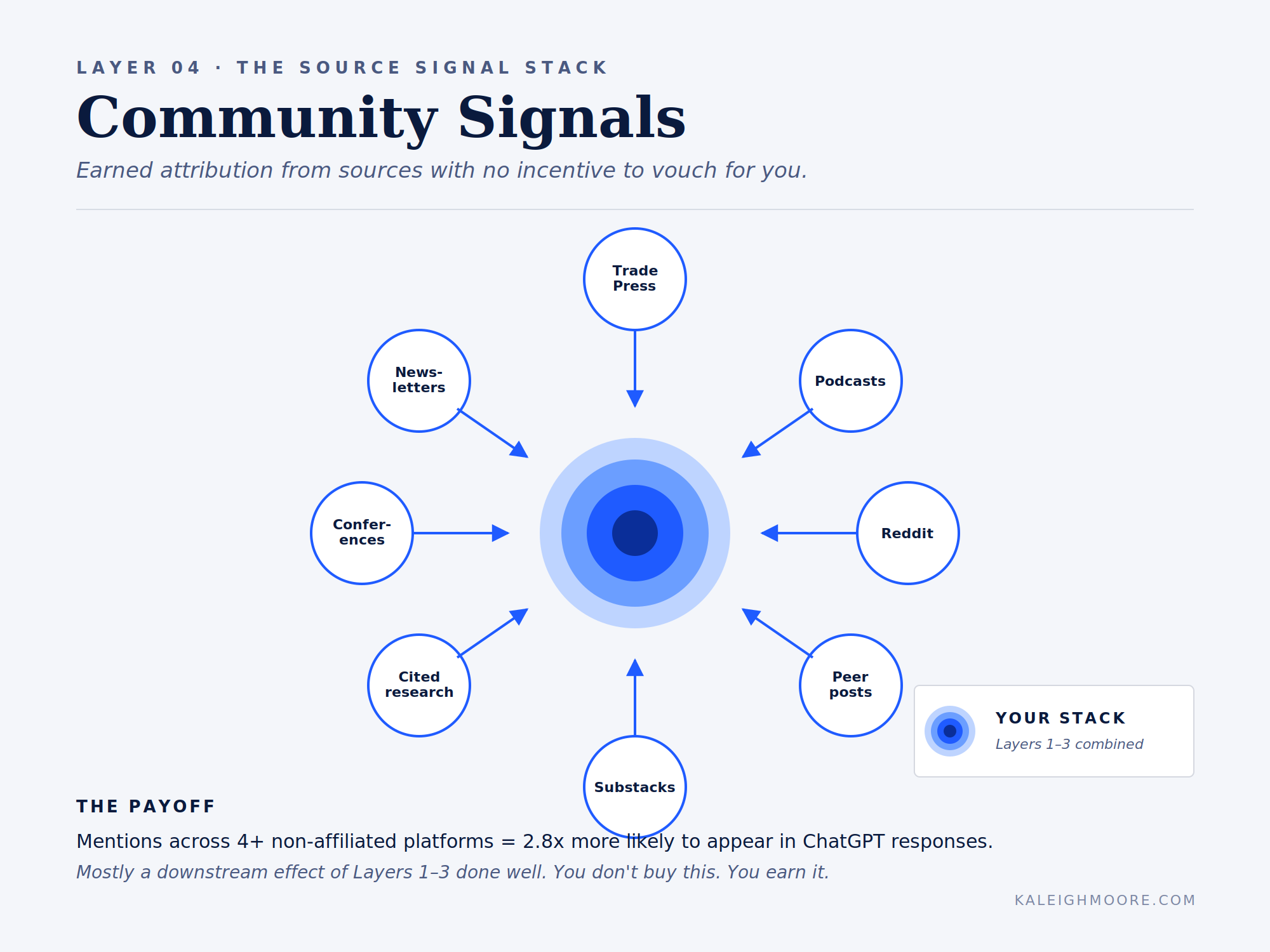
This is the most powerful layer in the stack, as none of these sources has an obvious incentive to vouch for your brand. The data is unambiguous here: DigitalBloom's 2025 AI Citation and LLM Visibility Report found that brands and people mentioned positively across four or more non-affiliated platforms are 2.8x more likely to appear in ChatGPT responses.
Muck Rack's analysis of AI-cited content also found that more than 85% of AI-cited links come from earned coverage, not owned content or paid placements.
The most important thing to understand about Layer 4, though, is that it is mostly a consequence of Layers 1 through 3 being done well. You don't buy your way into community signals; you build Layers 1, 2, and 3 until the industry starts citing you back.
A trade reporter quoting your VP of engineering in a story happens because that VP has been publicly sharing expertise at Layer 3 long enough to be findable.
A peer tagging your SME in their own LinkedIn post happens because that SME has made a reputation for a specific, defensible point of view.
A podcast booking your head of customer success happens because she's been publishing Layer 3 content that demonstrates she has something to say.
The common mistake at Layer 4 is treating it as a PR tactic. “Let's pitch a few trade publications this quarter" detached from the lower layers has a very low ceiling. You can spend a lot of money and still not move the citation needle because the lower layers aren't producing the material that the upper layers are supposed to amplify.
How the Source Signal Stack Compounds
The Source Signal Stack is multiplicative. Here’s what a single insight, moving through a properly built stack, looks like:
An SME publishes a contrarian take on LinkedIn under her own name.
A trade publication covers the idea and quotes her by name in the story.
Two peers reference the insight in their own LinkedIn posts, tagging her.
Her company blog publishes a bylined deep dive that expands the argument.
The CEO cites her framework in an external podcast appearance.
An industry newsletter references the framework a month later.
Someone on Reddit posts "I've been thinking about [Name]'s point about X" in a topical subreddit.
That's one insight generating seven independent source signals across all four layers, spread across at least five distinct platforms, attributed to a named human whose expertise AI can now cross-verify from multiple unrelated angles.
This is exactly what AI systems are looking for, and it's the reason a properly built stack will outperform a content program producing 5x the volume but entirely at Layer 1. Volume doesn't create citation-driving signals in the same way as independent, cross-verifiable attribution to named people does. The stack is the infrastructure that makes those signals inevitable rather than accidental.
Diagnostic: Which Layer Are You Weakest In?
You can run a rough version of this audit in fifteen minutes. It won't be precise, but it'll tell you which layer to prioritize.
Search your company name in ChatGPT and Perplexity. Does the answer describe your brand in the terms you'd use, or does it miss the category, misdescribe the product, or default to a generic summary? This is your Layer 1 check. A weak result means your owned content isn't producing a clean entity definition.
Search your CEO's or founder's name in the same tools. Do they appear as a named expert in your category? Are the topics AI associates with them the topics you'd want? This is your Layer 2 check. A weak result means your executive doesn't yet have an independent enough footprint to be citable.
Beyond the founder or CEO, can you name three internal SMEs an LLM could already identify as experts on your category? Search them. This is your Layer 3 check.
In the last 90 days, how many independent third parties (podcasts, trade publications, peer posts) have mentioned your experts by name? Not your company. Your people. This is your Layer 4 check.
If only one of those four returns a strong yes, you have a top-heavy stack.
That's the most common failure pattern in B2B: Layers 1 and 2 invested heavily, Layer 3 left thin, Layer 4 never materializing because the lower infrastructure isn't producing the people for the upper layer to amplify.
My 2026 Prediction: The Source Signal Stack Will Become The Emerging Methodology Across the AEO Landscape
The B2B brands that dominate AI search over the next 18 months will be the ones who figured out Layer 3 first (because Layer 3 is what makes Layer 4 inevitable, and the other two layers almost take care of themselves when Layers 3 and 4 are active).
This is also a window, and it's narrower than it looks.
Authority compounds. Once LLMs have anchored their entity graphs around a set of named humans at a competitor's company, the cost for your SMEs to displace them goes up significantly.
The cheapest moment to build this infrastructure is before your category's AI citation patterns harden—which, based on what I'm seeing, is happening faster in B2B than almost anyone expected.
The stack is the work. Join me, and figure out how to build yours.
FAQs on The Source Signal Stack AEO Framework
How is the Source Signal Stack different from a regular thought leadership program?
Most thought leadership programs in B2B are single-author programs in a trench coat. One executive, usually the CEO or founder, publishing on LinkedIn under their own name, supported by a ghostwriter and a content calendar. That's a Layer 2 program, and the stack treats it as exactly that — one layer of four.
The Source Signal Stack is built around the assumption that AI systems are cross-verifying signals across independent sources, which means a single named voice (no matter how prolific) is structurally limited in how much citation lift it can produce. The framework forces you to think about your content program as a portfolio of source types, not a publishing schedule.
Realistically, how many SMEs do I need to activate?
Three to five is the right starting target for most mid-market B2B companies. That's enough to give LLMs multiple independent human sources to cross-verify, enough to seed Layer 4 activity across different topic areas, and enough to survive the inevitable departures and sabbaticals that would collapse a single-executive program.
The mistake is trying to activate fifteen SMEs at once because more sounds better. It doesn't. Three SMEs publishing consistently for twelve months will outperform fifteen SMEs publishing inconsistently for three, every time. Citation infrastructure rewards depth over breadth, especially in the early innings.
What if my SMEs aren't natural writers?
Most of them aren't, and that's fine. The skill that matters here isn't writing; it's having a defensible point of view formed from real experience. The job of the content team (or an outside partner) is to extract that point of view through structured interviews, then translate it into the shapes LinkedIn rewards.
If your content team's only model for SME content is "send the SME a Google Doc and ask them to fill it in," you'll fail at Layer 3. If your model is "spend forty-five minutes with the SME, walk away with three to five insights they couldn't get anywhere else, then handle the production end," you'll succeed.
How long until we see citation rate improvements?
Plan for nine to twelve months before you see meaningful movement in citation rates across ChatGPT, Perplexity, Claude, and Google AI Mode, and assume the first six of those will feel like nothing is happening.
Entity graphs in LLMs don't update on the same timeline as Google's index. They update as new content gets ingested, cross-referenced, and weighted across multiple sources, which takes time even when you're doing everything right. The companies that win at AEO are the ones that started this work before they could measure it working.
Does the stack apply to B2C, or only B2B?
The framework is built for B2B because that's where named-expert citation is most undervalued and most leverageable. In B2C, brand signals tend to dominate AI answers in a way they don't in B2B, because consumer queries lean more toward product comparisons than expertise lookups.
That said, the underlying principle (LLMs trust independent, cross-verifiable, human-attributed sources more than brand-controlled ones) is true everywhere. B2C brands with high-consideration purchase cycles (financial services, healthcare, enterprise software-adjacent products) can absolutely apply the stack. B2C brands selling impulse purchases probably can't justify the investment.
How does this fit with our existing SEO program?
It doesn't replace it; it sits next to it and feeds the same content infrastructure into a different distribution surface.
A bylined SME deep dive on your blog earns SEO authority, attracts backlinks, and gets ingested by LLMs as a Layer 1 signal. The same SME's LinkedIn version of that argument earns Layer 3 citation weight. The trade publication that quotes the SME a month later earns Layer 4 weight. One piece of underlying expertise is producing returns across three distinct surfaces, and your SEO and AEO programs are both better off for it.
The companies in trouble are the ones treating SEO and AEO as competing budget lines. They're not. They're competing distribution strategies for the same source material.
Should our SMEs write their own posts, or should we ghostwrite for them?
Both, and the ratio matters. The strongest model I've seen is roughly 70/30: seventy percent of posts are produced through a structured extraction-and-editing process (effectively ghostwritten, but with the SME's voice, point of view, and approval), and thirty percent are written directly by the SME with light editing.
The fully ghostwritten model produces consistency at the cost of voice fidelity, which LLMs and humans both eventually notice. The fully self-written model produces voice fidelity at the cost of consistency, which kills the publishing cadence the stack requires. The hybrid is what actually compounds.
What happens to our stack if a key SME leaves the company?
This is the question that should keep you up at night if you've over-indexed on Layer 2. If your only named human source signal is the CEO and the CEO leaves, your stack collapses back to Layer 1 overnight.
The Layer 3 strategy is partly insurance against this. Three to five active SMEs means no single departure cratters the program, and the named-expert authority that walks out the door with a departing SME can be partially replaced by activating someone new. You don't get to keep the entity-graph weight that was attached to the departed SME, but you don't lose the whole program either.
Some companies handle this by structuring SME content so the company itself is also being established as a topical authority alongside the individual; that way, Layer 1 inherits some of the weight Layer 3 builds.
How do we pick which SMEs to activate first?
Three filters, in order. First, who has the most defensible, hard-to-replicate point of view based on actual experience? (Not "who's most senior" — seniority and unique perspective often diverge.) Second, who's at least open to the idea, even if they're not enthusiastic? (Forced participation produces forced content, which LLMs and audiences both ignore.) Third, whose topic areas align with the queries you actually want to be cited on?
The intersection of those three is usually a list of two or three people. Start there, prove the model works, then expand.
Is this just a LinkedIn play, or do we need to be on other platforms too?
LinkedIn is where the leverage is highest right now for B2B, which is why the piece focuses there. The Profound and SEMrush data both point to LinkedIn as a disproportionately weighted source for AI citations in B2B contexts.
But the stack is platform-agnostic at the framework level. Substack, industry-specific publications, podcast appearances, conference talks, and Reddit threads all generate signals that feed the same entity graph. LinkedIn is the highest-ROI starting point. It's not the ceiling.
What does "good" look like at the end of year one?
A defensible answer for a mid-market B2B company twelve months in: three to five SMEs with consistent publishing cadences (at least five posts per month each, per the SEMrush data on what gets cited), a measurable lift in branded and category-level citation rates across at least two LLMs, and the start of unprompted Layer 4 activity — trade press quotes, peer references, podcast bookings — that you didn't have to chase.
If you're getting all of that at month twelve, you're ahead of essentially every B2B company in your category. The bar is low because almost no one is doing this well yet. That's the window the prediction at the end of this piece is pointing at.