Why Your AI Content Sounds Like AI (+ How to Fix That)
If you’ve been hands-on with AI writing tools, you've probably hit that moment where the output feels…off.
It’s fine, but maybe it's too generic, too formal, or just doesn't sound like you. There’s a reason for that. AI tools don't magically absorb your brand's voice and personality the way a human writer would. They need LOTS OF CONTEXT.
Not just a quick prompting instruction like, “write in a tone that’s irreverent,” or “don’t use jargon.” It needs so much more than that if you want quality V1s that don’t require hours of editing.
Let’s get into what I’ve found produces the highest quality AI content. ⬇️
If you don’t have a brand voice/tone guide, start there.
A brand voice and tone guide is a must if you’re using AI tools.
If you don't have one, creating this doc should be your top priority.
If you do have one, consider tweaking it.
A brand voice and tone document for AI needs to be more explicit and example-heavy than what you'd create for human writers, including specific examples of what to do and what to avoid.
One practical approach: Create a "voice and tone snapshot" document specifically for AI use that distills your full guide into 2-3 pages, focusing on the most important pieces. I put together a full list of what to include in your brand voice and tone snapshot doc(so if you want that info, you can dive in.)
I will say this: The key is being hyper-specific.
Instead of the prompt "be conversational," show exactly what conversational looks like in your brand's context, with real before-and-after examples. The more concrete guidance you provide, the better AI can mirror your voice. From there, once you’ve uploaded those voice and tone guidance to an AI tool, don't just attach the PDF and call it done. Be sure to explicitly reference it in your prompts.
Try something like: "I've uploaded our brand voice and tone guide. Review it carefully, then draft a blog post about [topic] that adheres to these voice principles."
Create a library of examples
Beyond the style guide, nothing trains an AI tool better than showing it actual examples of your best work that demonstrate the standard you expect. Curate a library of 10-15 pieces of your strongest content across the formats you create: blog posts, landing pages, email campaigns, social media posts, etc.
Choose pieces that best showcase your brand voice and that performed well with your audience. The more relevant the example to the current task, the better the output.
Cheat code: If you don’t have a voice and tone guide already, you can use this step as a reverse-engineering process.
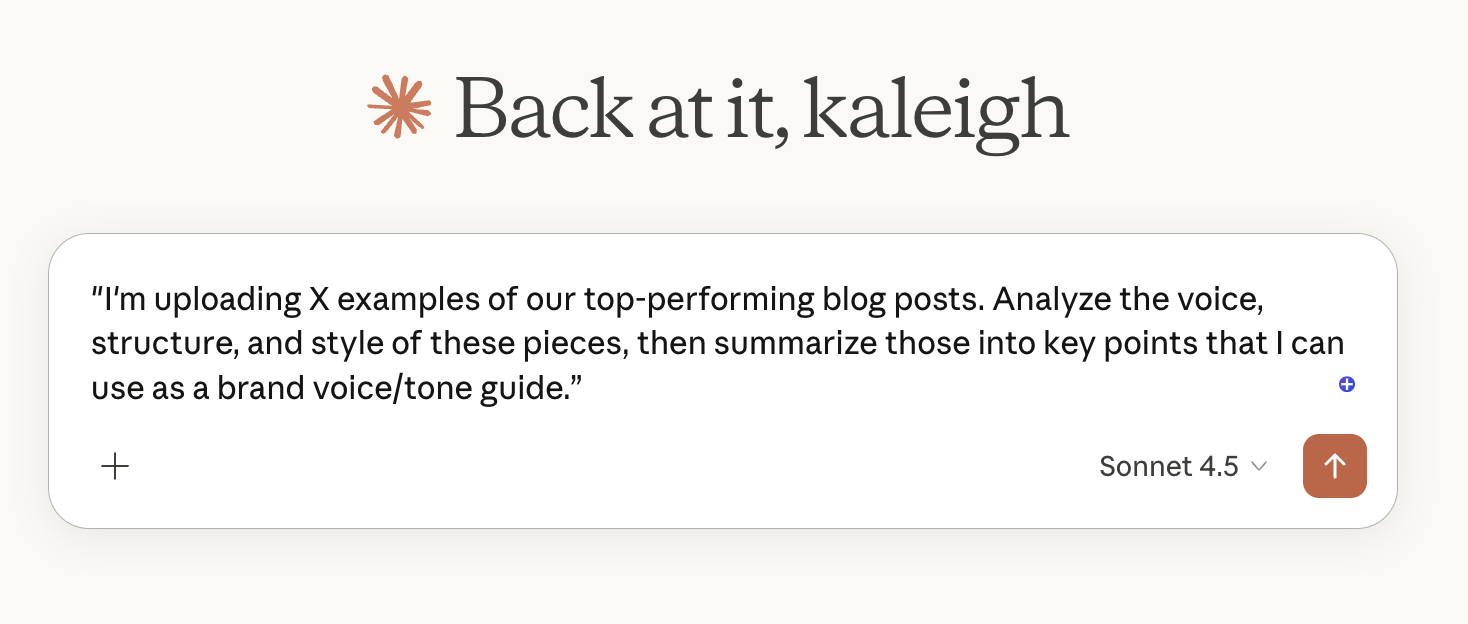
For example, you could use this prompt: "I'm uploading X examples of our top-performing blog posts. Analyze the voice, structure, and style of these pieces, then summarize those into key points that I can use as a brand voice/tone guide.”
You can also use examples to show progression. Upload a first draft and a final edited version, then ask the AI to note the differences. This helps it understand not just what good looks like, but the specific editorial choices your team makes.
For example, you could use this prompt: "Notice how the edited version removes passive voice and replaces generic transitions with more specific connectors? Apply those same editing principles to this draft."
Context is king
Context is everything when working with AI tools. The more background information you provide upfront, the less generic and more targeted your outputs will be.
Before asking for any content, provide detailed audience information. Don't just say "B2B marketers." Get specific with something like: "Mid-level marketing managers at enterprise SaaS companies with 500-5000 employees, who are responsible for content strategy but don't have large teams or budgets. They're technically savvy but not developers."
From there, share your competitive landscape by including 2-3 competitor articles on similar topics, and explain what you want to do differently.
Example: "Competitor A takes a very technical approach. Competitor B oversimplifies. We want to land in the middle; accessible but substantive."
Share internal knowledge, too. Stuff like relevant product documentation, customer research, case study data, or subject matter expert interviews. The more proprietary information you can provide, the more differentiated your content outputs will be.
It’s not one-and-done
As your brand evolves, your content standards shift, and AI capabilities improve, your AI training approach needs to evolve, too. So what’s your system for maintaining those AI training materials? Because they can’t be static, one-and-done docs you create once and then never touch again.
Update your content examples library monthly with new top performers.
Revise your brand guidelines when you notice the AI consistently missing new voice elements.
Make sure your product info/brand positioning/target personas are updated as those evolve quarter-to-quarter.
Document your most effective prompts.
If your objective is to use AI tools to put out a higher volume of content each month, this work is necessary for quality control…otherwise, you’re going to either put out a bunch of AI slop or spend a lot of time editing each individual piece of writing it kicks out.
AI content writing tools ARE genuinely useful, producing strong first drafts that need only light editing rather than complete rewrites. BUT ONLY IF THEY HAVE ALL THE NECESSARY CONTEXT.