
What to Include in Your Brand Kit (So Tools Like AirOps and Claude Can Write In Your Brand Voice)
A brand voice and tone guide is a must if you’re using AI tools, especially ones like AirOps.
If you don't have one, creating this doc should be priority number one.
If you do have one, consider tweaking it. A brand voice and tone document for AI needs to be more explicit and example-heavy than what you'd create for human writers.
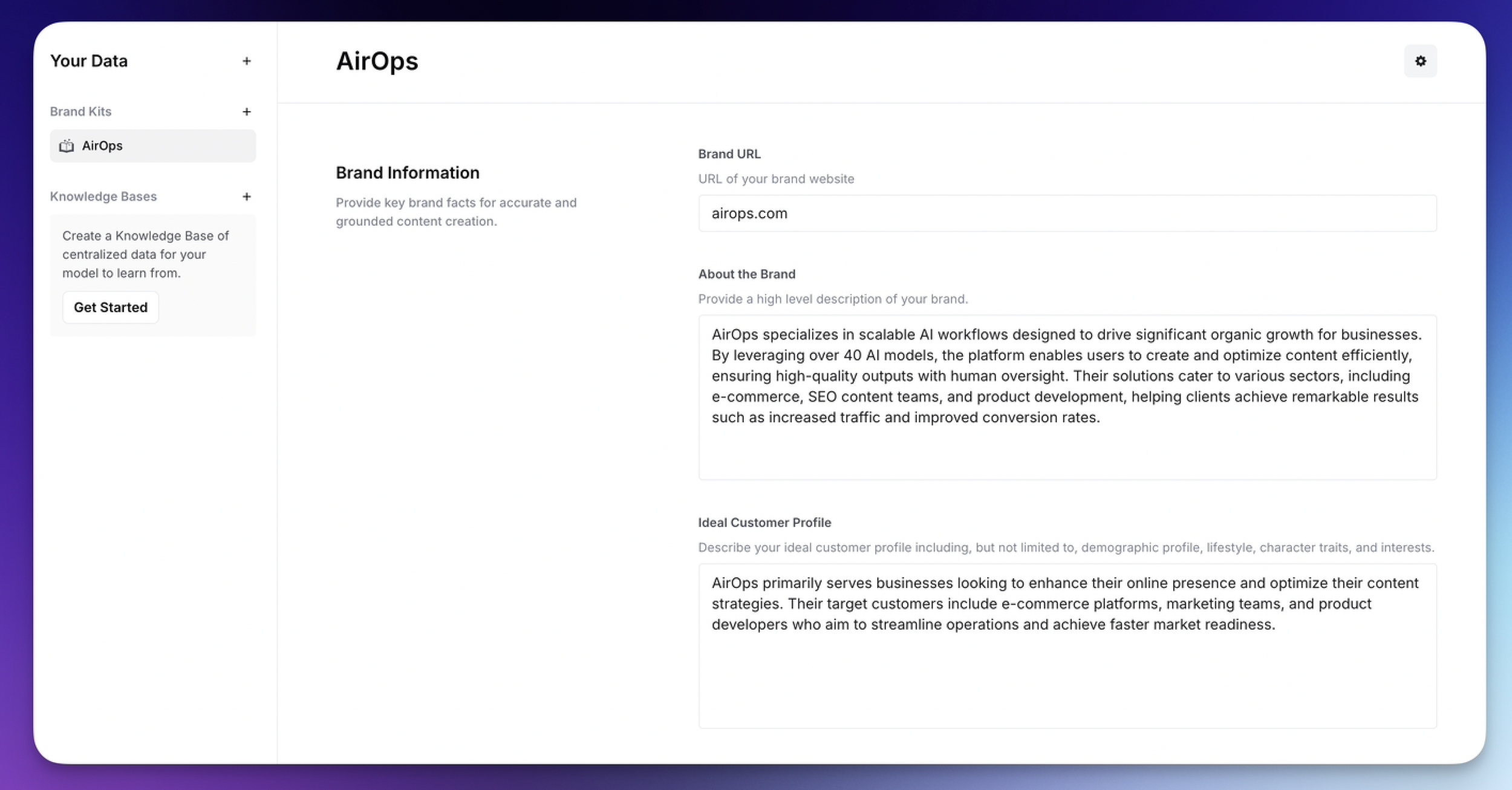
A practical approach: Create a "voice and tone snapshot" document specifically for AI use that distills your full guide into 2-3 pages of the most critical, actionable elements. This becomes your go-to reference document for every AI writing session.
Here’s everything I’d recommend including in this kind of document.
Core voice attributes with definitions
Don't just list adjectives like "conversational" or "authoritative." Define what those mean for your brand:
"Conversational means we write like we're explaining something to a colleague over coffee, not like we're presenting to a board of directors"
"Authoritative means we cite specific data and real examples, not vague claims"
Your brand's personality
If your brand were a person, who would they be? Are they the helpful expert, the irreverent challenger, the empathetic guide? Give the AI a persona to embody.
Do This, Not That Examples
This is the most critical section. AI learns best from concrete examples showing the difference between on-brand and off-brand writing.
Word choice examples
We say "helps you" not "enables you to"
We say "complicated" not "complex"
We say "figure out" not "ascertain"
Words we avoid: leverage, synergy, utilize, paradigm shift, best-in-class
Sentence structure examples
✅ "You can automate this in three simple steps."
❌ "Automation of this process can be achieved through a three-step methodology."
Tone examples for different contexts
When explaining technical concepts: [show 2-3 sentence example]
When addressing pain points: [show 2-3 sentence example]
When making a sales pitch: [show 2-3 sentence example]
Sentence length and structure
Average sentence length: 15-20 words
Use short sentences for emphasis. Like this.
Avoid sentences longer than 25 words unless absolutely necessary
Punctuation and formatting preferences
We use em dashes—like this—not parenthicals (like this)
We use contractions (don't, can't, you'll)
We use Oxford commas
We bold for emphasis, not italics
We use sentence case for headers, not title case
Themes we care about
List 5-10 themes your brand consistently returns to.
For a SaaS brand, it might be: "We believe marketing should be data-driven, not gut-driven" or "We think most software is unnecessarily complicated."
Our point of view on industry debates
Where does your brand stand on controversial topics in your space? This helps AI write with conviction rather than fence-sitting.
Language guidelines
We use "they/them" as singular pronouns
We say "sales rep" not "salesman"
We say "staffed by" not "manned by"
Industry jargon policy
Jargon we embrace: [list terms with brief definitions]
Jargon we avoid: [list terms with why we avoid them]
How we handle unavoidable jargon: define it on first use, use analogies
Abbreviations and acronyms
We spell out on first mention: Search Engine Optimization (SEO)
Exception: Terms we assume readers know (URL, API, CRM)
Content structure preferences
Start with a hook (question, surprising stat, or provocative statement)
Get to the point in the first 100 words
Use subheadings every 200-300 words
Include at least one specific example per major point
End with a clear takeaway, not a generic conclusion
How we use examples
We prefer real company names over "Company X"
We use specific numbers ($47K, not "significant revenue")
We include context (why this example matters)
How we handle CTAs
Natural integration vs. hard sell
Where they appear in content
Language we use
What we never do
Be explicit about hard boundaries:
Never write in first-person plural ("we at [Company]") in blog content
Never use exclamation points except in quotes
Never start sentences with "So," or "Well,"
Never use buzzword phrases like "in today's digital landscape"
Never include generic inspirational quotes
Never use sports or war metaphors
Comparison examples
The most powerful training tool: Show 2-3 full paragraphs written in different styles, labeled as:
✅ This is our voice
❌ Too formal/corporate
❌ Too casual/unprofessional
❌ Too technical/dense
This gives AI a reference point for calibration.
Audience Context
Who we're writing for: Demographics, role, experience level, pain points, what they care about, what they're skeptical of.
What our readers already know: List assumed knowledge so AI doesn't over-explain basic concepts or under-explain complex ones.
What our readers need: Tactical advice vs. strategic thinking, step-by-step instructions vs. frameworks, specific tools vs. general principles.
The TL;DR on Brand Kits for AI Tools
AI tools are great at being the “sponge” that can soak up information and then put it to work. The key is being hyper-specific with this type of editorial guidance.
Instead of "be conversational," show exactly what conversational looks like in your brand's context with real before/after examples. The more concrete guidance you provide, the better AI can mirror your voice.