5 Things Content Marketers & SEOs Should Stop Doing in 2026
Search has changed in 2026 = maybe the most “duh” statement I’ve ever written here. At OpenAI's DevDay on September 29, Sam Altman said ChatGPT now reaches 1.2 billion people every week. That's up from 900 million in February and 400 million in early 2025 (so…it tripled in about 18 months.)
And on Google, we know clicks on links in search results are shrinking, too. When Pew Research tracked the real browsing behavior of 900 U.S. adults, people who saw an AI Overview clicked a traditional search result on just 8% of visits. Without one? 15%. That's nearly half the clicks, just…gone.
We are officially in the zero-click content era, so here are five things SEOs need to stop doing in 2026, and what to do instead. (This was a reader question, by the way!)
1. Stop building around keywords and start building around buyer questions.
People don't talk to AI the way they type into Google. Semrush's analysis of 80 million clickstream records found the average ChatGPT prompt runs 23 words long. That's not a keyword. That's a context-rich query for a user trying to answer a niche question.
These long, conversational stuff are exactly what triggers Google AI Overviews: Pew Research found just 8% of one or two-word searches produced an AI Overview, but 53% of searches with 10+ words did, and so did 60% of searches starting with "who," "what," "when" or "why.”
When an AI tool gives a user an answer to his/her question it will factor in the user's context and try to deliver an answer tailored to that exact use case, pulling from recent data, expert voices, and niche recommendations.
For the nerds who care: Behind the scenes, we know AI tools like ChatGPT break a prompt into multiple sub-searches (called "fan-outs".) The more specific the question gets, the harder it is for a broad, generic page to match. This is why niche content is valuable, if not high-volume traffic-drivers.
I recently asked Claude how it decides on an answer, and it said:
"By drawing on knowledge learned during training plus whatever is in the conversation, and when that isn't enough, by using tools like web search to find and cite current sources. That means brands show up in AI answers either by being well represented across credible sources in training data or by publishing clear, quotable content that gets retrieved during a real-time search."
Translation: Scattered posts chasing low-density keywords won't win you an AI citation. One deep cluster of content covering the core questions, the terminology, and the products around your offering? That's ripe for it. And yes, keywords still matter for research. They're just not the whole strategy anymore.
2. Worry less about traffic. Start tracking AI visibility, citations, and brand mentions.
I know, I know. Traffic is the number content marketers and SEOs have always reported. But look at what's happening to it.
Ahrefs studied 300,000 keywords and found that when an AI Overview shows up, the #1 ranking page now gets a 58% lower clickthrough rate. In their words, for every 100 clicks a top-ranking page used to earn, Google now keeps 58. If you're still grading your content program on sessions alone, you're grading it on a shrinking pie.
Here's the thing, though: when an AI answer names your brand and nobody clicks, that still counts. It shapes who people trust, and it shapes what they search for next. So measure it:
Do you show up in AI answers for your key buyer questions?
Are you cited as a source (with a link), or just mentioned?
Is your branded search growing?
My advice for this work is: pick one engine and lean in. Each answer engine has its own taste in sources, so one strategy won't master them all.
How different are they? A study of 22.7 million citations across ChatGPT, Gemini, Perplexity, AI Overviews and AI Mode (January to June 2026) found that 79.6% of the websites cited for a given question showed up on only one of the five engines. ChatGPT is a smart default given its reach, so experiment there, and expand once you know what works.
3. Start refreshing and consolidating what you already have.
Most sites don't need more content. They need better content: updated, improved in quality, and expanded in scope.
The data backs this up in a big way. Seer Interactive looked at 7,683 pages cited by ChatGPT, Gemini and Perplexity between March and June 2026, and 75% of them had been updated in the last year.
But here's the twist: among the pages the models cited most heavily, 75% were updated in the last year while only 40% were actually published that recently. More than a quarter of the "fresh" pages were first published over two years ago. They earned their spot by being maintained.
Open your content library and find the pieces that are already performing and driving traffic. Then improve them:
Update the stats.
Sharpen the answers (lead with the answer, then explain).
Add an FAQ section at the end.
Tie in some third-party expertise.
Merge thin, overlapping posts into one stronger page.
It's cheaper and faster to work with content that's already proven itself than to start from a blank page.
4. Start earning mentions where AI actually looks.
AI doesn't just read your blog; it pulls from Reddit, LinkedIn, review sites, podcasts, YouTube, and industry publications. If your own site is the only place saying your company is great, that's a weak signal.
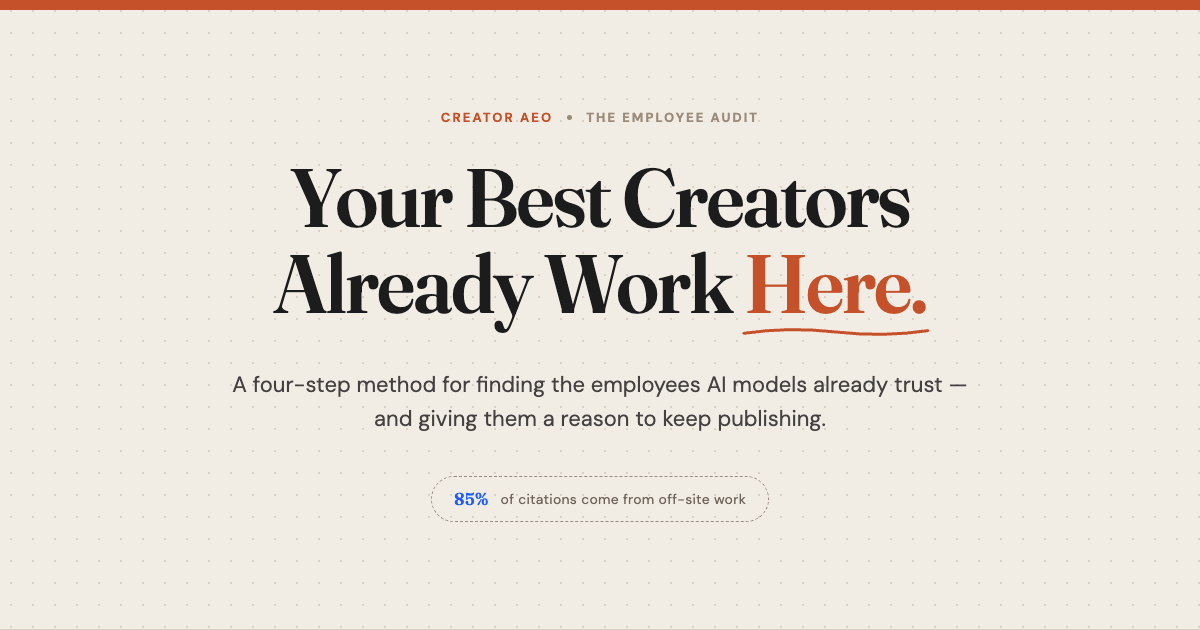
And the numbers here are kind of staggering. AirOps analyzed 21,311 brand mentions across ChatGPT, Claude and Perplexity for top-of-funnel commercial queries and found 85% came from third-party sources.
Brands were 6.5x more likely to be surfaced through someone else's content than their own, and nearly 90% of those third-party mentions came from listicles, comparisons, or reviews.
Seer's freshness study found something similar from a different angle: across the pages AI cited in their dataset, brands own only about 2% of them. The other 98% belongs to someone else.
Even on Google, Pew found Wikipedia, YouTube and Reddit were the three most-linked sources in AI Overviews, together making up 15% of all cited sources.
So…do this:
Get quoted in press and trade publications.
Show up in community threads (and actually add value).
Go on podcasts.
Ask happy customers for reviews on sites.
Get your employees posting wins and lessons learned on their personal LinkedIn pages.
Work with customer creators who'll show how they use your product on YouTube.
Find the "best X for Y" listicles in your category and earn a spot on them.
Your off-site reputation is SEO now.
5. Start publishing first-party data and original insights.
AI can write a generic guide in seconds, so if yours says what the top ten results already say, there's nothing uniquely valuable that would make an AI tool (or a human!) cite you.
There's actual research on what does move the needle. In the paper that coined "Generative Engine Optimization," researchers from Princeton, Georgia Tech and IIT Delhi tested different content changes and found that adding statistics, quotations from relevant sources, and data boosted a page's visibility in AI-generated answers by up to 40%. Old-school keyword stuffing, meanwhile, did little to nothing.
If statistics and quotable insights are what get you cited, the most valuable stats are the ones only you have.
My advice: publish what can't be copied.
Your data.
Your survey results.
Your case studies.
Your opinions, especially the ones people push back on.
That's what makes you citable, and interesting enough to be worth reading in the first place.
FAQs about Content Marketing and SEO in the AEO Era
Is SEO dead in 2026?
No. SEO still matters, but it now includes AI-visibility work: getting your brand cited and mentioned in answers from tools like ChatGPT, Gemini, Perplexity, and Google's AI Overviews, not just ranking in traditional results.
What is the "zero-click" content era?
It's the shift where people get answers directly from AI tools or AI Overviews without clicking through to a website. Pew Research found that users who saw an AI Overview clicked a traditional search result on only 8% of visits, compared with 15% when no Overview appeared.
Should I stop doing keyword research?
No. Keywords are still useful for research, but they shouldn't be your whole strategy. AI prompts are much longer and more conversational than search queries (Semrush found the average ChatGPT prompt is about 23 words), so build content around the specific questions your buyers ask instead.
What are "fan-outs," and why do they matter?
Fan-outs are the multiple sub-searches an AI tool runs behind the scenes when it breaks down a single prompt. The more specific a question is, the harder it is for a broad, generic page to match, which is why deep, niche content clusters tend to earn more AI citations.
If traffic is declining, what should I measure instead?
Track AI visibility alongside traffic. Check whether you appear in AI answers for your key buyer questions, whether you're cited with a link or just mentioned, and whether your branded search volume is growing. A brand mention in an AI answer still builds trust even if no one clicks.
Which AI engine should I optimize for first?
Pick one and start there; ChatGPT is a sensible default given its reach of roughly 1.2 billion weekly users. Each engine favors different sources, and one study of 22.7 million citations found that about 80% of sites cited for a given question appeared on only one of the five engines studied.
Is it better to publish new content or update existing content?
In most cases, update what you already have. Seer Interactive found that 75% of pages cited by major AI tools had been updated within the past year, even though many were originally published years earlier. Refresh stats, lead with clear answers, add FAQs, include outside expertise, and merge thin or overlapping posts.
Why do third-party mentions matter so much for AI search?
Because AI tools mostly cite sources other than your own site. AirOps found that 85% of brand mentions in AI answers to top-of-funnel commercial queries came from third-party sources, mostly listicles, comparisons, and reviews. Press coverage, podcasts, community threads, reviews, employee LinkedIn posts, and creator content all strengthen that signal.
What kind of content is most likely to get cited by AI?
Original content that can't be found elsewhere. Research behind the term "Generative Engine Optimization" found that adding statistics, quotations, and data boosted AI visibility by up to 40%, while keyword stuffing did little. Your own data, survey results, case studies, and strong opinions make you the most citable.