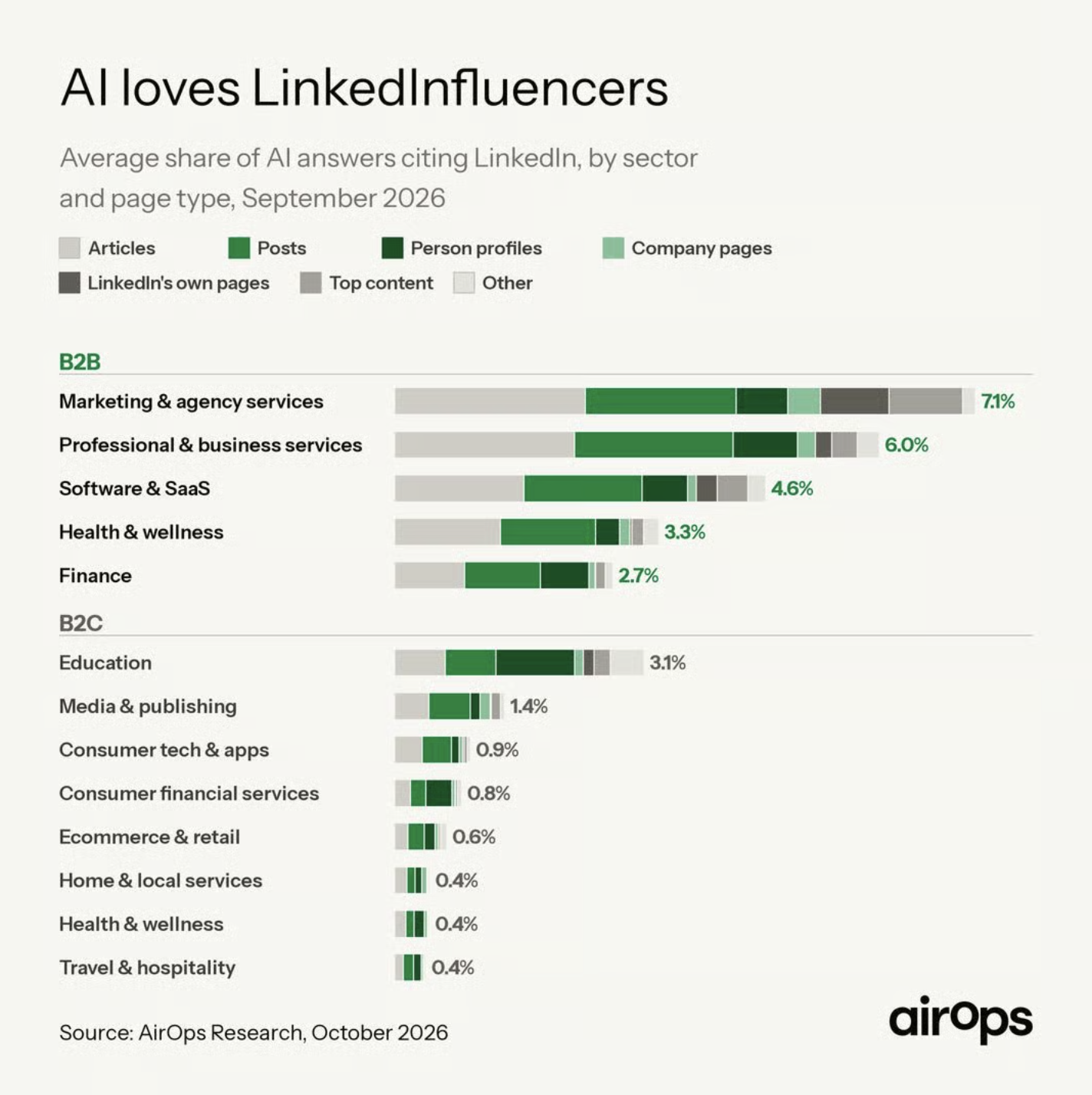
There's a growing body of evidence that further validates that LinkedIn is an important source of information for AI search. New (Sep-Oct 2026) data from AirOps shows that AI tools cite LinkedIn approximately 4x as often in B2B answers as in B2C answers.
The standout is in the marketing and agency services category, where LinkedIn appears in 7.1% of AI answers. Professional services follow at 6%, with software and SaaS at 4.6%. For comparison, most consumer-facing categories see LinkedIn cited in fewer than 1% of answers.
Here’s what you should take from this finding if you, too, work in B2B.
B2B AI answers are looking for expertise, not just people
AirOps found that LinkedIn articles and posts account for two-thirds or more of the LinkedIn pages cited in B2B AI answers. AI tools appear to be retrieving professional knowledge from there: explanations, educational content, industry commentary, and substantive posts about specific topics.
This is important for marketers trying to figure out where LinkedIn fits into their AI visibility strategy, as it shows expertise-driven (human!) content from professionals with deep knowledge is being pulled into AI answers around B2B questions.
This is something I've been arguing for a while. In May, I wrote about how B2B creators on LinkedIn can help companies establish the independent, named-human expertise that AI search systems need when resolving entities and deciding which sources to surface.
The underlying idea: A company can publish all the educational content it wants on its own website and company pages, but that doesn't necessarily establish the same kind of credibility as having identifiable experts independently discussing those subjects in public (on a platform like LinkedIn.) The AirOps findings add another piece of evidence to that argument.
If AI systems are regularly pulling professional information from LinkedIn when answering B2B questions, the people publishing useful, substantive information on that platform become an increasingly important part of a brand's broader visibility strategy.
The employee-versus-creator question gets more interesting
For B2B brands, this creates two distinct opportunities.
The first is activating internal employees’ expertise.
Most companies have expertise-rich employees who know their category inside and out: product leaders, engineers, consultants, customer success teams, researchers, and executives. These people have firsthand knowledge that a corporate marketing department often struggles to replicate.
When they publish thoughtful explanations, original observations, and informed commentary under their own names, they're creating another source of professional information associated with the brand's area of expertise.
This doesn't mean turning every employee into a corporate influencer.
In fact, I'd argue the opposite. The most useful employee content is often the content that doesn't sound like marketing. It's someone explaining a complicated industry problem, sharing what they're seeing in the field, or offering a perspective that could only come from doing the work.
The second opportunity is partnering with external B2B creators.
Not every company has internal subject matter experts who are willing, available, or equipped to publish consistently. Some have excellent technical talent but no appetite for public visibility. Others operate in categories where an independent voice already has more credibility and reach than the brand itself.
That's where creator partnerships come in. I argued in June that LinkedIn's growing investment in B2B creators was more than an advertising development. Its investments in creator sponsorships, Thought Leader Ads, and creator monetization infrastructure suggested a platform increasingly interested in making individual expertise more visible and commercially valuable.
There's a strategic connection here, too.
Internal experts contribute professional knowledge under their own names.
External creators bring established audiences, independent perspectives, and existing recognition within a particular niche.
Both can contribute to the broader body of information AI systems encounter when researching a category.
What B2B brands should do with this information
I don't think the AirOps findings suggest companies should abandon their existing content programs and redirect their entire AEO budgets toward LinkedIn. They do suggest that the definition of an AI visibility strategy needs to expand.
A few things are worth prioritizing:
1. Give internal experts a publishing infrastructure.
Don't just tell employees to post more. Identify the people with genuine subject matter expertise, establish a sustainable publishing cadence, and give them the editorial support to turn their knowledge into useful content.
2. Build relationships with external B2B creators.
Look beyond follower counts. Prioritize people with a defensible point of view, a relevant professional audience, and a history of publishing consistently about your category. Think longer-term partnerships rather than isolated sponsored posts.
3. Invest in evergreen educational content.
The age of cited content is a reminder that evergreen content is a good investment. Develop explainers, original research, technical commentary, and substantive articles that will still be relevant six or twelve months from now.
4. Measure citations, not just engagement.
Track which LinkedIn URLs appear in AI answers for the prompts that matter to your business. Identify the authors, content formats, topics, and platforms associated with those citations. Don't assume that high engagement means high AI visibility.
5. Don't make LinkedIn your entire strategy.
Your LinkedIn program should complement your owned content, third-party coverage, community participation, and broader authority-building efforts.
The bottom line: AI visibility is becoming a human opportunity
AI systems are assembling answers from an increasingly broad range of sources, and the AirOps data suggests that professional knowledge published on LinkedIn is an important part of that ecosystem.
The opportunity here is to give the people who genuinely understand your category a reason, a platform, and the editorial freedom to contribute to the conversation.