AI Search & AEO Salaries: What AI Search Roles Pay in 2026
Back in July, I wrote about the first 50-ish AI search roles I'd tracked down. The big takeaway then: companies already had started treating AI search as a real, permanent job function and were putting real hiring budget behind it.
Since then, I've kept going. Every week I hand-review new listings for the AI Search Jobs board, and the board has since carried 191 roles in total. As of this week, there are 84 open roles across 75 different companies. That's finally enough data to start answering the questions that flooded my inbox after the July post. (And there were a LOT of them.)
Mostly, people wanted to know three things:
What does this work actually pay?
Can I do it remotely, or do I need to be in SF or NYC?
What skills do I need to get hired for one of these roles?
So I turned the insights from the board into a live hiring report that answers those with real numbers (and it updates itself every week.) Here’s what I’ve gleaned from the data so far.
AEO jobs salary ranges: $119,500 to $167,500
For AEO jobs or roles in the AI search space I’ve found, $119,500-167,500 USD is the median published salary range (94 listings, open and closed). Many job postings didn’t have a salary range listed, but some did. The levels of seniority for these roles vary, so here’s a more contextual look at the median midpoint of each range, based on title:
Director & above: ~$185,000
Lead, principal & senior: ~$156,050
Manager: ~$128,000
Specialist & associate: ~$93,750
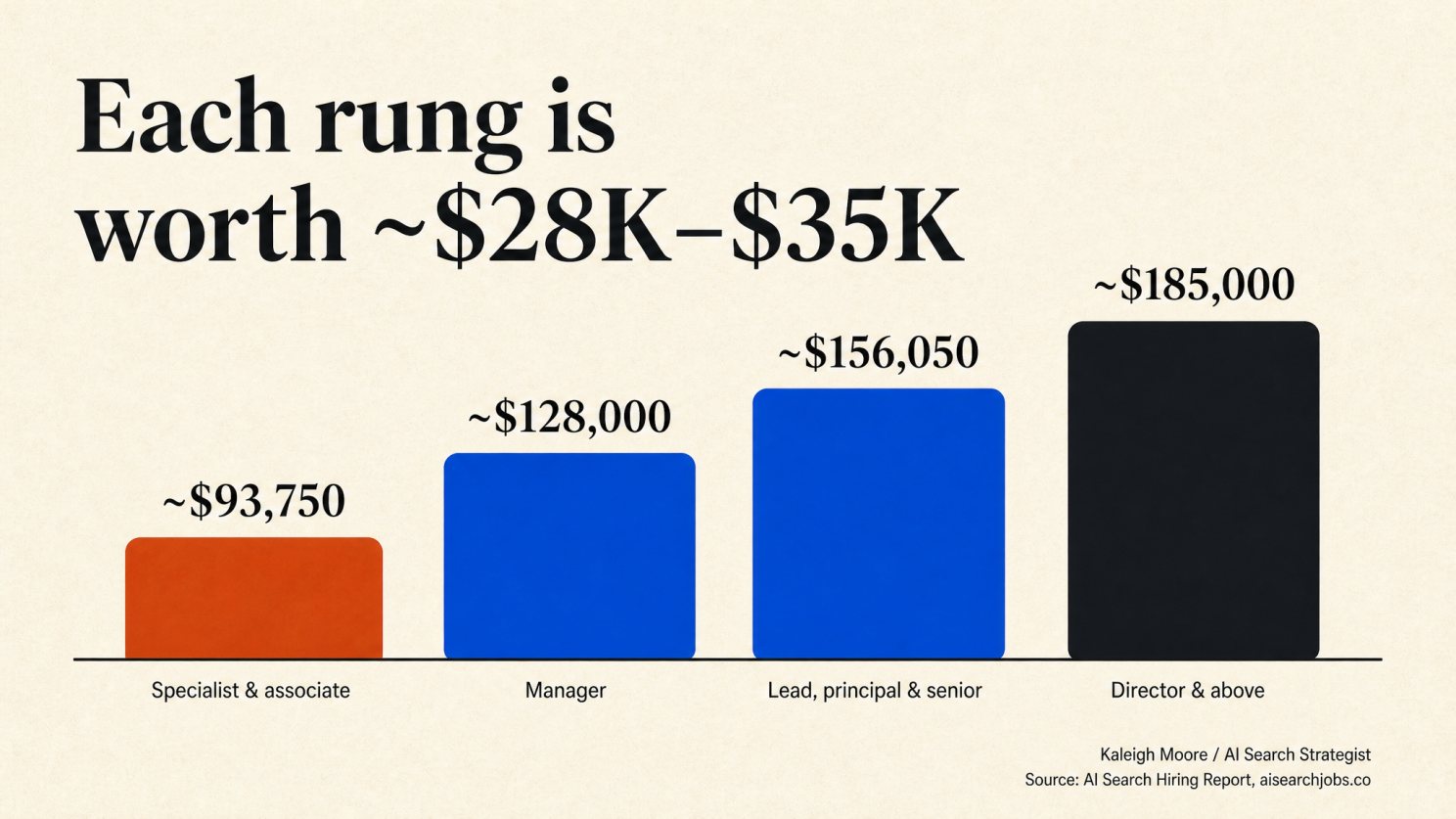
The steps between tiers are fairly even: roughly $28K to $35K between each rung. Going from manager to senior is worth about as much as going from senior to director, and almost all of these roles are above six figures, which I think is promising as a very new marketing role on the scene.
But the medians hide a huge amount of spread. The manager band alone runs from $62,800 to $250,000. Senior roles go from $53,500 to $314,000. That's...a lot of range for one title. Two people with the "AEO Manager" title listed on their LinkedIn profiles can be doing wildly different jobs at wildly different companies (and have very different annual salaries.)
What the top of the AI search job market looks like
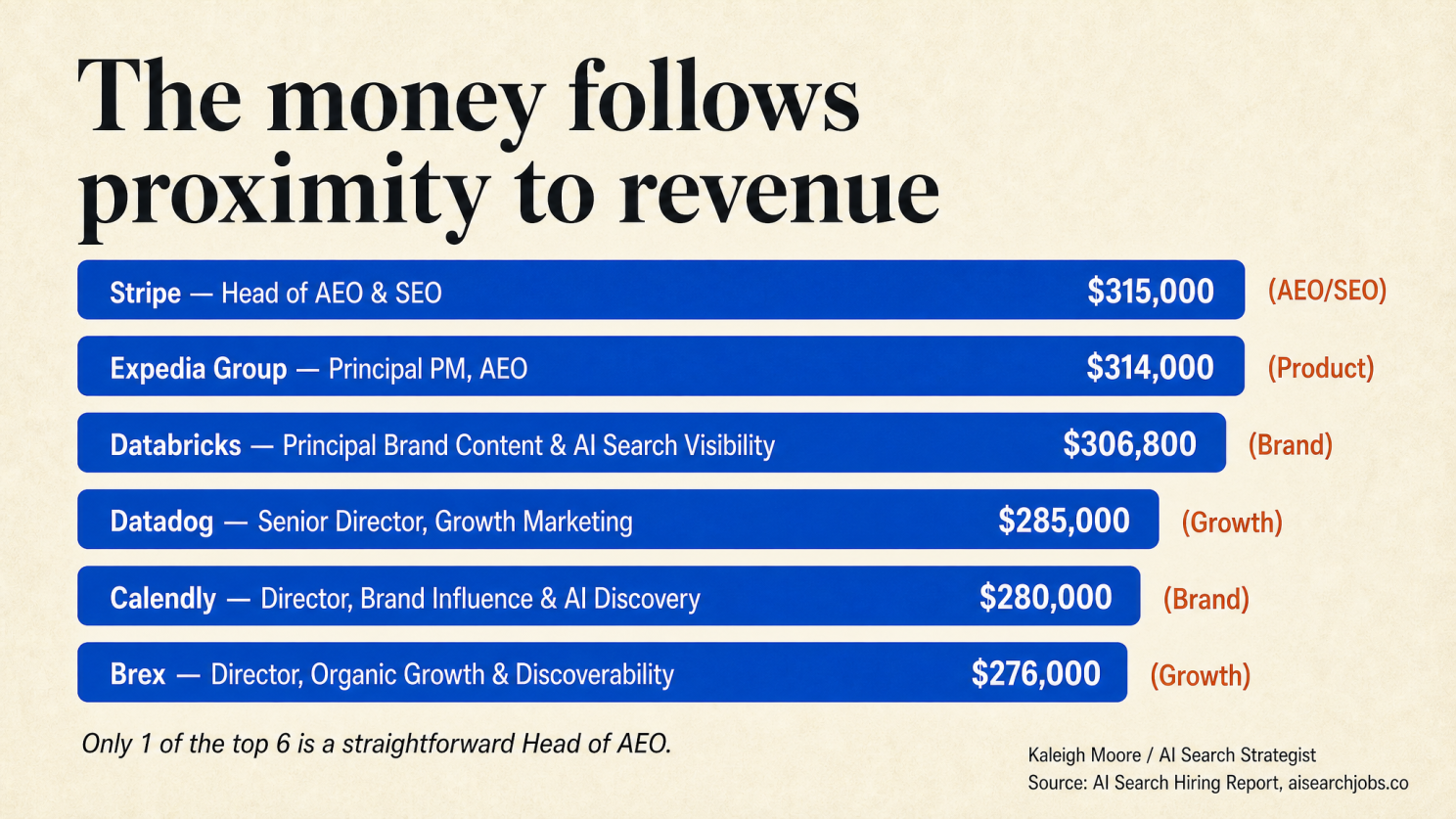
Here are the highest published ranges on the board as of this week:
Principal Product Manager, AEO (Expedia Group): $224,000–314,000
Principal Brand Content & AI Search Visibility (Databricks): $223,100–306,800
Head of AEO & SEO (Stripe): $210,000–315,000
Senior Director, Growth Marketing – Organic Growth (Datadog): $214,000–285,000
Director, Organic Growth & Discoverability (Brex): $220,000–276,000
Director, Brand Influence, Advocacy & AI Discovery (Calendly): $205,000–280,000
Now look at the titles instead of the numbers: Only one of the six is a straightforward "Head of AEO" role. The rest are a product manager, a brand content lead, two growth leaders, and a brand influence and advocacy director.
This emerging role is going beyond the marketing department and is still living under a few different teams’ umbrellas. It's attached to product at Expedia, to brand at Databricks and Calendly, and to growth at Datadog and Brex. (Personally, I’ve seen this too; I’ve been hired for AEO consulting work by a Head of Growth, SEO leads, CMOs, and Heads of PR/Communications. This work is still all over the map!)
My read (and this is my opinion, not something the data proves outright): the money follows proximity to revenue and to the product. If you want to hit those top-of-market numbers, the path probably isn't "become the world's best AEO specialist." It's "become the person who connects AI visibility to a business outcome that someone very senior cares about." It’s still shaking out, and I don’t think anyone is certain about where this role will ultimately live. In fact, it may be a whole new department, or a net-new senior IC role. We’ll see.
Salaries for AEO roles are still largely unlisted
Only 58% of AI search roles publish a salary. It makes sense: it’s a brand new role, and it’s almost too early to know how much bottom-line impact a role like this can have on the business long-term.
This is honestly the main reason I pulled together this report: If you're interviewing for one of the roles that doesn't list pay, you now have a benchmark for your level. Use that information as a frame of reference.
If you’re interviewing for an AEO role with no salary listed:
Ask for the range in the first screen, not after the third round. You've earned the right to know before you invest hours in a take-home project.
Reference the benchmark. "I’ve seen data that shows median published midpoint for senior AI search roles is about $156K. Is this role in that neighborhood?" is a perfectly reasonable question to ask a recruiter.
And if you're the one hiring: publishing your range is a cheap advantage. In a talent market this small, I'd bet the listing that shows its pay gets the better, more motivated candidates.
AEO roles often are location-based, not remote
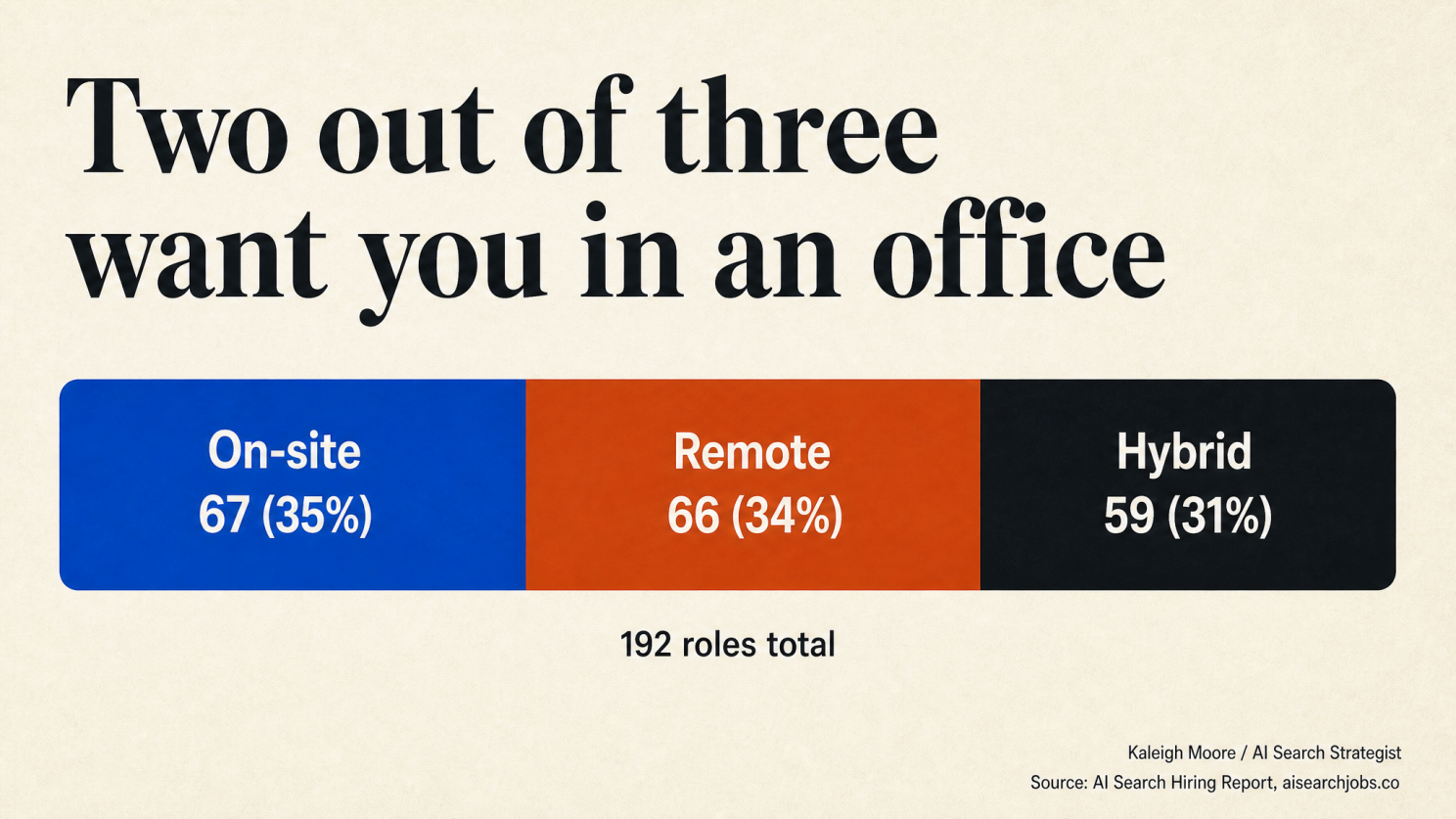
Here's the work-model breakdown for all 192 roles posted on the board since launch:
On-site: 67 roles (35%)
Remote: 66 roles (34%)
Hybrid: 59 roles (31%)
I'll be honest: I expected remote to run away with this. Content and SEO have been remote-friendly for years, and I assumed a brand-new, digitally-native discipline would follow suit. But, nope! It's close to an even three-way split, and two out of three roles want you in an office at least part of the week.
My theory (and it's just a theory): these roles sit at the intersection of a LOT of teams. SEO, content, brand, comms, product, and sometimes the exec team. When a company is standing up a brand-new function that has to pull all of those people together, they want that person in the room, at least for now.
Where AI search jobs are located
For the 140 roles with a listed city, here's what I found on where AI search jobs are based from (roles listing several cities count toward each one):
New York: 52
San Francisco Bay Area: 30
London: 9
Chicago and Los Angeles: 7 each
Atlanta, Austin, and Boston: 4 each
Seattle, Phoenix, Berlin, and Miami/Orlando: 3 each
I wasn’t shocked by NYC and SF having the highest demand; most roles I see on social media in anything AI-related are based out of one city or the other. This is where these companies are building, events are happening, and capital is flowing, so it makes sense most of these roles want boots on the ground in one of these major hubs.
I think this may change over time and eventually become more remote-friendly, but for now, I think many teams are building and growing so fast they want the convenience of an on-site team.
What level of experience is expected for full-time AI search jobs?
112 of the 192 AEO roles (58%) sit in the manager-to-senior middle tier. Only 18 (9%) are specialist or associate level, and there are almost twice as many director-and-above roles as entry-level ones.
Here's the seniority mix across all 192 roles I've tracked since launch:
Director & above: 33
Lead, principal & senior: 57
Manager: 55
Specialist & associate: 18
Other: 29
What I take from this is that AEO is a role that requires a decent amount of past experience, thrives with autonomy, and that has pretty high expectations. You don’t hire a senior-level employee and expect novice-level outcomes.
If you pursue one of these roles, it seems safe to say you’ll be expected to produce ROI on your salary and will report directly to leadership.
80% of AEO roles still want SEO experience
Eight in 10 AI search job listings still ask for SEO experience, so if you're looking for the adjacent seat to grow from, SEO appears to be the closest one.
That said, almost all of these roles (9 out of 10) also ask for some variation on the language around building AI visibility, whether they call it AEO, GEO, AI search, or something else.
To me, that means they want someone who:
Has been hands-on with AEO reporting tools/software + understands how to use it
Has experimented with what helps a brand show up in AI answers, and can show a body of work around wins, success, or early traction
Grasps the inter-departmental work required to drive AI visibility
Knows the metrics, terminology, and is up-to-date on experimental tactics and what’s working in this new arena of search
One more practical note hiding in those numbers: only about half the listings say "AEO," and fewer than half say "GEO." If you're only searching job boards for those three letters, you're missing a big chunk of the market.
Try "AI search," "AI visibility," "discoverability," and "organic growth," too. (Several of the six highest-paying roles above wouldn't show up in an "AEO" search at all.)
Again, all the language for these roles is brand new. We still haven’t agreed on what to call it!
Key Takeaways: AI search job tips for job hunters and companies hiring
I’ve heard from quite a few people this year who worked in SEO or content marketing that they’re feeling the squeeze, have been laid off, or they’re looking to pivot into where marketing is going next. I think AI search is here to stay, and it’s a safe bet as you think about what to focus on next professionally.
If you're job hunting for an AI search role:
Start learning the basics of building a brand’s visibility AI search if you haven’t yet. (May I suggest my YouTube channel as a resource?)
Widen your job search terms beyond "AEO" so you don’t miss out on these roles when they’re called something else.
Decide honestly how flexible you are on location, because right now they may require relocation depending on where you live
Start building a body of work around AI visibility and be able to talk about results produced if you apply to one of these roles
If you're hiring for an AI search role:
Publish your salary range. More than four in 10 of your competitors don't, so it's an easy way to stand out and attract top talent.
Consider offering a remote option or a short-term contract to start. With 44% of roles requiring on-site work, a remote option widens your candidate pool overnight.
Pay to the market. If your senior offer lands well below $156K, you’re going to lose out on the candidates who can help do this work well, but expect to be paid well for it.
Post your job listing on AIsearchjobs.co to get in front of a highly relevant audience :)
The AI Search Hiring Report updates every week straight from the live board, so these numbers will keep moving with the market. Bookmark it, share it with the friend who keeps asking you about this stuff, and feel free to cite it. And as always, new roles hit the AI Search Jobs board every Monday.
Frequently asked questions about AI search jobs
How much do AI search (AEO) jobs pay?
The median published salary range for AI search and AEO roles is $119,500 to $167,500. That figure comes from 94 job listings with posted pay on the AI Search Jobs board. Almost all of these roles pay over six figures.
What’s the salary for an AEO manager vs. a senior or director role?
These are the median midpoints by seniority:
Director and above: about $185,000
Lead, principal, and senior: about $156,050
Manager: about $128,000
Specialist and associate: about $93,750
Pay varies widely within each title. Manager roles range from $62,800 to $250,000.
What are the highest-paying AI search jobs?
The top published ranges include Principal Product Manager, AEO at Expedia Group ($224,000 to $314,000) and Head of AEO & SEO at Stripe ($210,000 to $315,000). Most of the best-paid roles sit in product, brand, or growth teams rather than in traditional marketing.
Are AI search jobs remote?
Mostly not. About a third are remote (34%). The rest are on-site (35%) or hybrid (31%), so two out of three roles expect you in an office at least part of the week.
Where are most AI search jobs located?
New York leads with 52 roles, followed by the San Francisco Bay Area with 30. London, Chicago, and Los Angeles come next. Atlanta, Austin, and Boston each have a handful.
Do I need SEO experience to get an AI search job?
Usually, yes. 80% of AI search job listings ask for SEO experience, and about 90% also ask for experience building visibility in AI answers, under names like AEO, GEO, or AI search.
Are there entry-level AEO jobs?
Very few. Only 9% of roles are specialist or associate level. Most (58%) are manager to senior level, and there are almost twice as many director-level roles as entry-level ones.
What job titles should I search for besides “AEO”?
Only about half of listings use “AEO,” and fewer than half use “GEO.” You should also search for “AI search,” “AI visibility,” “discoverability,” and “organic growth.” Several of the highest-paying roles don’t mention AEO at all.
What if a job listing doesn’t include a salary?
Only 58% of AI search roles publish pay. Ask for the range in your first recruiter screen, and use the benchmarks above for your level. For example, senior roles have a median midpoint around $156K.