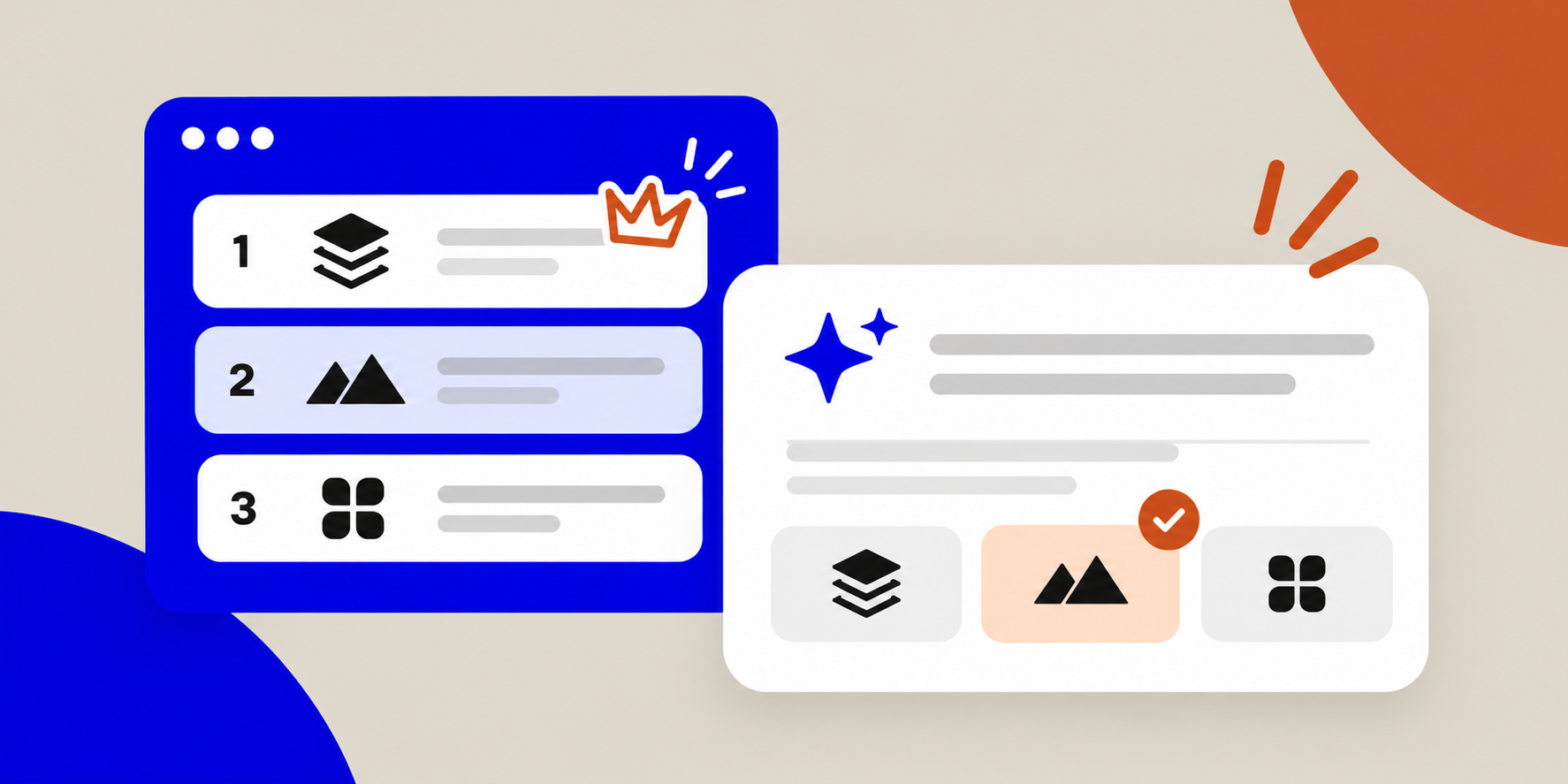
If you work in software, you've probably seen plenty of listicles in 2026. Stuff like "Best Email Marketing Software in 2026 for Small Teams." And typically, the company authoring said listicle conveniently ranks themselves as #1.
It's an old SEO tactic, and now these pages have another purpose: convincing ChatGPT, Gemini, and other AI tools that the company publishing the list deserves the top recommendation. But does it work?
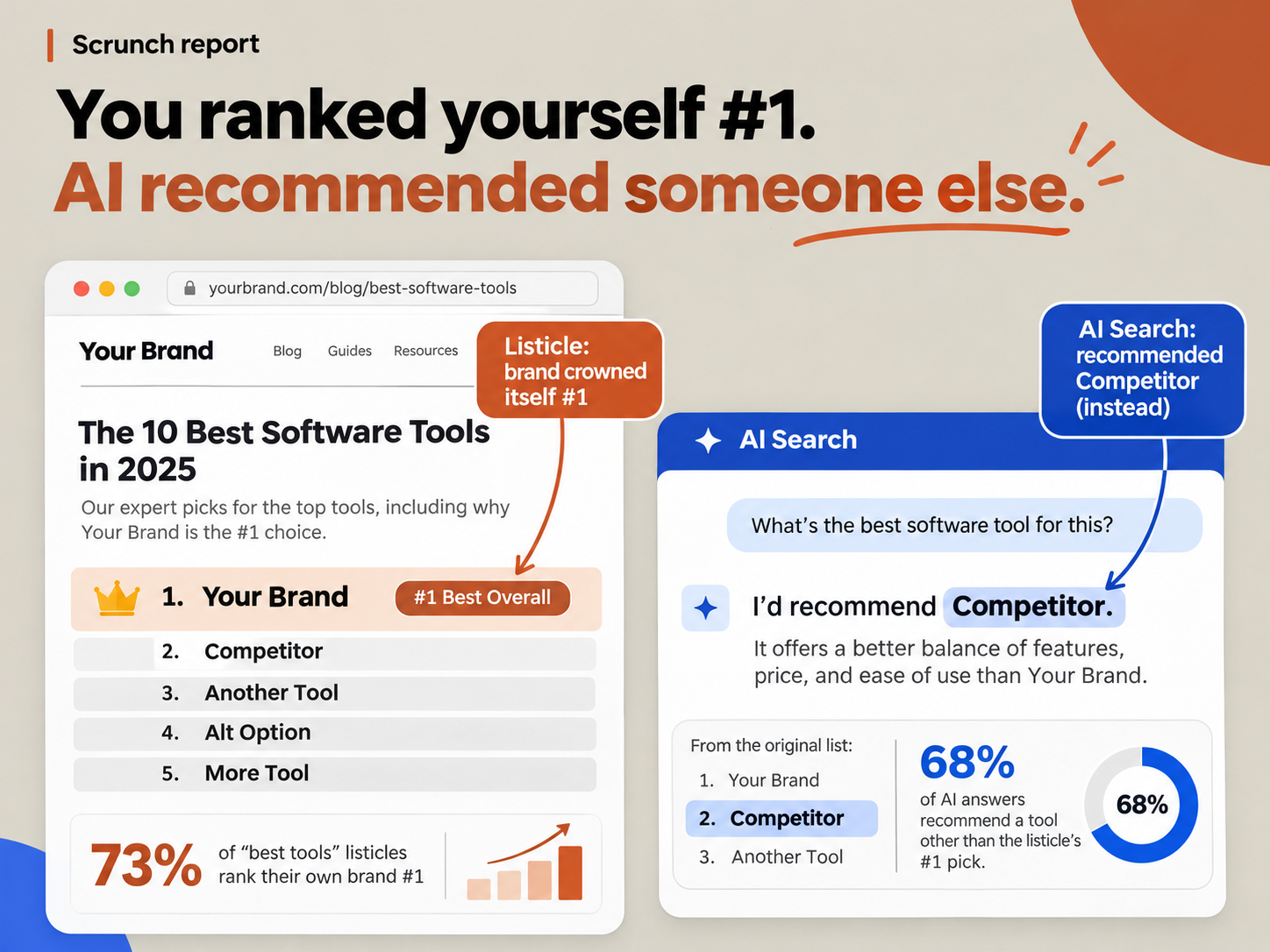
New research from Scrunch looked at about 10,000 AI-cited URLs between May and June 2026 and found that of the nearly 8,000 pages researchers could classify, roughly 30% of those comparison pages were self-promotional listicles where a company ranked itself #1. Yeesh.
Does cited mean recommended?
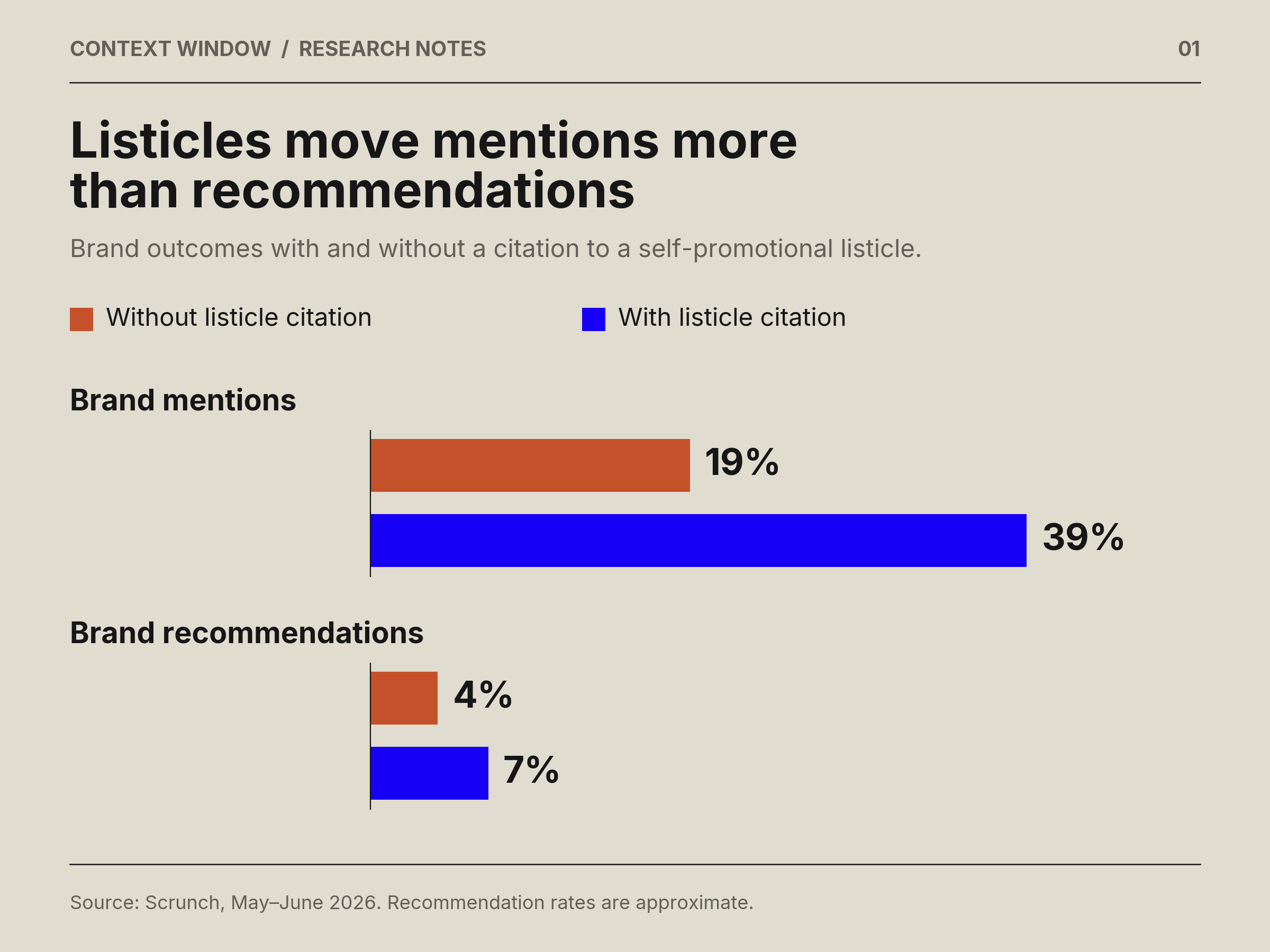
These listicles appear much more effective at getting brands into the conversation than convincing AI to recommend them. Scrunch found that in 63.9% of responses citing these listicles, AI didn't adopt the publishing company's #1 claim as a recommendation. Instead, when AI cited a brand's self-promotional listicle, the likelihood of that brand being recommended increased from approximately 4% to 7% (small, but not nothing!) Meanwhile, brand mentions increased from 19% to 39%.
The takeaway: Getting cited and getting recommended by AI are two very different outcomes.
Consider three outcomes of what can happen in an AI answer:
Citation: AI links to your company's comparison article.
Mention: AI names your product as one of several options.
Recommendation: AI tells the user your product is the best fit for their needs.
All three count as visibility, but if your goal is to influence buying decisions, that third outcome is arguably the most important. A growing citation count doesn't necessarily mean AI is making a stronger case for your brand.
Your listicle might actually recommend your competitor
In 24.3% of answers citing a company's self-promotional listicle, AI recommended a competitor instead of the publishing brand.
Imagine writing an article explaining why your product is the best option, getting cited by ChatGPT, and watching it recommend somebody else. SEO researcher Lily Ray documented a similar pattern in June 2026. She analyzed 100 B2B software queries across Google AI Overviews and found that when a self-promotional listicle was cited, the publishing brand was left out of the recommendations 69% of the time.
In an October follow-up, she reported:
Google AI Overviews cited 38% fewer self-promotional listicles in September compared with June.
The publishing brand was excluded from recommendations 83% of the time.
The studies use different samples and methodologies, so their percentages aren't directly comparable. But they highlight the same problem: AI can cite your content without agreeing with your conclusions.
The same listicle can work for one brand and fail for another
John-Henry Scherck and Camden Gaspar also explored this topic in their article, Our Approach to Buyer's Guides & Featuring Competitors in Content.
Their argument is that the effectiveness of self-promotional comparison content depends heavily on how established a company already is and whether the broader information available about the company supports its claim to be the best.
I think that's an important distinction. Publishing the right content doesn't automatically make you an authority in your category.
The reverse can also be true: An established brand might earn recommendations with or without its self-promotional listicle because other sources already support its position. For emerging brands, this means buyer's guides can still be useful for traditional SEO, educating customers, and explaining category positioning…but expecting one article to overcome a much larger competitor's established reputation is probably unrealistic.
Brand reputation impact of “we’re #1” listicles
Another piece of this conversation that doesn't get enough attention: What happens when a real person lands on your self-promotional listicle? Mic King, founder of iPullRank, offered a memorable perspective:
"It's a tactic that has worked off and on, but is that really how you want your brand to be perceived? Personally, whenever I come across one of those when I'm looking to buy something I scan the list then look at the logo on the top and bounce from the page and go look for another option."
I think that's a fair criticism. We're spending so much time trying to influence AI-generated answers that we're sometimes overlooking how these tactics affect the people making purchasing decisions.
If a buyer sees that the company publishing an article has ranked itself #1, they might question the credibility of the entire comparison.
Your website can't be the only source making the case for your brand
Scrunch found that among AI answers citing self-promotional listicles, 43.4% also cited a competitor's website.
This highlights a weakness in relying primarily on on-site content: Companies are investing heavily in what they say about themselves, but AI is pulling information from across the wider web.
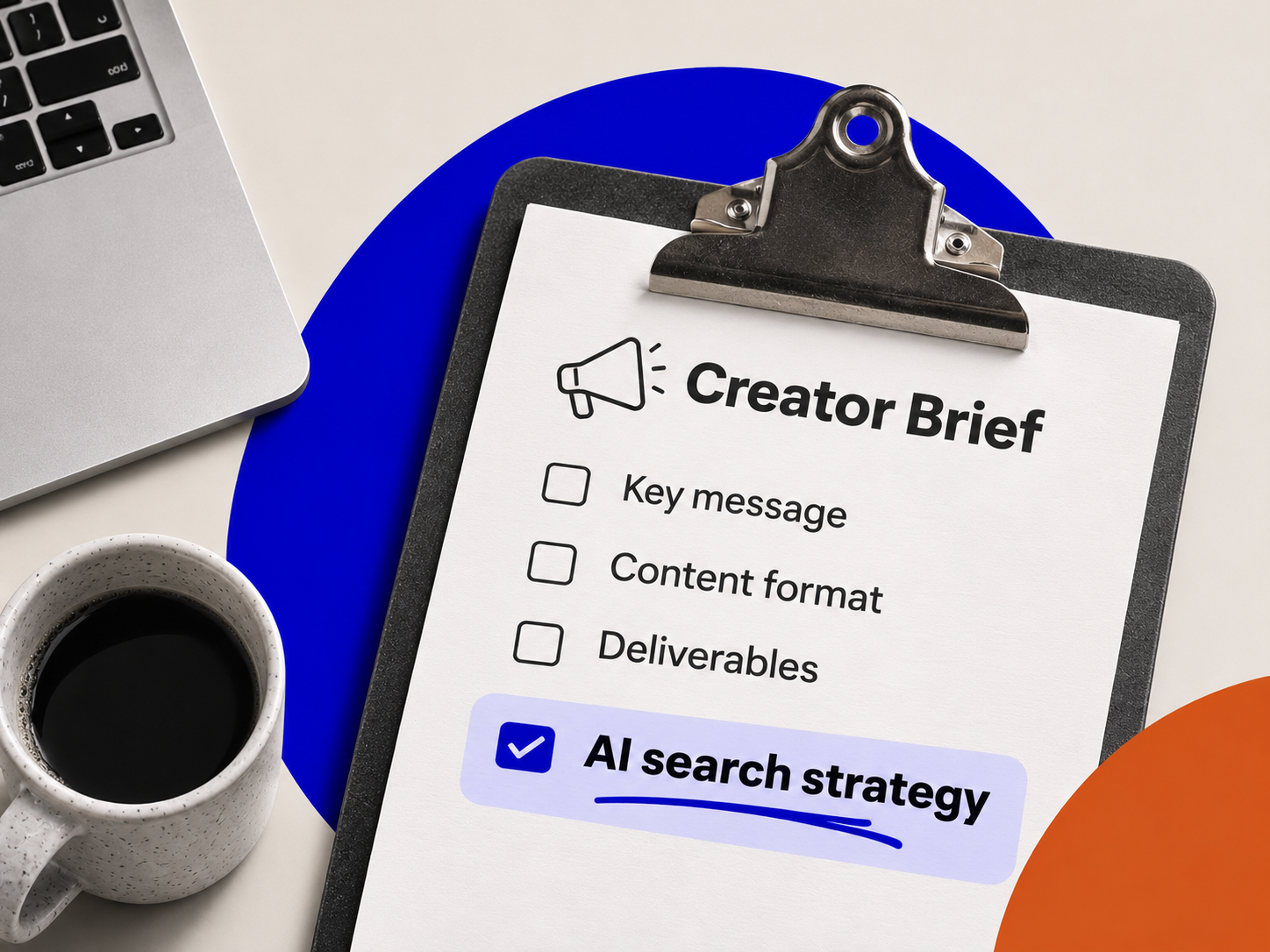
For smaller companies especially, publishing more self-promotional content isn't necessarily going to overcome a lack of independent recognition. They need more (external) people discussing, evaluating, and recommending their products in places beyond the company's own website. And that's where Creator AEO comes in.
How creators can help build the authority you're missing
One of the opportunities I see with Creator AEO is using creator partnerships to address gaps in the information available about your brand.
Not by paying influencers to repeat that you're the best, but by working with credible practitioners and industry experts who can produce useful content about your category.
A few examples:
Independent comparisons: A creator evaluates several products and explains which are best suited to different customers.
YouTube tutorials: A practitioner demonstrates how they use your product to solve a specific problem.
LinkedIn articles: An industry expert explores the advantages and limitations of competing solutions.
Customer content: Someone explains why they selected your product, which alternatives they evaluated, and what happened after implementation.
Each creates another opportunity for your brand to be discussed outside its own website. And more importantly, these formats can provide context around the use cases and customer needs your product is best suited to address.
There's a difference between a creator saying "Brand X is the best" and explaining why Brand X works particularly well for a 50-person marketing agency that needs profitability reporting. The second example gives AI more specific information to potentially use in a recommendation.
A good Creator AEO partnership shouldn't be about getting someone else to repeat your marketing message. It should produce credible, firsthand information that answers real buyer questions.
Final thoughts on listicles for AEO
Self-promotional listicles can still be useful for traditional SEO, educating buyers, and getting cited in AI answers, but Scrunch's research shows their impact on recommendations is modest.
Lily Ray's findings suggest their effectiveness may be declining in Google AI Overviews.
Growth Plays makes an important point about how much your existing reputation influences the outcome.
Mic King's criticism raises another consideration entirely: Even when the tactic works, it might not be great for your brand.
I think the bigger opportunity is investing in the people and sources that can make a credible case for your product beyond your own website. That means getting SEO, creator partnerships, customer marketing, social, and PR working toward a shared goal.
You can tell AI you're the best all day long, but the more interesting question is: Who else is saying it?
Frequently asked questions about self-promotional listicles and AEO
Do self-promotional listicles work for AI search?
Self-promotional listicles can help brands earn citations and mentions in AI-generated answers, but their impact on recommendations is more limited. Research from Scrunch found that when AI cited a listicle in which a brand ranked itself #1, the brand's recommendation rate increased from approximately 4% to 7%, while its mention rate increased from 19% to 39%.
What is a self-promotional listicle?
A self-promotional listicle is a comparison article published by a company that ranks its own product or service as the best option in its category. These articles often target commercial search queries, such as "best email marketing software" or "top project management tools," and are used as both an SEO and Answer Engine Optimization (AEO) tactic.
Does ranking yourself #1 help you get recommended by ChatGPT?
Not necessarily. Scrunch found that in 63.9% of AI responses citing self-promotional listicles, AI did not adopt the publishing company's #1 claim as a recommendation. A brand's existing reputation and the information available about it from other sources may influence whether AI recommends its product.
What is the difference between an AI citation, mention, and recommendation?
An AI citation occurs when an AI-powered search engine or chatbot references a source. A mention occurs when AI names a brand or product in its answer. A recommendation occurs when AI endorses a product as a suitable choice for the user's specific needs. All three contribute to AI visibility, but they represent different outcomes for brands.
Can self-promotional listicles help competitors gain AI visibility?
Yes. Scrunch found that in 24.3% of AI answers citing a company's self-promotional listicle, AI recommended a competitor instead of the publishing brand. Including competitors in comparison content can provide AI with information it uses to recommend alternative solutions.
Is Google reducing its reliance on self-promotional listicles?
Research from SEO expert Lily Ray found that Google AI Overviews cited 38% fewer self-promotional listicles in September 2026 than in June 2026. Her October follow-up also found that publishing brands were excluded from recommendations 83% of the time when these listicles were cited. These findings suggest the tactic may be becoming less effective within Google AI Overviews, although they do not establish a permanent trend.
Do self-promotional listicles work better for established brands?
They may. Analysis from Growth Plays suggests that the effectiveness of self-promotional comparison content depends partly on a brand's existing authority and whether information across the broader web supports its claims. Emerging brands may struggle to overcome a competitor's established reputation through self-published content alone.
Should brands stop publishing listicles for AEO?
No. Listicles and buyer's guides can still serve a purpose in traditional SEO, customer education, product positioning, and AI citation strategies. However, brands should avoid relying on self-promotional listicles as their primary strategy for earning AI recommendations. Useful, transparent comparisons that address specific buyer needs may also be more credible to human readers.
How can Creator AEO help brands earn AI recommendations?
Creator AEO (Answer Engine Optimization) is the practice of earning brand citations and recommendations in AI-powered search engines and chatbots through third-party voices rather than content published on a company's own website.
By working with credible creators, practitioners, customers, and industry experts, brands can build a broader ecosystem of firsthand information about their products. This gives AI additional sources to draw from when evaluating competing solutions and answering buyer questions.
What types of creator content can support AI visibility?
Creator content that provides specific, firsthand, and useful product information includes:
Independent product comparisons and reviews
YouTube tutorials and product demonstrations
Expert-authored LinkedIn articles
Customer case studies and implementation stories
Industry-specific buyer's guides
Practitioner commentary on product strengths, limitations, and use cases
The objective is to build credible external evidence that helps AI understand who a product is best suited for, rather than simply paying creators to repeat a brand's marketing claims.
How should brands measure the effectiveness of listicles for AEO?
Brands should measure citation frequency, brand mentions, and recommendation rates separately across relevant buyer-intent prompts. They should also track which competitors are recommended, which external sources appear in AI answers, and whether AI accurately describes their product's strengths and ideal customers. Citation growth alone is not sufficient evidence of improved brand preference.