Your AI citations got you shortlisted with buyers. Now what?
A buyer asks ChatGPT for software recommendations, and there you are: cited, shortlisted, and in the running. But six weeks later, they go with someone else. What happened? That's the story hiding in G2's 2026 Buyer Behavior Report, and it's making me rethink where the AI search journey really ends.
AI compressed software discovery from months of research into a single chat query. But the friction didn't disappear…it moved. Evaluation is now the longest stage of the buying journey (ahead of research, even!) for the first time in this study's history. Once AI puts you on the shortlist, a human still has to defend you—to security, to finance, to a room full of skeptics.
Everything we've covered about AI visibility so far has been focused on the research stage. That's still necessary, but it’s no longer enough. The process keeps moving, and according to this data, evaluation is the next piece of the buyer journey to focus on.
Key findings from G2’s Buyer Behavior report
G2 surveyed 1,038 B2B decision-makers in June 2026 and ran 55 qualitative interviews with GTM leaders. Here are three key findings from it:
1. AI builds the shortlist (and the shortlist sticks). More than 80% of buyers sourced software recommendations from AI chatbots in the last two years, and half say AI's greatest influence came at the shortlisting stage. Among buyers who used AI chatbots, 80% purchased from their initial shortlist in at least three of their last five purchases, versus 65% for those who didn't use a chatbot. Miss the shortlist, miss the deal.
2. Peer proof validates what AI says. The top two influences on shortlist decisions are review sites (38%) and AI chatbots (37%). And review platform citations inside AI answers nearly double (data from Growth Memo’s Kevin Indig shows this went from 7% to 13%) as buyers move from discovery into evaluation. The deeper into the funnel, the more the AI tools lean on third-party proof. (This is Source Signal Stack 101!)
3. Finance moved into the room. CFO and finance involvement in buying committees jumped from 31% to 46% in a single year, and 49% of buyers watched their CFO veto a purchase that had already been approved in the last twelve months.
If this is interesting to you, be sure to read the full report for the complete picture—including a chapter on AI agents entering the evaluation process that deserves its own issue.
How these findings validate the Source Signal Stack
If you've been reading this newsletter, you know the Source Signal Stack: the four layers of source signals LLMs cross-verify before deciding who to cite.
Layer 1: Brand Signals. Company blog, product docs, owned pages.
Layer 2: Executive Signals. C-suite publishing under their own names.
Layer 3: SME Signals. Internal experts and B2B creators publishing under their own names.
Layer 4: Community Signals. Earned media, peer mentions, third-party coverage.
The core principle: the further a signal originates from brand control, the more weight AI systems give it.
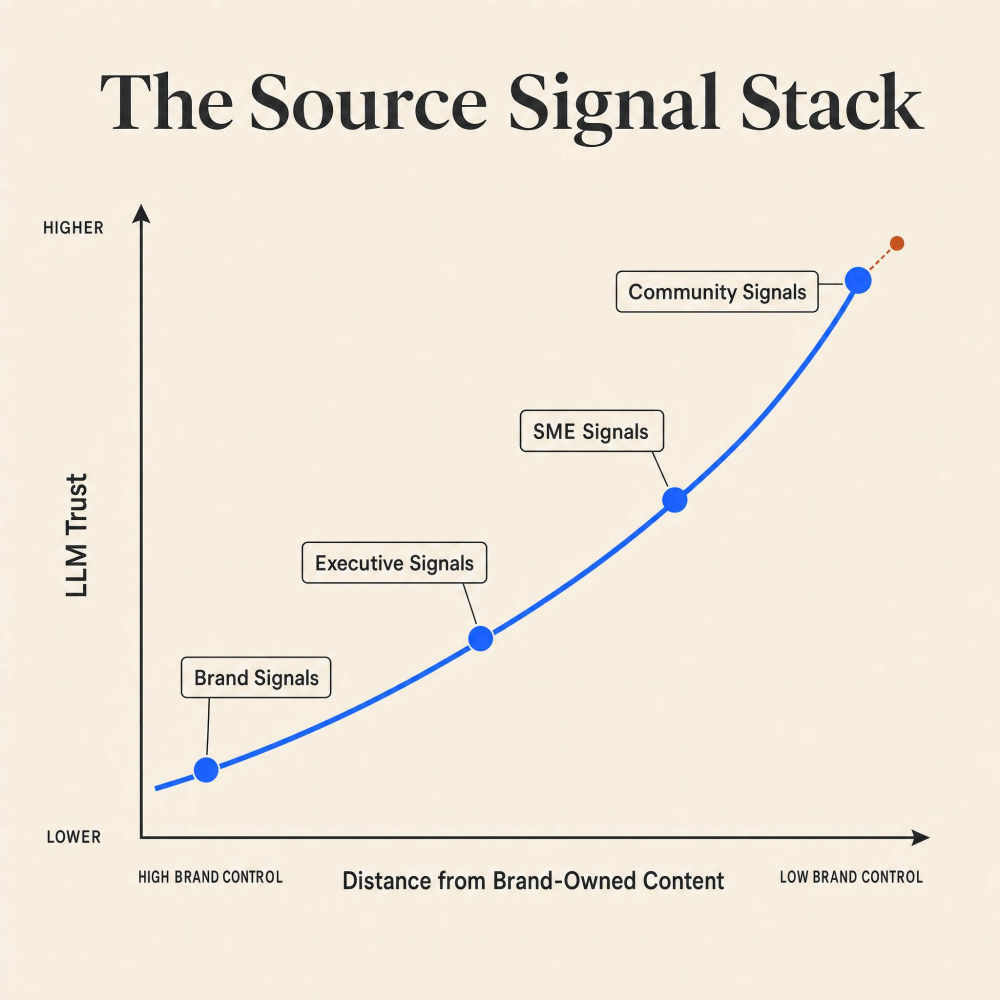
G2's data doesn't just support that principle; it extends it. It turns out the same process applies to the humans on the buying committee.
Layer 1 just got a second reader. Your comparison pages, pricing context, and implementation content have always needed to be structured so AI can parse where you fit. Now they need to survive a different test too: can a buyer forward them to finance without translating them first? Vague ROI claims that worked as top-of-funnel copy die in a CFO review.
Brand signals now do double duty—legible to models, defensible to committees.
Layer 3 is the corrective layer. One of the most striking threads in G2's qualitative interviews is that sales teams now spend real time un-teaching things buyers learned from AI: Things like stale conclusions, category-level generalizations, outdated pricing. Your SMEs publishing current, specific, first-person content is how you correct the record before the sales call has to.
If the models are going to teach your buyers, your experts should be writing the curriculum.
Layer 4 is structurally different from every other layer. Here's what makes review platforms unique in the Stack. Layers 1 through 3 are signals you create. Layer 4 is the only layer you can't, and that's precisely why it carries the most weight. Verified review platforms like G2 are the structural exception in your signal portfolio: the content is authenticated, it's written by actual users, and you can't edit it.
LLMs weigh review platforms heavily for the same reason buying committees do: it's the one source in the funnel that isn't vendor-controlled.
But "can't create it" doesn't mean "can't influence it." You have real levers here:
Presence. A claimed, active profile with enough review volume to be citable. Thin profiles don't get surfaced by models or committees.
Recency. AI systems and evaluators both discount stale proof. A steady cadence of fresh reviews beats a big batch from 2024.
Category. You get cited for the categories you're placed in. If you're sitting in the wrong one (or missing an emerging one), you're invisible for the queries that matter.
Completeness. Filled-out profiles, pricing transparency, screenshots, and integration listings are the structured data models parse.
And here's the part that ties the whole issue together: this is the same source doing double duty.
The G2 profile that feeds the AI-assembled shortlist at discovery is the same asset your champion screenshots into the Slack thread where the real decision happens.
One investment, two audiences: the model that builds the list, and the human who has to defend it.
The audience nobody's writing for: The champion
The report's most actionable insight for marketers isn't about the buyer as evaluator. It's about the buyer as defender. Concern about internal resistance to AI-related purchases nearly doubled year over year from 16% to 29%. (Yikes.)
Your buyer isn't just deciding whether they like you; they're preparing to defend you to finance, to the colleague who got burned by the last tool, and to the skeptical CEO.
The answer to this is creating champion-grade content, AKA material your buyer can easily share and make a case with. These are things like:
Plain-language AI transparency docs. 87% of buyers say they'd choose a vendor with transparent AI over a cheaper black-box competitor. If your AI story requires a solutions engineer to explain, your champion can't repeat it.
ROI cases with the assumptions shown. Not just the headline number, but the math behind it.
Third-party validation they didn't have to generate. Reviews built around evaluation questions: integrations, implementation speed, why customers switched from a named alternative…not star ratings alone. A 4.6 average is wallpaper. A review that says "we switched from X and were live in three weeks" is GOLD.
This is reputation engineering's natural extension. You're not just engineering how AI sees you; you're engineering the case your champion makes to the rest of their team.
How to put this intel to work
Audit your comparison pages for evaluation answers, not discovery answers.
Pricing logic, TCO, implementation timelines, security posture. Then test what chatbots say about you at the "X vs. Y for a 500-person company" level (not just "best tools for X.")
Run one piece of bottom-funnel content through the forward test.
Could a champion send this to a CFO unedited? If it needs a cover note explaining what it really means, rewrite it.
Pull the levers on your review presence.
Check your profile against the four: presence, recency, category, completeness. Rebalance your next review campaign around evaluation questions instead of ratings volume.
If your product uses AI, publish the plain-language version of how.
Do this before it becomes a late-stage objection instead of a mid-funnel selling point.
The evaluation never ends
One finding from the report I can't stop thinking about: buyers now re-evaluate vendors they've already chosen.
The deal you closed last quarter is being re-run through the same gauntlet—the shortlist, the committee, and the CFO. A better alternative is one AI query away. Every day. Forever. So no—citations aren't a campaign you run and finish. They require maintenance, persistence, and consistency over time.
Your buyers will check again to see which new competitors have entered the space.