LinkedIn's AI Search Impact, By The Numbers
We've been talking about execution and attribution of the Source Signal Stack for several weeks now, so today, I want to zoom out a bit and take a look at the data around why this work is so important in 2026, and why LinkedIn is a prime platform for leveraging executive thought leadership, internal employee experts, and B2B creators.
Below, you'll find a condensed synthesis of published research from Profound, Semrush, SE Ranking, ConvertMate, Yext, and Search Engine Land. Citation data and methodologies belong to the original researchers cited throughout; this is not original research.
The strategic implication this brief draws: LinkedIn long-form articles and newsletters now function as AI search assets that AI models cite, in addition to being SEO assets that rank on Google. For B2B publishers, founders, executives, and subject-matter experts, LinkedIn is now one of the highest-leverage platforms for shaping how AI systems understand, cite, and recommend thought leaders (and the companies they work at) within a vertical.
What LinkedIn content gets cited in AI search results
LinkedIn ranks #1 for professional queries across all six major AI platforms per Profound, with citation frequency on ChatGPT more than doubling between November 2025 and February 2026.
Long-form articles and newsletters drive roughly 60% of LinkedIn AI citations per LinkedIn internal data referenced by Vulse - Employee Advocacy Platform (a single secondary source, not independently verified). SEMrush's separate analysis corroborates the broader pattern with more granular detail:
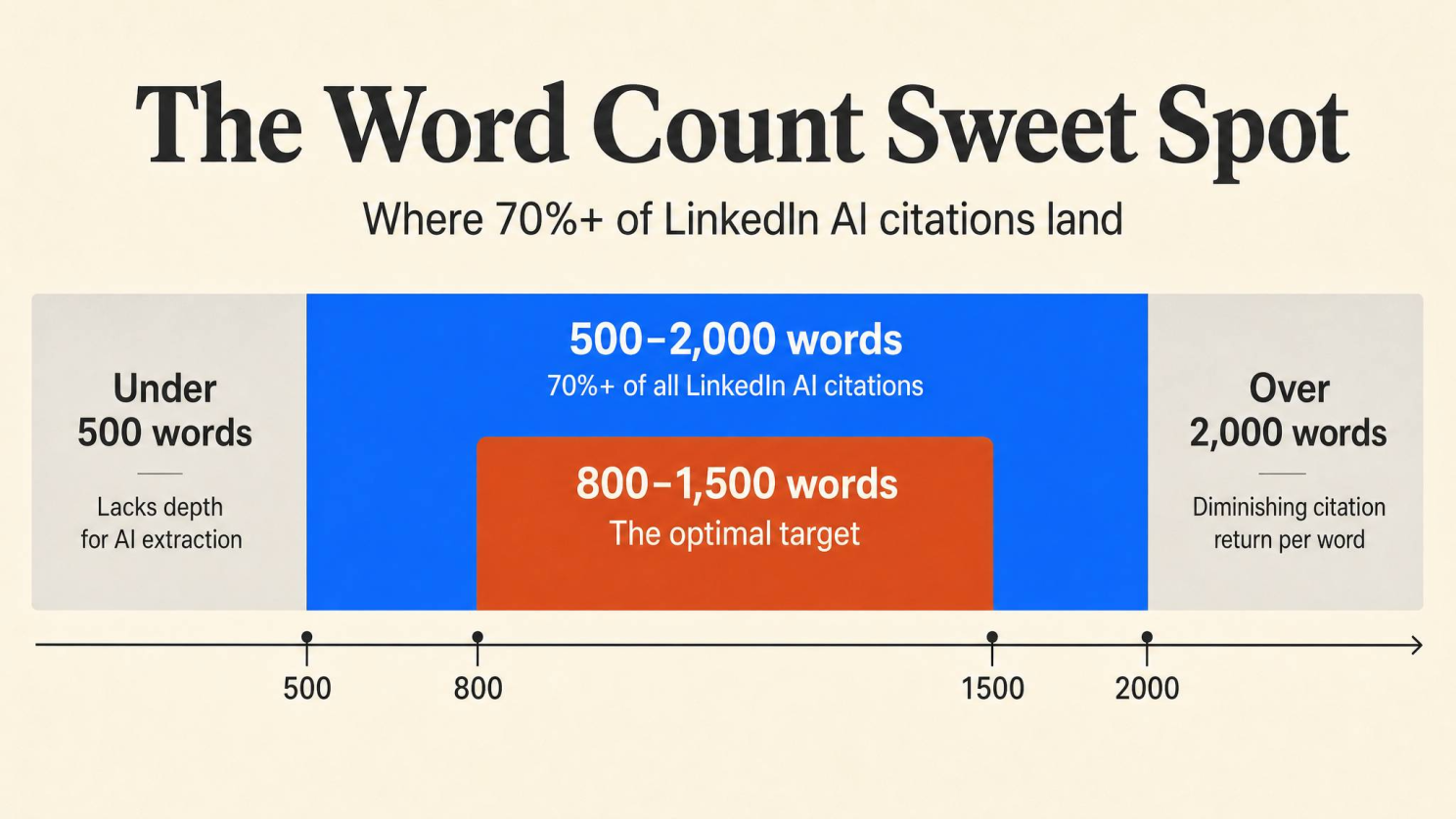
More than 70% of LinkedIn AI citations land on articles between 500 and 2,000 words.
Feed posts contribute meaningfully (over 28% of citations on ChatGPT specifically), with mid-length posts (50–299 words) performing best.
Posts and articles grew from 26.9% to 34.9% of LinkedIn citations during the Profound study period.
Profile page citations dropped sharply from 33.9% to 14.5% in the same window.
Original content wins
95% of AI citations from LinkedIn come from original content; reshares account for roughly 5%. Recycled content, or reposting with "great insights!" produces no AI visibility benefit.
Engagement patterns that predict AI citation
AI citation behavior does not track virality. Most cited LinkedIn posts had only 15–25 reactions. What predicted citation:
75% of cited authors post at least five times per four-week window.
Nearly half have 2,000+ followers.
Semantic similarity between LinkedIn content and AI responses ranges 0.57–0.60, meaning AI responses often paraphrase the LinkedIn author's framing of a topic.
Bottom line: Publishers who win citations effectively shape how AI explains their market.
Why LinkedIn Wins in AI Search
Generative AI systems use retrieval-augmented generation (RAG) to assemble answers, prioritizing sources that meet a specific profile: verified authorship, topic clustering, recency signals, substantive depth, and E-E-A-T alignment (Experience, Expertise, Authoritativeness, Trustworthiness).
LinkedIn packages all of this in one platform. Every article carries a verified author with a populated profile, work history, and connection graph. Articles are organized by topic clusters via skills pages and tags. Publish dates and engagement signals are visible.
LinkedIn's overall authority signals (Ahrefs Domain Rating ~98, Moz Domain Authority ~98, tens of millions of referring domains) translate into AI training data and retrieval prioritization. Content from a DR-98 platform clears trust thresholds that newer, lower-authority sites cannot; this is the same dynamic that produces fast organic Google search surfacing (and in general, SEO rankings).
LLM Platform Differences
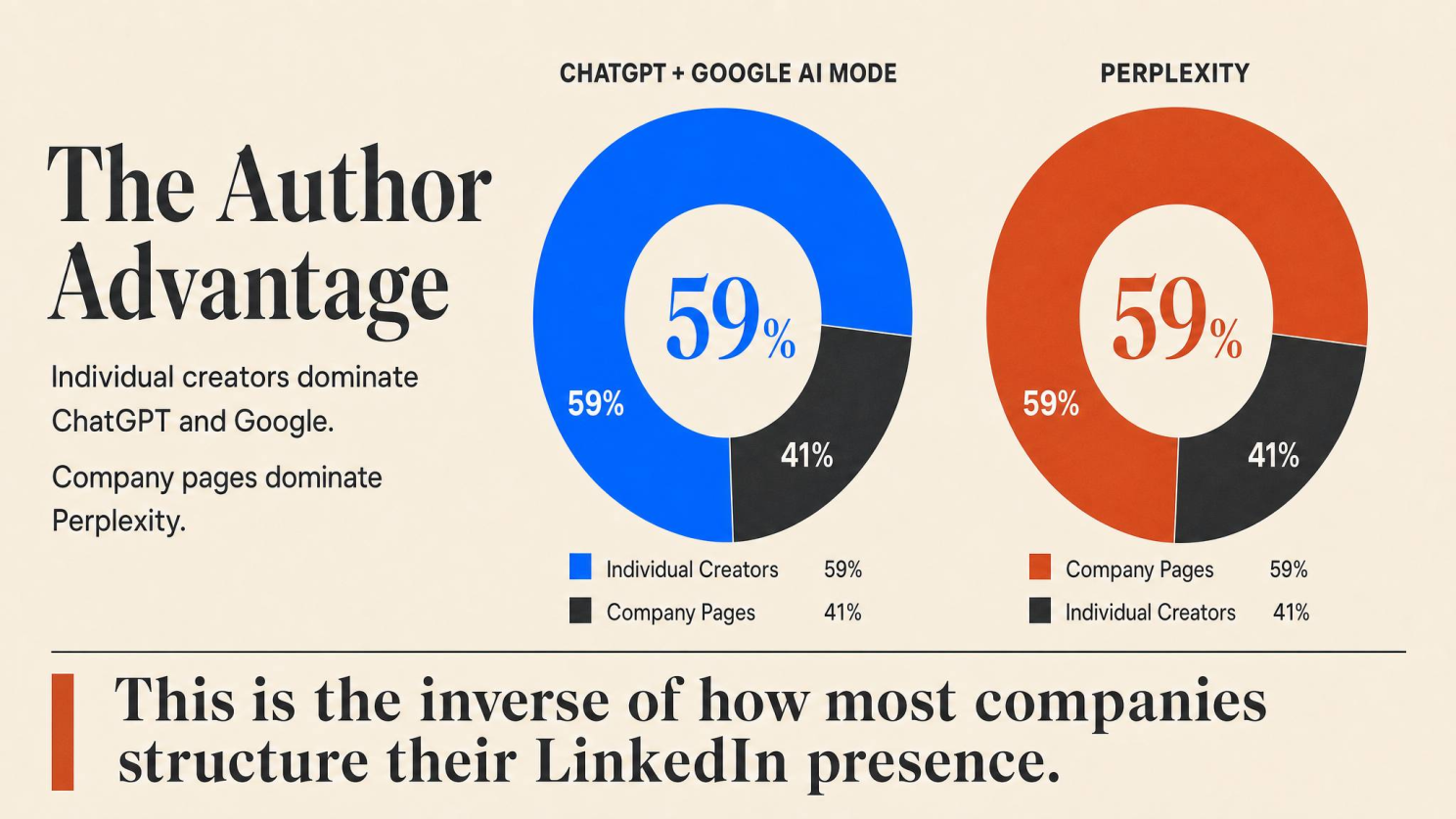
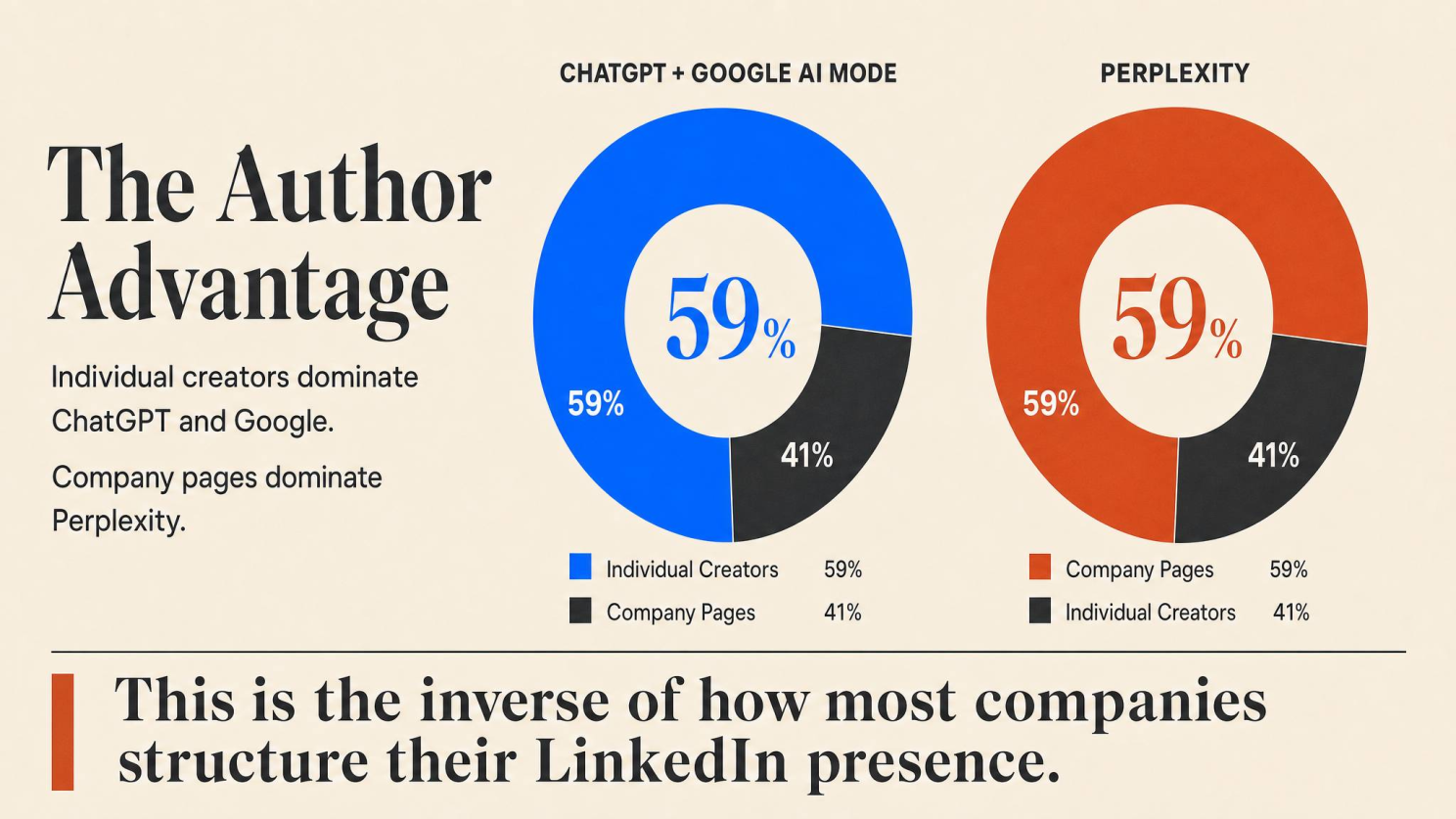
ChatGPT Search (14.3%): 59% of LinkedIn citations come from individual creators. Founder, executive, and expert profiles are the primary assets.
Google AI Mode and AI Overviews (13.5%; AI Overviews appear on ~16% of Google queries, rising to 70% for B2B tech and 90% for healthcare/education): Source mix similar to ChatGPT, individual creators dominate. Content that ranks well in organic Google search tends to also appear in AI Overviews.
Perplexity (5.3%): The inverse of ChatGPT. 59% of LinkedIn citations come from Company Pages. Brands targeting Perplexity need to operate their Company Page as an active content hub. Perplexity also relies heavily on Reddit (46.7% of top citations).
Microsoft Copilot and Gemini: Less granular data publicly available, but Profound confirms LinkedIn as #1 source for professional queries on both. Gemini follows AI Mode patterns; Copilot benefits from LinkedIn's parent company relationship.
Claude: Less citation data publicly tracked, but LinkedIn long-form content appears in Claude's responses on professional queries with patterns consistent with the broader trend.
Articles vs. Newsletters: LinkedIn offers two long-form formats cited by AI. Both publish on the /pulse/ slug and are fully indexable.
Standalone articles suit evergreen topics, reference content, and comprehensive guides.
Newsletters are a serialized format using the same infrastructure. Subscribers receive push notifications and email each time you publish, building a direct distribution channel independent of the feed algorithm. Maximum cadence is one edition per 24 hours; character limit is 110,000–125,000.
Newsletters appear to be the higher-leverage AEO format because:
Push notifications and email distribution generate immediate engagement signals (clicks, opens) that may influence freshness signals to AI retrieval systems.
Subscribers tend to read more thoroughly than feed-discovered readers, generating quality engagement metrics.
A newsletter focused on a specific topic builds compounding topical authority that AI systems reward.
The 500–2,000-word range captures over 70% of LinkedIn AI citations. The optimal target is 800–1,500 words for most pieces. Longer than 2,000 words shows diminishing citation return per word; shorter than 500 lacks depth for AI extraction.
The Author Advantage
On ChatGPT and Google AI Mode, individual creators account for 59% of LinkedIn citations. Company Pages account for 41%. This is the inverse of how most companies structure their LinkedIn presence.
The author advantage exists because individual profiles provide clearer authorship signals than Company Pages, aggregate E-E-A-T signals more densely, support first-person framing that AI systems favor, and tend to focus on narrower expertise areas.
For organizations, executive thought leadership now functions as an AEO asset in addition to a personal branding tool. A CEO, CMO, or subject-matter expert publishing consistently under their own name is producing AI citation real estate that the Company Page cannot produce.
The recommended structure:
Company Page: structured content hub for product, category, and customer success content. Wins on Perplexity.
Founder/Executive Profiles: opinionated, experience-driven content. Wins on ChatGPT and Google AI Mode.
Employee Advocacy Programs: extend the author surface across multiple voices, increasing total AI citation footprint.
Approximately 75% of AI-cited LinkedIn authors post at least five times per four-week window. This is the consistency threshold. A practical cadence: one newsletter or long-form article per week, two to three feed posts per week tied to article themes, with consistent topic focus across all content.
The Citation-First Content Framework
Patterns that (appear to) predict AI citation:
Structural: clear heading hierarchy (H2 for themes, H3 for specifics); sections of approximately 120–180 words for optimal extractability; lists and bulleted breakdowns; clear authorship attribution; substantive opening that addresses the topic in the first 1–2 sentences.
Content: practical, specific advice over abstract framing; first-hand experience and original analysis over synthesized summaries; embedded data, methodology, or specific examples; clear arguments with stated positions over balanced both-sides framing.
What does NOT predict citation: virality, FAQ schema markup (showed weaker citation rates per SE Ranking's analysis), LLMs.txt files (an industry-promoted optimization that did not improve citations), reshares.
The hook-explain-prove structure:
Hook (first 1–2 sentences): state a clear claim, position, or finding. AI systems often cite the first 1–2 sentences of a piece, so the hook must be self-contained and citable.
Explain (body): develop the argument with structured reasoning under clear headings. Each section should answer a specific sub-question and stand alone if extracted.
Prove (evidence): embed specific data, methodology, examples, or case studies.
Effective AI-citation-targeted headlines communicate a complete idea (typically 8–14 words) and mirror how professionals search. "How B2B Companies Use Employee Advocacy to Generate Pipeline" outperforms "Employee Advocacy Tips" because it tells both readers and AI systems exactly what the piece covers.
Strategic Recommendations: Using LinkedIn as Part of Your AI Search Strategy
Establish a weekly long-form cadence on a focused topic area.
Hit the 800–1,500-word sweet spot.
Publish under an identified individual for ChatGPT and Google AI Mode visibility; supplement with Company Page content for Perplexity.
Maintain topical focus. Topical authority compounds; topical scatter dilutes.
Content structure:
Lead with a citable claim in the first 1–2 sentences.
Use clear heading hierarchy with sections of ~120–180 words.
Embed evidence (data, methodology, examples, case studies).
Take clear positions over balanced framing.
Cross-surface strategy:
Bidirectional linking between LinkedIn articles and owned-domain pillar pages strengthens entity authority on both surfaces and increases citation likelihood across Google and AI search.
Repurpose long-form articles into supporting feed posts.
Maintain owned-property publishing to mitigate platform dependency.
Measurement:
Set up AI citation tracking via enterprise tools or manual query monitoring.
Track citation framing in addition to citation frequency.
Monitor across all six major AI platforms.
Risk mitigation:
Don't make LinkedIn your sole content distribution channel.
Watch for competitive displacement in your topic areas. The window for becoming the dominant AI citation source in underserved categories is open but narrowing.
Monitor Google's Site Reputation Abuse enforcement for any signals affecting LinkedIn content broadly.
Why LinkedIn Is Critical for AI Citation Visibility
The market for AI citation visibility is a huge opportunity right now: ChatGPT reaches 800M+ weekly users; Gemini has surpassed 750M monthly users; 37% of consumers now start searches with AI tools; AI Overviews appear on roughly 16% of Google queries, up from 6.49% at the start of 2025.
Some projections suggest LLM traffic could overtake traditional Google search by the end of 2027, so establishing subject matter expertise now is a smart move.
Want to learn how to start doing this work? Sign up for my free workshop on Maven on June 4th for a crash course on how to strategize your AI search visibility.
Primary Sources
Profound. "1.4 Million AI Citation Analysis." Industry coverage February–April 2026.
SEMrush. "We Analyzed 89K LinkedIn URLs Cited in AI Search." March 2026.
Averi.ai. "LinkedIn Is the #1 Most-Cited Source in AI Search for Professional Queries." April 2026.
Search Engine Land. "Answer engine optimization (AEO): How to win AI mentions." February 2026.
SE Ranking. ChatGPT citation analysis (129,000 domains). November 2025.
Vulse. "How To Use LinkedIn Articles Get Cited by AI Search." April 2026.
FAQs About Named Frameworks for AI Search Visibility
What is entity resolution, and why does it matter for AEO?
Entity resolution is the process by which an LLM connects a specific label (a name, framework, or concept) to a specific person or brand. It matters because without a discrete label, your expertise gets absorbed into the model's general knowledge with no attribution. With one, your name becomes a node in the model's knowledge graph that gets reinforced every time the label appears alongside you in a new document.
What's the difference between having expertise and having a named framework?
Expertise is the knowledge itself — the patterns you've noticed, the approach you've refined, the diagnostic logic you walk clients through. A named framework is that expertise packaged into a 2-to 5-word label with a specific claim attached. Without the label, LLMs can use your thinking to construct an answer but can't point at you when they do.
Do I have to invent something completely new to coin a framework?
No. Clayton Christensen didn't invent the observation that people hire products to solve problems — researchers had been circling that insight for decades. He named it, published under that name repeatedly, and the label stuck. Amanda Natividad didn't discover that social platforms suppress outbound links; she gave the pattern a handle ("Zero-Click Content") and owned the association. Naming and consistent publishing matter more than pure originality. A framework needs three traits: a clear, specific name (2-5 words, memorable, searchable), a specific claim that takes a position (not just a category or description), and published evidence rooted in your direct, first-party experience. If you give different advice every time you're asked, you don't have a framework yet. If you walk people through the same logic, the same steps, the same diagnostic questions repeatedly — that's the signal.
How long does it take for LLMs to start citing a named framework?
There's no fixed timeline, but the mechanism is repeated co-occurrence across enough independent sources that the model builds a statistical association between the name and the person. That means publishing the label consistently across LinkedIn, podcasts, newsletters, trade publications, and conference talks. Cross-platform verification is what compounds the signal.
Why won't an LLM cite me if I'm explaining a well-known concept in my own words?
Because there's nothing for the model to resolve back to you. If you describe the idea generically, the LLM treats it as general knowledge and pulls from its broad understanding of the topic. The label is the handle the model grabs onto. Without one, your perspective becomes background.
How does naming a framework fit into the Source Signal Stack idea?
The Source Signal Stack (Brand, Executive, SME, Community) is the infrastructure — where to publish and which voices to leverage. Named frameworks are the IP that travels through that infrastructure. As more companies build out source signal programs, the advantage of simply having the infrastructure narrows. The lasting differentiator is the named, ownable concepts no one else can claim because you coined them.