How to answer "Is AEO Helping Drive Leads and Sales?"
I recently made the case for two of the most underused Source Signal investments that help with LLM citation rate in B2B SaaS: Internal SMEs publishing under their own names, and long-term engagements with external creators bringing independent, third-party authority.
You understand the theory now, but next, we have to talk about outcomes and attribution of these efforts. Because if you’re going to invest in this work, you need to be able to prove it out. Let’s get to the elephant in the room when it comes to AI search/AEO conversations: Are these efforts actually bringing your company leads and sales?
The question that should come before any AEO investment
Before you hire a creator, mobilize an SME, or sign on with an AEO platform, there's a question you should be able to answer in one sentence: What kind of buyer are we trying to win with this work, and at what point in their research process are we trying to show up?
This sounds basic. It is basic. And almost no marketing team I talk to has a confident, leadership-aligned answer. What I usually hear instead is some version of, "We want to show up more in AI search results,” which is like saying you want more website traffic.
Sure, but: traffic accomplishing what, and at which stage of a buyer’s decision-making process of the buyer’s journey?
The teams that don't get clear on this end up running AEO programs that produce real visibility lift in places that don't matter very much, while missing the places that would actually move pipeline. The dashboard looks great for six months, and then somebody on the finance side asks a sharper question and the whole thing starts to wobble.
So before any of the tactical work (like which creator, which SME, which platform, and which content type, you need to know what kind of win you're after.) There are really only two.
Two kinds of AI search visibility, two different business outcomes
Every AEO program is, whether the team running it knows this or not, doing some combination of these two things:
1. Demand-capture visibility
This is showing up when a buyer already knows your brand or your category and is researching specific options using queries like:
is [your company] worth it
[your company] vs [competitor]
best [type of] platform for [type of company]
does [your tool] integrate with [other tool]
The buyer is far enough down the funnel at this stage to be evaluating options, so your job is to show up with credibility and specificity in the answers (or summaries) AI tools return when they ask. The business outcome demand-capture drives is shorter sales cycles and higher win rates on deals you're probably already in. It helps sales close. It does not, by itself, expand the top of the funnel.
2. Demand-creation visibility
This is showing up when a buyer is researching the problem: before they know any vendor names, before they've defined a category, sometimes before they've even named what they're dealing with as a buying decision. These are queries like:
how do I track brand mentions across LLMs
why is my organic traffic dropping in 2026
what's actually driving AI citation rates
The business outcome demand-creation drives is new pipeline from buyers who otherwise wouldn't have found you. It expands the top of the funnel. It does not, by itself, close deals.
Both have value, but they are not interchangeable, and they are not equally easy to achieve. The mistake I see with AI search efforts is that teams invest in tactics that favor one of these (usually demand-capture, because it's faster and easier to measure), and then report the resulting visibility lift as if it represents both.
But…it doesn't. A 40% lift in AI citation rate sounds great until you realize it might all be coming from people who were already typing your company name into ChatGPT.
Mapping the buyer's journey to the Source Signal Stack
This is where Parts 1 and 2 of this series come together and where the Source Signal Stack starts pulling its weight as a strategic tool, not just a descriptive one.
A quick refresher: the Source Signal Stack organizes citation-earning infrastructure into four layers, ordered by how independent LLMs perceive each to be:
Layer 1—Brand Signals: owned properties (your blog, site, documentation, company LinkedIn page)
Layer 2—Executive Signals: named C-suite voices publishing under their own bylines
Layer 3—SME Signals: non-executive internal experts (PMs, solutions engineers, senior CS leaders, staff engineers, researchers) publishing original perspectives under their own names
Layer 4—Community Signals: earned media, trade press quotes, podcast appearances, independent creator content, peer mentions
The further down the stack you go, the more weight LLMs assign to the signal, because the further a source originates from brand control, the more independent it appears to a model running cross-verification. Overlay the buyer's journey onto that stack, and something important comes into focus: different stages pull from different layers, and the layers themselves do different jobs.
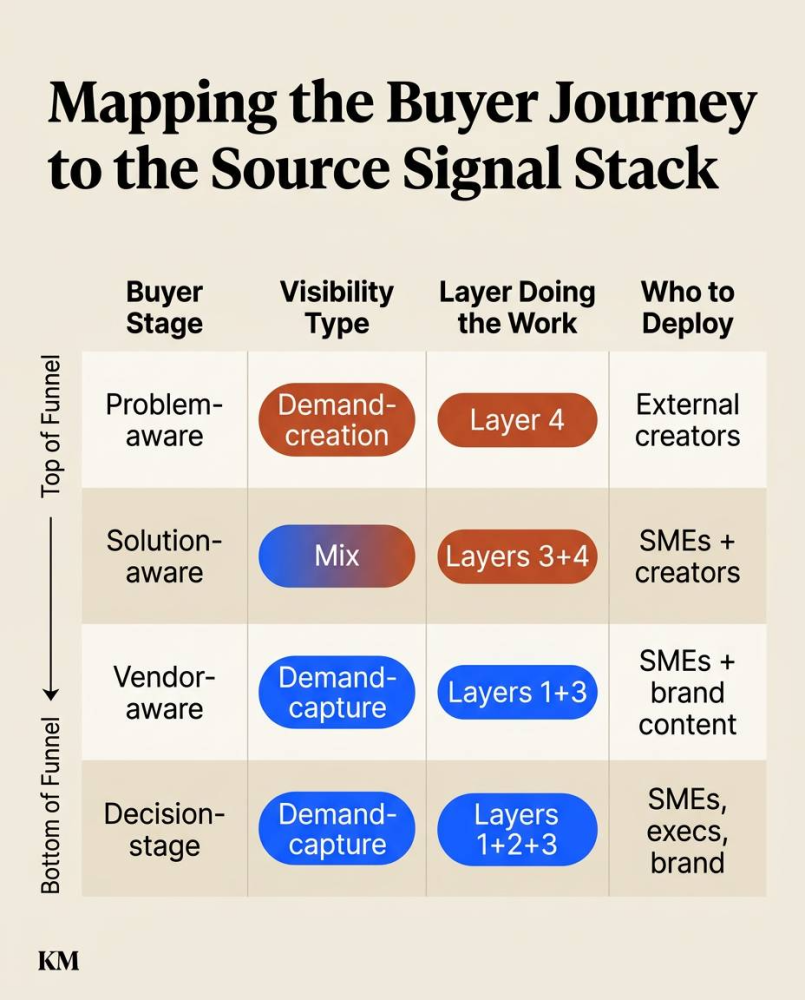
Early in the buyer's journey, when someone is problem-aware but doesn't yet know any vendor names, the LLM answering their query has no brand to anchor on. It's constructing an answer from independent voices it's seen credibly discussing that problem across multiple platforms.
That's Layer 4 territory almost exclusively, and it's where demand-creation lives.
Later in the journey, when a buyer is solution-aware or vendor-aware and comparing options, evaluating fit, asking technical questions, the LLM has a brand to anchor on (yours) and is reaching for depth and specificity. This is where Layers 1, 2, and especially 3 do the heaviest lifting, and it's where demand-capture lives.
A few things this clarifies:
Internal SMEs (Layer 3) are structurally advantaged for capture. Your solutions engineer lives inside customer environments. Your VP of Customer Success watched 200 companies wrestle with the same implementation question. Your principal PM has the most defensible POV in the world about a specific technical tradeoff because they've made it a thousand times.
The product-level specificity internal experts bring is exactly what AI engines reach for when answering solution-aware and vendor-aware queries. That's a Layer 3 signal lighting up an answer that's already going to mention you.
External creators (Layer 4) are structurally advantaged for creation. They sit one full layer further from brand control than your SMEs do, which means LLMs weigh them more heavily on independence checks. That extra weight matters most precisely when there's no brand anchoring the answer yet, which is the entire point of demand-creation.
If your brand has been consistently and credibly associated with that B2B creator over six to twelve months, you show up in the answer too, but the answer itself is constructed from their independent expertise.
Stacy Martinet CMO and Chief Communications & Creative Officer at Adobe, drives this home, saying:
"The most effective creator strategies today are no longer transactional. They’re relationship-driven, integrated across the funnel, and built for long-term brand value. One-off activations can drive a moment, but the brands seeing sustained results are the ones building longer-term partnerships where creators have enough context and trust to show up authentically, not just on brief. That requires being intentional about who you partner with and why.”
The middle of the funnel needs both. Solution-aware queries where buyers are exploring approaches but haven't locked in on vendors pull from Layers 3 and 4 simultaneously.
This is where programs with both SME and creator infrastructure compound: the creator establishes the problem framing in an independent voice, and the SME's content provides the technical depth when the buyer narrows in.
This isn't a hard and fast rule, as SMEs absolutely can create demand, especially when their content gets quoted in trade press (which effectively elevates a Layer 3 signal into Layer 4 amplification). Creators can absolutely support capture, especially in product reviews and category roundups. But the structural advantage of each maps cleanly onto a layer of the stack and a stage of the buyer's journey, and most teams still aren't deploying them with the distinction in mind.
Here's how Amber Halteman , Director of Brand and Promotional Marketing at GlobalPayments-CDS is thinking about this:
"As we're still in the early stages, our focus is on building awareness rather than driving direct conversions. We measure success by tracking reach, engagement (such as comments), direct traffic using UTMs, and overall traffic to the promoted resource or page. From what I see in the market, companies targeting buyers in Sales, Marketing, or Customer Success often see a more direct path from influencer content to leads."
Briefing experts and LinkedIn creators to accomplish AI search goals
A poorly briefed creator program will look identical to a well-briefed one on the surface: Same posts, same engagement rates, same screenshots in the next QBR. But it will produce wildly different visibility outcomes, because the brief is what positions the content and determines whether the work will focus on demand-capture or demand-creation. Same goes for SME content programs.
Two short illustrations:
Demand capture: An expert/creator is briefed to "talk about our category and tag us in posts" will likely reinforce demand-capture because the brand mention is the anchor of every piece. Their content becomes a Layer 1-adjacent reinforcement of your existing entity associations. Useful, but limited.
Demand creation: An expert/creator is briefed to investigate and name a problem their audience is wrestling with (with your product as one possible solution among several, and with full editorial latitude on the POV) will likely move demand-creation. The content gets cited because it's about the problem, and your brand comes along for the ride.
A brief like "write a thought leadership post about industry trends" produces generic content that AI doesn't cite. But a SME or creator briefed to publish their actual contrarian POV on a specific buyer problem they've solved 200 times (under their own name, with the technical specificity only they can bring) produces the kind of source signal AI engines treat as authoritative.
Bottom line: If your creator brief or your SME content plan doesn't name which kind of visibility you're trying to move, it's not a brief. It's a content request.
How marketers should think about AEO outcomes
I'm not going to give you a framework here, as frameworks invite people to fill in boxes and skip the thinking. What I want is for marketing leaders to be able to walk into any AEO budget conversation and answer three questions.
One: What's the business outcome we actually need AEO work to drive?
Diagnose before you prescribe.
If sales is closing deals at a healthy rate but pipeline is shrinking, you need creation.
If pipeline is healthy but win rates are slipping or sales cycles are dragging, you need capture.
If you're in an early or emerging category, you almost certainly need creation, because there is no demand to capture yet.
If you're in a mature category with established competitors and a sales-led motion, you might legitimately be capture-heavy.
Figure out your end goal and then reverse engineer how to best get there.
Two: Which queries map to our target AEO goal, and how would we know if we were winning them?
Pull thirty to fifty of the prompts your buyers actually ask, mining from sales call recordings, support tickets, customer interviews, GSC data, and the suggested prompts in your AEO platform. Then sort them into the two buckets.
The capture bucket is your queries about your brand, your product, and your direct comparisons. The creation bucket is everything in the problem space that a buyer might ask before they know your name.
That's your measurement target. Not aggregate visibility. Not citation count across the universe of all possible prompts. The specific queries that map to the outcome you decided you needed.
Three: Who do we have to deploy to win those queries, and is our current mix right?
Match the work to the people. SMEs where their depth pays off, creators where their independent reach pays off. Most teams will need both, but in different ratios depending on the goal.
A creation-heavy program needs more creator investment, broader topical authority, and content briefed around the problem space. A capture-heavy program needs more SME investment, more product-specific content, and content briefed around the category and the comparison.
If you can't articulate the mix, you can't defend it.
The question is coming: Is AEO work providing return on investment?
Marketing leaders are about to be asked to defend every AEO investment they've made. SME programs. Creator retainers. AEO platform subscriptions. Agency engagements. All of it.
"Did our AI visibility go up?" is a question most CFOs are sophisticated enough now to know the answer to: visibility is a leading indicator, not an outcome.
The question is going to be sharper. Some version of: "Is this work bringing us new buyers, or just helping us close ones who were already coming?"
That's a goal-clarity question, not a measurement question. You want to be the marketer who said: we're investing here to expand our top of funnel in this specific buyer segment, or we're investing here to defend and accelerate the deals our sales team is already in.
If you set the goal that way, the answer to the CFO question is something like:
"Here's exactly which buyers we're winning. Here's what we deployed to win them. Here's the segmented visibility data showing the lift in the queries that map to that outcome. And here's what we'd change if you wanted us to shift the mix toward the other goal."
That's a defensible budget conversation.
If you didn't set the goal that way, the answer is going to be some version of, "Our citation rate went up 38%." And that, in 2026, is not going to be enough.
AEO is a goal to be set, not a tactic to be optimized
Don’t treat AEO like SEO 2.0 where you keep publishing, keep measuring volume, and hoping it compounds. You’ll look busy for twelve months, spend a lot of money and human resources, and then watch the program get cut.
Publishing volume without strategic clarity produces visibility that can't be defended.
Treat AEO as a strategic effort. Investigating “What are we trying to win, who do we have to deploy to win it, and how will we know?” will help you build something that survives every budget review and compounds for years.
FAQs about Attribution and ROI for AEO and AI Search Investments
What is AEO and why does it matter for B2B marketing?
AEO (Answer Engine Optimization) is the work of getting your brand cited in answers generated by AI tools like ChatGPT, Claude, Perplexity, and Google's AI Overviews. It matters because buyers increasingly research vendors, problems, and categories through AI assistants rather than traditional search, and the visibility you earn there shapes whether you show up in their decision process at all.
What are the two kinds of AI visibility, and why does the distinction matter?
Demand-capture visibility means showing up when a buyer already knows your brand or category and is comparing options ("[your tool] vs [competitor]," "is X worth it"). It shortens sales cycles and lifts win rates on deals you're probably already in. Demand-creation visibility means showing up when a buyer is researching the underlying problem before they know any vendor names ("why is my organic traffic dropping," "how do I track LLM brand mentions"). It expands the top of the funnel. They're not interchangeable, and most AEO programs quietly favor capture because it's easier to produce and measure, then report the lift as if it represents both.
What is the Source Signal Stack?
A way of organizing the sources LLMs use to build answers, ranked by how independent each appears to a model. Layer 1 is Brand Signals (your owned content). Layer 2 is Executive Signals (C-suite voices under their own bylines). Layer 3 is SME Signals (non-executive internal experts like PMs, solutions engineers, and senior CS leaders publishing under their own names). Layer 4 is Community Signals (earned media, podcasts, independent creators, peer mentions). The further down the stack, the more weight LLMs give the signal, because distance from brand control reads as independence during cross-verification.
How do the layers map to the buyer's journey?
Problem-aware buyers pull almost entirely from Layer 4, because there's no brand for the LLM to anchor on yet — that's demand-creation territory. Solution-aware buyers pull from Layers 3 and 4 together, as they explore approaches but haven't picked vendors. Vendor-aware and decision-stage buyers pull from Layers 1, 2, and especially 3, where the LLM has your brand to anchor on and is reaching for technical specificity — that's demand-capture territory.
When should I deploy internal SMEs versus external creators?
SMEs are structurally advantaged for capture. Your solutions engineer, VP of CS, or principal PM has product-level specificity that AI engines reach for on solution-aware and vendor-aware queries. External creators are structurally advantaged for creation, because they sit one layer further from brand control, so LLMs weight them more heavily on independence checks — exactly when no brand is anchoring the answer yet. Most teams need both, but in different ratios depending on the goal.
What's wrong with reporting AEO success as overall citation rate?
A 40% lift in citation rate sounds impressive until you realize it might all be coming from people who were already typing your company name into ChatGPT. Aggregate visibility hides which queries you're winning. If pipeline is shrinking, capture-side wins don't fix it. If win rates are slipping, creation-side wins don't fix it either. The number has to be tied to the outcome you actually need.
What three questions should marketing leaders be able to answer before defending AEO budget?
First, what's the business outcome we actually need this work to drive — capture, creation, or a specific mix? Second, which queries map to that outcome, and how would we know we were winning them? Third, who do we have to deploy (SMEs, creators, or both) and is our current mix right for the goal?
How should I diagnose whether I need demand-creation or demand-capture?
If sales is closing deals at a healthy rate but pipeline is shrinking, you need creation. If pipeline is healthy but win rates are slipping or cycles are dragging, you need capture. Early or emerging categories almost always need creation because there's no demand to capture yet. Mature categories with established competitors and a sales-led motion can legitimately be capture-heavy.
How do I brief a creator or SME to drive the right outcome?
A brief like "talk about our category and tag us" anchors every piece on the brand mention and reinforces capture — useful but limited. A brief to investigate and name a problem the audience is wrestling with, with your product as one possible solution among several and full editorial latitude on POV, moves creation. The content gets cited because it's about the problem, and your brand comes along for the ride. Generic "thought leadership about industry trends" briefs produce content AI doesn't cite at all. If the brief doesn't name which kind of visibility you're trying to move, it's a content request, not a brief.
Where should I source the queries I measure against?
Pull thirty to fifty prompts your buyers actually ask. Mine sales call recordings, support tickets, customer interviews, Google Search Console data, and suggested prompts inside your AEO platform. Sort them into two buckets: capture queries (your brand, product, direct comparisons) and creation queries (problem-space questions a buyer might ask before they know your name). That sorted list is the measurement target, not aggregate visibility.
Is AEO just SEO 2.0?
No, and treating it that way is the fastest path to getting the program cut. SEO 2.0 thinking says keep publishing, keep measuring volume, hope it compounds. Publishing volume without strategic clarity produces visibility that can't be defended in a budget review. AEO is a goal to be set — what are we trying to win, who do we deploy to win it, how will we know — not a tactic to be optimized.
What question should I expect from my CFO about AEO?
Not "did our AI visibility go up" — most CFOs already understand visibility is a leading indicator, not an outcome. The sharper question is some version of: "Is this work bringing us new buyers, or just helping us close ones who were already coming?" If you set the goal clearly upfront, you can answer with the specific buyers you're winning, what you deployed to win them, segmented visibility data on the queries that map to that outcome, and what you'd change to shift the mix. If you didn't, you're left with "our citation rate went up 38%," which won't hold up in 2026.