LinkedIn + B2B Creators: Borrowing Expertise When Internal Experts are Limited
Last week, I published a piece on the Source Signal Stack, a four-layer framework for thinking about which content signals LLMs actually trust when they decide who to cite in ChatGPT, Perplexity, Claude, and Google AI Mode.
The TL;DR: the stack starts with brand-owned content at the bottom and ends with earned community mentions at the top, and the further a signal originates from brand control, the more weight LLMs give it.
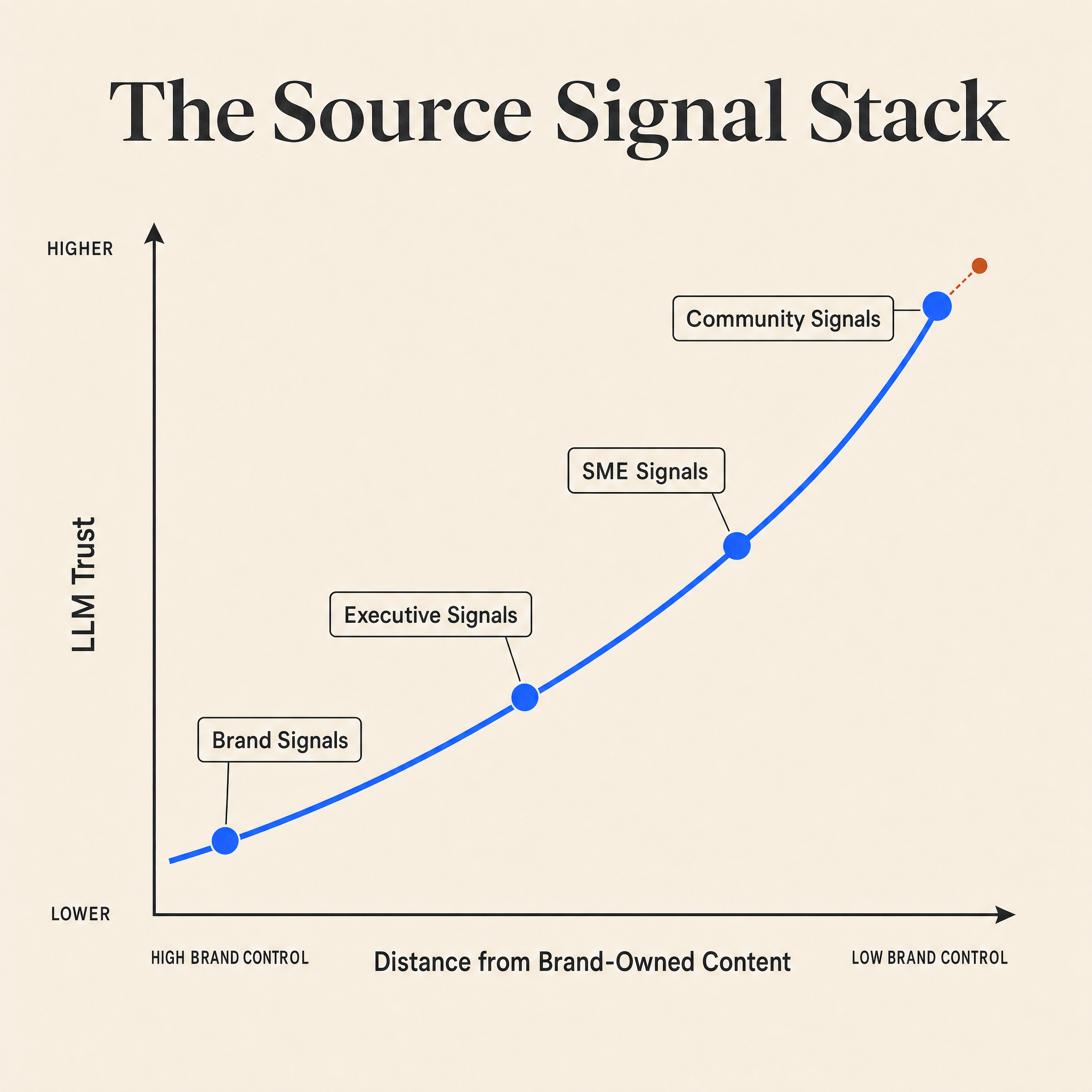
That piece argued Layer 3, with internal subject matter experts (SMEs) publishing under their own names, is where most B2B content programs have the biggest gap and the biggest opportunity.
Then the replies started rolling in, and a specific version of the same pushback kept coming:
"We don't have internal SMEs who can do this. Our PMs won't post. Our VPs of customer success are drowning in work and don’t have time for this. Our engineers refuse to open LinkedIn. So…what do we do?"
For many B2B SaaS companies, this is the reality. And trying to force reluctant internal experts into a creator role tends to backfire in every direction: lackluster posts, resentful employees, and inconsistent output that weakens your signal by making the whole program look amateur.
The good news: there's a second path through Layer 3.
The Source Signal Stack Without Internal SMEs: How Specialized B2B Creators Help Fill Layer 3
The fix here is to supplement with specialized external B2B creators, influencers, and thought leaders in your niche. (Reader, did you know "LinkedIn influencer" was a thing?)
These are people who already publish consistently, are in front of your ideal customers on LinkedIn, already have a defensible POV in your category, and have a track record of generating the kind of independent, cross-verifiable signal the Source Signal Stack was built to reward.
Today, we’re going to start talking about this avenue. It's not a better path than internal SMEs; both routes work well when built correctly. This is just a different path, and for some SaaS companies, it's the only realistic one.
Quick Refresher: The Source Signal Stack Framework for AEO
A quick recap for anyone who needs to catch up on what the four layers of the Source Signal Stack are:
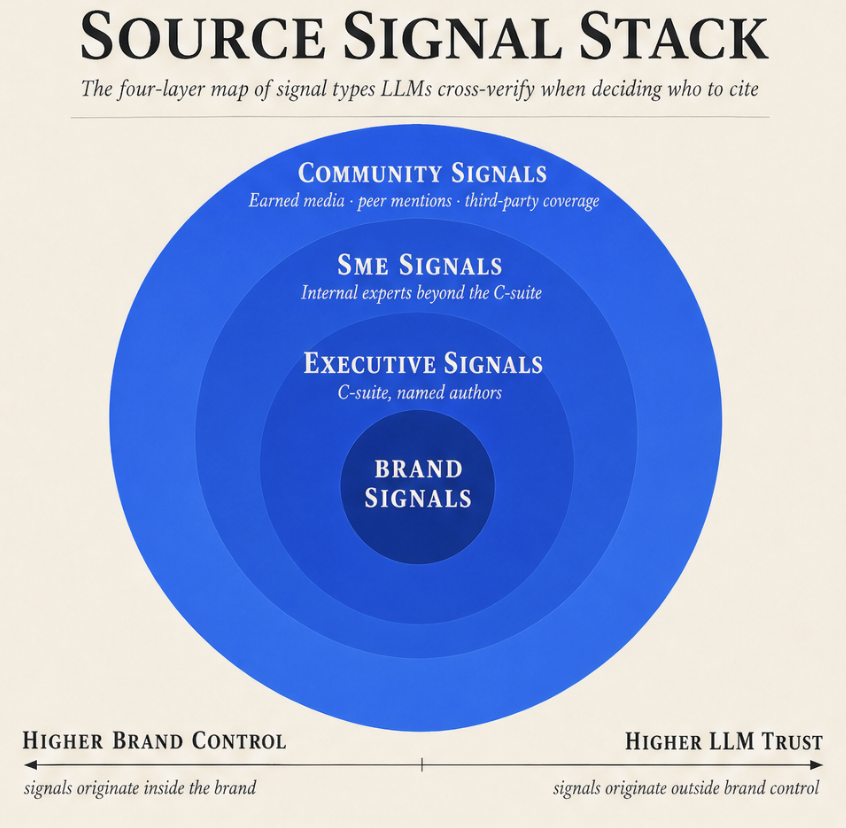
Brand Signals: owned media (website, blog, company pages)
Executive Signals: C-suite publishing under their own names
SME Signals: internal experts beyond the C-suite publishing under their own names
Community Signals: earned media, peer mentions, third-party coverage
One important distinction when we swap internal SMEs for external B2B creators at Layer 3: They are, by definition, structurally more independent than internal SMEs. They don't draw a salary from your company, their reputations exist outside of your company, and their audiences follow them.
For some companies, this means external creators with their own subject matter expertise, trusted following, and ability to get in front of eyeballs can be a powerful springboard that helps them get a real jumpstart on these efforts.
That said, these types of engagements need to be approached thoughtfully and with authenticity.
The Data: B2B Buyer Attention is Already Shifting Toward Creators on LinkedIn
Before anyone decides this path is a workaround rather than a real strategy, I want us to sit with the data for a minute, because it's striking how much of the B2B buyer behavior has already moved toward external creator content on LinkedIn. LLMs are downstream of that same movement.
LinkedIn's 2025 research, based on 1,716 surveyed B2B decision-makers, found that 82% say creator content influences their purchasing decisions, 59% of B2B buyers consume creator content on LinkedIn, and 79% engage with B2B creator content at least monthly.
More data:
The trust data from the 2025 Edelman-LinkedIn B2B Thought Leadership Impact Report (drawing on ~2,000 global professionals) reinforces this direction: 74% of B2B decision-makers consider thought leadership more trustworthy than traditional marketing materials, and 53% say that when a company's thought leadership is strong, brand recognition matters less.
TopRank's 2025 B2B Influencer Marketing Report found that 85% of B2B marketers are now running influencer programs (up from 34% in 2020), and LinkedIn's own data on Thought Leader Ads shows a 252% lift in click-through rate over conventional single-image ads.
AI systems are built to evaluate in much the same way that smart buyers navigate purchasing decisions online: if they hear/see/read a recommendation from someone (a human!) they trust, it feels more reliable than if it comes straight from the company or brand page itself.
Internal SMEs vs. External Creators: Different Tools, Similar Role
With the data in view, let me be honest about the comparison between internal SMEs and external creators at Layer 3. Both work!
Internal SMEs have something external creators structurally can't: deep, proprietary, first-party access to your product, your customers, and your internal data.
When a senior staff engineer at your company publishes a teardown of how you solved a thorny technical problem, nobody outside the company could have written that piece. That uniqueness is a citation magnet in its own right. An activated internal SME program is a real asset.
External creators bring different advantages:
They sit a little further up the independence dial. An LLM's cross-verification check treats a third-party voice (with its own audience, track record, and public reputation) as structurally different from someone on the company's payroll. Not categorically better, but distinct and closer to Layer 4's independence profile.
They already have an engaged audience of your target persona. You're not building a Layer 3 footprint from zero; you're partnering with one that already exists.
They publish at a cadence your SMEs almost certainly can't match. Publishing 5+ posts per week is their job, not an effort fit in between work sprints.
Their content is already inside the parametric memory LLMs use. Seer Interactive's analysis of 541,213 LLM responses suggests that AI systems first decide which brands to recommend from training-time memory, then find citations to support the choice after the fact. Creators who've been publishing in your category for a good long while are already part of that memory. Partnering with them gets your brand into the same orbit.
If you have the right internal SMEs and the appetite to activate them, do it. At the very least, someone in a leadership role should be doing this work.
If you don't have employees who can participate (because of bandwidth, willingness, culture, or just the current shape of your team), external creators can help fill the same role in the stack.
Most companies will end up using both over time, but if the choice right now is "external creators or nothing," external creators are probably the move.
The Hybrid Model
A clean either-or framing makes this argument easier to follow, but some B2B SaaS companies don't fit nicely into either bucket.
For example, maybe they have one VP who's willing to publish, or a single product leader with a small but engaged following, but there’s a hard ceiling on how much more internal capacity they can activate. For these teams, a powerful version of this strategy is hybrid.
A version that works: the internal SME stays the primary Layer 3 voice, anchoring the program with proprietary, first-party content nobody else could write.

External creators sit next to that work, cross-referencing it in their own posts, co-authoring in-depth content, and collaborating on things like webinars or in-person events.
The external creators function as a force multiplier and an independence amplifier rather than a replacement.
What this gives you that pure internal-only programs don't: cross-verification from named third-party sources LLMs can triangulate against.
What it gives you that pure external programs don't: the proprietary edge only an internal voice can produce.
If you have one or two willing internal voices, don't pick a path; combine them. Now, onto finding said external partners…
What "Specialized B2B Creator" Actually Means
I think it’s worth defining the term “B2B creator” before anyone reads this and thinks I'm recommending generic influencer marketing. I am not.
A specialized B2B creator, in the sense that matters for Layer 3, has four key attributes.
A specific, defensible POV on a narrow slice of your category. Not "B2B SaaS marketing," but “AI content workflow creation for Ecommerce SaaS” or "RevOps for Series B–D startups." The narrower the POV, the stronger the signal.
An established, engaged audience of your target customers. Follower count is a weak proxy. What matters is who is in their comments, how many eyeballs and comments their content is getting, and how many (relevant) people sign up for the webinars they host. If your actual buyers are in that audience, the follower numbers matter less.
A consistent publishing track record. A SEMrush study of 325,000 AI prompts I cited in the last newsletter found 75% of LinkedIn authors whose content is cited by AI posts at least five times per month. Your creator partner needs to already be operating at that cadence on their own.
Content an LLM could cross-verify topically. Their past posts need to be focused on a specific audience and topic, and take a stance with a real point of view. Vague commentators don't often generate a strong, citation-worthy signal.
Where to find them: industry newsletters, podcast guest rosters, niche Slack and Discord communities, LinkedIn topical search, your own LinkedIn feed (they'll be the ones whose comments sections are very active), and the people your sharpest internal team members already follow.
I cannot talk about this topic without pointing to Heike Young as an example of a stellar B2B creator who's already been doing this work for a long time. If you want context on what an A+ partner looks like, look no further:
Next week, I’m going to do a deep dive into the B2B influencer/LinkedIn creator version of this, but for now, let’s stop here.
Closing Thoughts on Leveraging B2B Creators for AI Search Efforts
Some food for thought as we wrap up here: The data on how fast B2B buyer behavior has shifted toward AI search is pretty surprising. Look at the numbers from early 2026.
Forrester's 2026 B2B Predictions report found that 94% of B2B buyers used an LLM during their buying journey in 2025, while Averi's March 2026 analysis of 680 million AI citations found 73% of B2B buyers now use AI tools like ChatGPT and Perplexity in their active research process.
Only 22% of marketers currently track their AI visibility, and fewer than 26% plan to develop content specifically for AI citations.
I share this to say that brands building a Layer 3 footprint now (internal, external, or hybrid) have an opportunity to be cited in AI responses, while their competitors are still arguing about whether AEO is real. By the time the gap closes, the citation graph for most B2B categories will be much more competitive.
Best to start now and iterate as you go (this is my theory on all things!)